 An official website of the United States government


Featured Volunteer Profile
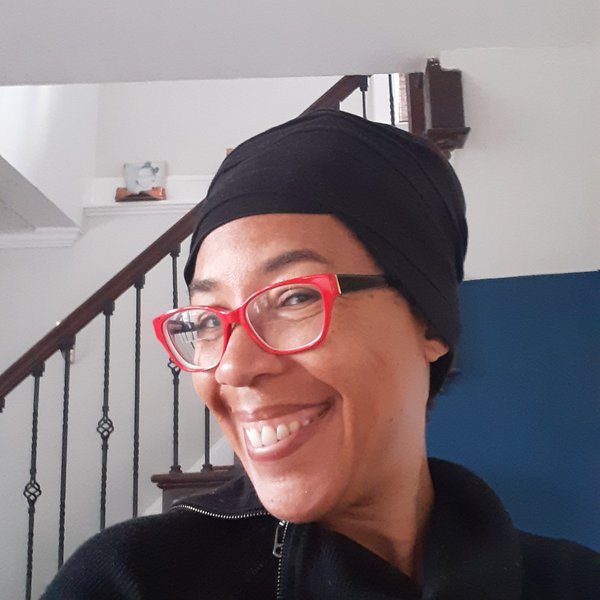
Tracy W.
“My host family asked me a lot of questions, as did many of my students, about my faith and beliefs. This led to many profoundly moving conversations around our shared humanity and common goals.”
1. What got you interested in the Peace Corps?
When I was younger, I saw a commercial for the Peace Corps and I was intrigued. I thought, what a wonderful way to see the world, discover different cultures, and advance mutual understanding and respect for people from different parts of the world!
I’ve always been a staunch advocate for peace, and as I grew older, it seemed to me that the surest way to achieve that was through one-on-one connections with others. I decided to go back to school and earn a graduate degree in international development. In that program, I learned about the academic and theoretical models of sustainable development. I joined the Peace Corps to see those models applied in the real world, and with the goal of becoming a capable, sustainable development practitioner, working at the intersection of policy and praxis.
2. What projects are you working on?
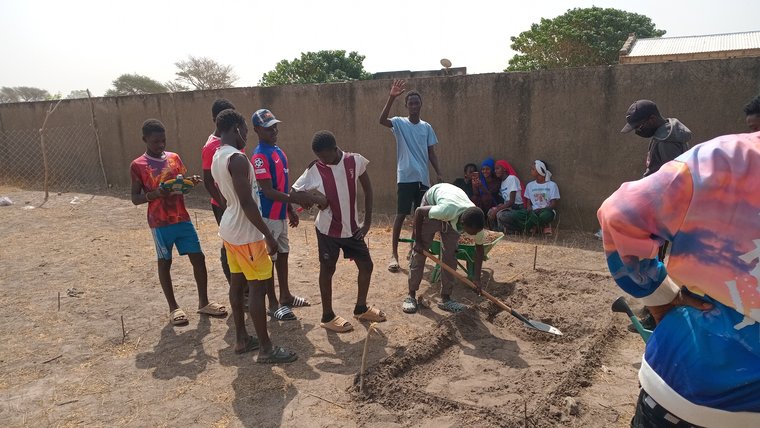
I recently distributed grains to several farmers. I am preparing my comparison plots in some of their fields and co-facilitating farmer trainings on field crop best practices. In the English club, we started corresponding with an American classroom through Peace Corps’ Global Connections program, and I am supporting club members to prepare their responses. I am also co-facilitating conservation farming trainings with members of garden collectives in other villages.
3. What strategies have you used to integrate into your community?
I like to walk around a lot! I like to ask people what they’re growing because just about everyone has a garden. Then I ask if they’re seeing any pests, what type, etc. If I have my pest identification book with me, I flip through it and ask if they’ve seen any of the pests in it. If not, I offer to come back (and I always do) to show it to them. This opens up a conversation on integrated pest management and related topics. I also like to share what I’m growing in my nursery. I’ve started 3 tree nurseries and when the young trees are about ready for transplantation, I give a sapling to all the people who’ve expressed interest in having one. This is a great conversation starter and allows me to show other techniques for increasing soil fertility and preventing soil erosion.
I talk to everyone, even kids! I take time to ask what they’re doing, how school is going, if they had a good soccer match, and so on. I also started 3 clubs at our high school: English, French, and gardening. The kids love peppering me with questions before and after our club meetings.
I’m often invited to attend wedding receptions (ceet), which are a great way to meet new people and show off your dance moves! I now get called out by the griot (a local bard/chanteur who performs at celebrations) whenever I go to a Ngente (wedding/baptism)—my friends and counterparts always want me to dance!
4. What is a highlight of your time in service so far?
One day, a year and a half into my service, I sat on my porch enjoying the cool evening air. My host mom and father were sitting on their porch across from me, as they usually do at that hour. It was twilight, my favorite time of day, when the heat has dissipated and the sky is lit up in a brilliant kaleidoscope of color. My host mother and father recited a prayer and then asked me to do the same. I asked, “Pray your way?”, sheepishly, because I don’t know any Arabic. They responded, “No, pray your way.” So, I recited the Buddhist prayer (the daimoku of the Lotus Sutra), for the first time outside the privacy of my room. When I finished, they touched their faces and chests before holding their hands, palms up, and reciting their concluding prayer. In that moment, I felt we shared a recognition of our common wish for the happiness of all humanity and I was deeply moved.
When I arrived, everyone greeted each other with either No yendo ak jamm or No fanane ak jamm (“may you have peace in your day [or in your evening]”). The response is always the same, with the addition of “amin” (amen). When I arrived, whenever I said that, the other person(s) would respond “amin.” But, after my faith became known, I noticed that stopped. Even in a group of people, I alone would be excluded from this convention. Since that exchange between my host parents and myself, my community now acknowledges me when I say “Amin” and responds in kind. This was a powerful example of my community respecting my faith.
5. What have you enjoyed most about the community where you are serving?
The religious acceptance and curiosity. I am a practicing Buddhist. Twice a day, my host family and anyone who comes into our compound can hear me chanting in my room. In the beginning, I was afraid to be discovered, and I prayed in a whisper. In time, I began to feel more comfortable chanting as I would back at home. My host family asked me a lot of questions, as did many of my students, about my faith and beliefs. This led to many profoundly moving conversations around our shared humanity and common goals. It has opened up dialogues on spirituality, political events, the future of our planet, world history, and war.
Even when a neighborhood kid has teased me about not being a Muslim, it always leads to a deepened understanding of each other. Given the fact that most people in my community had never even heard of Buddhism, I am really moved by the acceptance displayed here!
6. What are some of the most important things you’ve learned from your community?
Kindness is contagious and my neighbors have been incredibly generous and patient with me, from the start. During my service, there were times when I misunderstood others. Times when I struggled to find my place within the complex dynamics of a much larger family than I'm used to. No matter how much room I feel I have for improvement, my host family, friends, neighbors and counterparts have consistently made me feel appreciated and welcome. They consistently take the time to share their culture with me and actively seek to learn about mine—and this is something I will never forget.
I’ve also learned that I can count on people to support me in my work. As an only child, raised by a fiercely independent single parent, it’s not easy for me to ask for help. When I first started co-facilitating the high school garden club, I really didn’t have the local language skills to pull it off. I reached out to my counterparts to ask if they could co-facilitate the classes with me, but inwardly I felt that I was passing off my work to others. This was my cultural bias, and I quickly learned to discard it.
In my community, people want to help you with whatever work you’re doing. Given how much work everyone already has, I didn’t want to add to anyone’s workload. But, in my community, everyone pitches in whenever they can and no matter how much work they have. I learned to be graceful in accepting the assistance of others. I learned that I can lean on people and that it makes everyday life so much better!
7. How do you spend time when you are not working on a project?
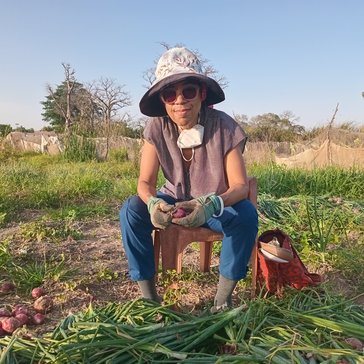
I catch up with friends and family back home, read, work in my garden or the tree nursery, work on my Wolof language, journal and write, play with my host nieces and nephews, and watch funny cat videos.
8. What are you looking forward to in your remaining time as a Volunteer?
Now that my grant is live, I’m looking forward to finalizing the building of a permanent protective enclosure, installing a solar pump in the community garden, seeding my comparison plots and recording the results and, finally, continuing to improve my local language proficiency.
I’m also very excited to finalize the database of scholarships for study abroad programs and university studies that I’ve started compiling to share with my high school counterparts and our students. I want to do everything I can to encourage the youth in my community to pursue their dreams—and give them ways to achieve them.
9. Once you finish service, what will you do differently when you return to the U.S.?
I still plan to pursue work in international development, but the way I want to do it has been hugely impacted by the lessons I’ve learned in the field during my Peace Corps service. Consistent with what I learned both in my international development graduate program and my Peace Corps service, conventional theories of change are not “one size fits all.” Threats to sustainable agriculture vary greatly and, consequently, the resources needed to combat them must also take into account their viability and/or scalability in a given context.
Many NGOs are working in Senegal on the issue of sustainable agriculture, and I hope to be able to work with either a sustainable agriculture NGO or INGO, when I return to the U.S. Ultimately, I hope to put the “lessons learned” from my time here to good use, inshallah (God willing).
Want to learn more about serving as a Volunteer in Senegal? Connect with a recruiter today.



