 An official website of the United States government


Featured Volunteer Profile
Andy C.
“I was constantly amazed by the creativity and resourcefulness of the Tanzanian people around me—repairing instead of replacing, repurposing instead of discarding, and finding solutions with what’s available.”

1. What got you interested in the Peace Corps?
Immediately after college, I began working as a business analyst at a major bank. The job was interesting and I was learning a ton, but after a while, I realized something was missing. The work didn’t allow me to make the kind of positive impact I cared about. About a year in, I started talking to mentors and exploring other paths. I knew I wanted to use my twenties to be brave—to step outside my comfort zone, pick up new skills, see more of the world, and get to know myself better by living and working somewhere completely different. During that time, the Peace Corps kept popping up in my research. The more I read about it, the more it felt like a good fit.
The idea of spending two years in a rural community, really immersing myself in a new culture, and learning a local language sounded challenging in the best way. I also liked that the Peace Corps provides strong support systems—extensive training (especially with local language), safety and medical resources, a living stipend, and local staff. Additionally, the post-service benefits, such as the Coverdell scholarship for graduate school and non-competitive eligibility for government jobs, were a significant plus. I started connecting with Returned Peace Corps Volunteers (RPCVs) and asked them to share their Peace Corps stories with me. Hearing their stories made me realize just how unique and meaningful this experience could be in shaping my life. Two years later, I’m infinitely grateful to my younger self for taking a leap of faith and joining the Peace Corps.
2. What projects are you working on?
My primary role is teaching math at the local secondary school. I work with about 250 students across two grade levels, so most of my week is spent preparing lessons, teaching, grading notebooks, and tutoring students who need extra help. I am also the school librarian, advisor to the entrepreneurship club, and play left back for the teacher’s football team— horribly, I must add, as I’m responsible for 50% of the goals scored against us. Beyond the school, I’ve collaborated with my community counterparts on four secondary projects—each community-driven and addressing a critical student need.
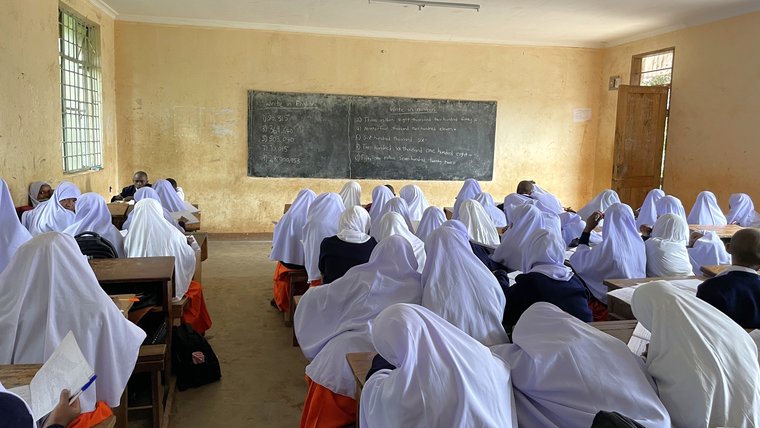
Our first project brought clean running water to the school, eliminating the need to send students to fetch water from a river during school hours.
We also built a school library and furnished it with tables, chairs, shelves, textbooks, dictionaries, storybooks, and a printer. This project was especially close to my heart because public libraries played a huge role in my own education. I remember many days spent with my nose between a book at the public library, and it brings me so much joy seeing my students do the same thing.
In addition, my community and I worked together to build a handball court, renovate existing sports facilities around the school, and purchase equipment to launch a community sports program. Lastly, with support from friends and family in the U.S., we funded and built 100 new desks and chairs so every student can sit comfortably instead of sharing seats and fighting for space on the desk to write their notes.
3. What strategies have you used to integrate into your community?
The most effective strategy for me was simply being friendly—greeting people I saw, showing up consistently, and being present in the community day after day. Speaking the local language is important, but what mattered even more was showing that I wanted to communicate. Kiswahili has never been my strongest skill, and I’m definitely way behind other Volunteers. Even with the vocabulary of a 10-year-old, though, people could see I was genuinely trying. Did they always understand me? Honestly, no—but the effort still went a long way in helping me connect with others and feel part of the community.
With my students, I would invite them over to my house to color, watch movies, or just hang out. I shared food when I could and tried to be kind and present (some days were easier, some days were harder). Those small gestures helped build trust, and eventually, I was invited to visit some of their families on weekends and holidays. Meeting parents and spending time in their homes helped me understand my students more deeply.
Another simple strategy was buying a football, playing with local kids and youth who lived around my house, and letting them borrow the ball from time to time.
4. What is a highlight of your time in service so far?
One of the biggest highlights was a trip to Cape Town that a group of us Volunteers took during our December holiday, a little over a year into service. Living in a rural community has been rewarding, but the isolation from friends and family has been tough, so having time with people who shared similar experiences and backgrounds was a sweet reset. We spent the week exploring the city, cooking and eating meals together, and trading stories about our first year in the Peace Corps.
The Peace Corps has made me a more grateful person, and there were lots of small things that were surprisingly memorable during that week—like finally using a washing machine after more than a year. I had honestly forgotten how soft my jacket could feel. I also made up for lost time with food: I think I got 8 dozen donuts (relax, it wasn’t just for me, it was for the group) and visited the same all-you-can-eat sushi place three days in a row. We celebrated one Volunteer’s birthday during that week and then spent the Christmas holidays together in wine country. A Secret Santa, holiday movies, lounging by the pool, cooking a family meal, sharing our gratitude for the year, and a sunset walk through the vineyard.
5. What have you enjoyed most about the community where you are serving?
The relationships I’ve built with my students and fellow teachers have been the most enjoyable part of my service. Over the past two years, I’ve interacted with more than 500 students at the secondary school, and spending time with them inside and outside the classroom has been a lot of fun. I’m really grateful to have been part of their lives during such an important time. With the teachers, I’ve gotten to know many of them well—there are only 12 of us—and their constant support and friendships have meant a lot to me throughout my service.
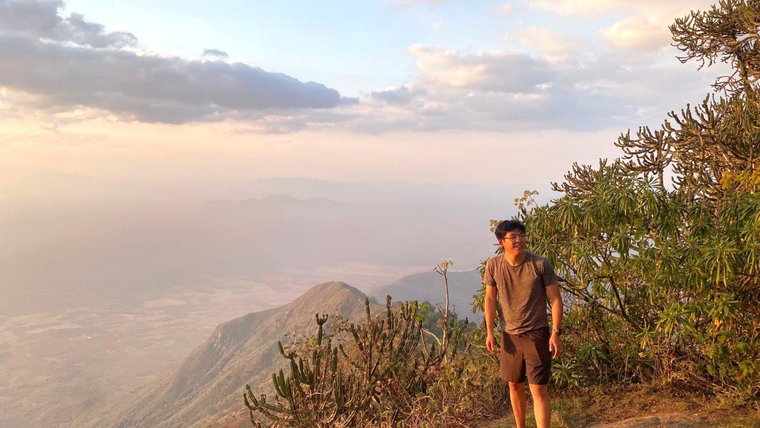
Outside of the people and relationships, my village itself is just so beautiful. I live on top of a mountain in northeastern Tanzania, and it’s breathtaking. We’re surrounded by a forest reserve, so no matter which direction I look, I see endless trees and rolling hills. The stars at night are stunning, especially on nights when the power’s out and everything is pitch-black. I’m from West Texas, and I had assumed Tanzania’s climate and landscape might be similar to Texas—but my site surprised me with how lush, green, and full of nature it is.
6. What are some of the most important things you’ve learned from your community?
- Facing the reality of life with resilience, joy, and generosity. Many people in my community navigate challenges that would have overwhelmed the pre-Peace Corps version of me. I know I would’ve complained constantly about the unfairness of it all. Yet day after day, I watch my community meet hardship with steadiness, humor, and generosity. In two years, I don’t think I ever heard a single student complain that life is unfair, but I did see them laugh easily and find joy in the small wins. They create their own joy and generously share what little they have.
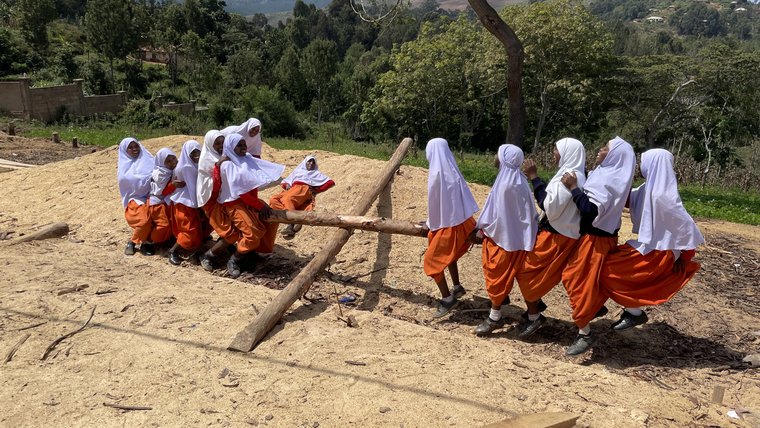
- Making the most of limited resources. Coming from a place where everything was one quick purchase away, adjusting to life in Tanzania has reshaped how I see resources. I was constantly amazed by the creativity and resourcefulness of the Tanzanian people around me—repairing instead of replacing, repurposing instead of discarding, and finding solutions with what’s available. I was surprised daily by the creativity I saw, especially the children who built toy cars out of oil containers, musical instruments from PVC pipes, or a football out of plastic wrappers held together by rubber bands.
- Setting boundaries and learning to trust wisely, not blindly. A defining moment in my service happened when several students I trusted stole money from my house. I was deeply hurt and even considered leaving service early. The story I was telling myself: I came here to help, and you stole from me? After some initial anger and bitterness, I realized that I was also responsible by leaving them unsupervised in my house. I learned that trusting people doesn’t mean ignoring common sense. I needed healthy boundaries: lock my doors, keep valuables out of sight, and avoid placing students in situations where trust is tested unnecessarily. I still love and trust my community, but I’ve learned to trust more wisely and set healthier boundaries.
7. How do you spend time when you are not working on a project?
In my free time, I try to keep up with the hobbies that bring me joy—mainly reading, running, staying connected with loved ones, and traveling. I’m part of a book club with friends back home, and my cohort started one as well, which allows me to connect with friends and read things I might not have picked up on my own. My Kindle has become one of my most valued possessions here. I also run around the village a few times a week. It’s a good workout (especially the hills section), but it’s also when I get to greet community members and enjoy the beautiful scenery. One of the highlights was running the Kilimanjaro Marathon with some of the other Volunteers.
Staying in touch with friends and family has been a key priority for me—the twenties move fast, and I’m grateful to be part of my friends’ and family’s lives while sharing updates from mine. When I’m not on the phone, I’m happily watching a show or movie on my laptop in bed. And whenever we have school breaks, I like to travel to different regions around Tanzania or to neighboring countries to explore more of Africa.
8. What are you looking forward to in your remaining time as a Volunteer?
I’m writing this during my final week in my community, with only about ten days left in my Peace Corps service. I’m feeling a mix of gratitude, awe, and joy for everything this experience has been—the good and the bad. Part of me feels like I just arrived a couple of months ago, and another part feels like I’ve lived here for many years. It’s bittersweet, and I know I’m going to miss this season of my life in rural Tanzania—a place that has become home.
In these last days, I’m looking forward to doing a few more hikes around the village and spending my evening outside watching the stars from a tree outside my house. Over the last two months, I took photos with all of my students and finally picked up the printed copies two days ago. I’m excited to give them out as a small parting gift during our final classes this week and to thank them for the impact they’ve had on me.
9. Once you finish service, what will you do differently when you return to the U.S.?
Once I return to the U.S., I want to live a more intentional and grounded life. My time in Tanzania taught me the importance of having a community to share life with, and I want to prioritize building more meaningful and loving relationships with my family and friends. I also want to slow down—listen better and notice more. And I’ll definitely be leaning into gratitude; A/C, clean drinking water, washing machines, Chipotle, 24/7 grocery stores, instant hot showers are all privileges I don’t plan to take for granted anytime soon.
This experience has also helped me build more confidence in myself. I’ve learned, over and over again, that I can do hard things (with help from others, of course), and that failure is temporary—even if the first couple of days after failing always sting deeply. Peace Corps taught me to trust the journey and believe I’m exactly where I’m supposed to be. It also deepened my belief that underneath our differences, we all share a common humanity and dignity that can’t be taken away. I’ve come to be kinder to myself, learn to belong more fully to myself, and listen more to the truest parts of my soul.
I’ve also gained a clearer understanding of the historical impact of colonialism in Africa and the lasting effects it continues to have on a continent home to 18% of the world population. It showed me how dehumanization causes real harm and how distance dulls our empathy. I want to stay better informed about international affairs and use my voice to advocate for those who are often overlooked.



