 An official website of the United States government


Featured Volunteer Profile
Adam R.
“Despite the different languages, religions, cultures, and environments, the community here is not that different from my home in Appalachia. People have a grit and mental toughness that they use each day to overcome the challenges they face.”
1. What got you interested in the Peace Corps?
Having a parent and several close family friends who are Returned Peace Corps Volunteers, I’ve listened to many stories throughout my childhood of their adventures through service. I’ve heard of the tough times and the struggles, along with the immense joy and satisfaction that has come out of the unique experience of serving as a Peace Corps Volunteer. Prior to submitting my application, I knew that this position would not be easy. You are placed in a new environment, with new food, language, and culture. You are isolated from your friends and family and must build a new life at this temporary home. However, challenges offer great opportunities, and there are few programs that enable an individual to build the sort of lifetime connections that come from living in a community for a two-year period.
2. What projects are you working on?
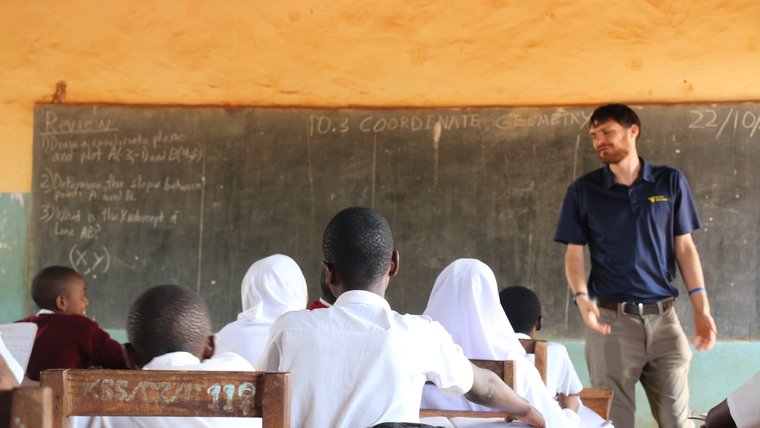
My primary assignment is teaching math for first year students at a secondary school. This includes attending district-level curriculum trainings and collaborating with other math teachers at the school, in addition to preparing and evaluating student assessments. Outside of classroom instruction, I have hosted remedial sessions for students. I have also organized a STEM conference with hands-on activities that could provide meaning and connection to their studies, as well inspire creativity. Currently, I am also working with the school board on a project to drill a water well on the school campus to improve water accessibility. With inspiration from other Volunteers, I have also initiated a program for the repair and maintenance of student desks and chairs.
3. What strategies have you used to integrate into your community?
Learning a new language can be difficult, but once you gain proficiency, it can really support integration. When I arrived at my site, I was not confident in my Kiswahili skills. I fumbled through conversations and was embarrassed by my inability to understand what was being said. Ultimately, the exchanges ended in laughter and we would move on. As time passed and my language skills improved, I gained confidence. Strangers became neighbors, and neighbors became friends. Now, I find myself walking to the market and ending up spending hours sharing stories, asking questions, and learning more about my fellow community members.
I also enjoy exploring new areas and seeing where unfamiliar paths lead. This is consistent with the Participatory Analysis for Community Action (PACA) approach that includes community walks and mapping. I combine practicing my language skills while also seeing what is happening in my community.
4. What is a highlight of your time in service so far?
One highlight was traversing a large loop through several regions of the country, visiting multiple Volunteer sites as well as my host family from pre-service training during a school break. It was exciting to use multiple modes of transit including buses, trains, ferries, bicycles, and my own two feet. I experienced the diversity of the country and its people. I saw mountains, waterfalls, rainforests, plains, coasts, oceans, and islands.
It was special to meet community members that other Volunteers introduced me to. One time I ate dinner with the neighbor of a Volunteer, eating stewed octopus and rice from a shared pot while sitting on a rug. Although the food was simple, it was one of the most delicious meals that I have had during service.
5. What have you enjoyed most about the community where you are serving?
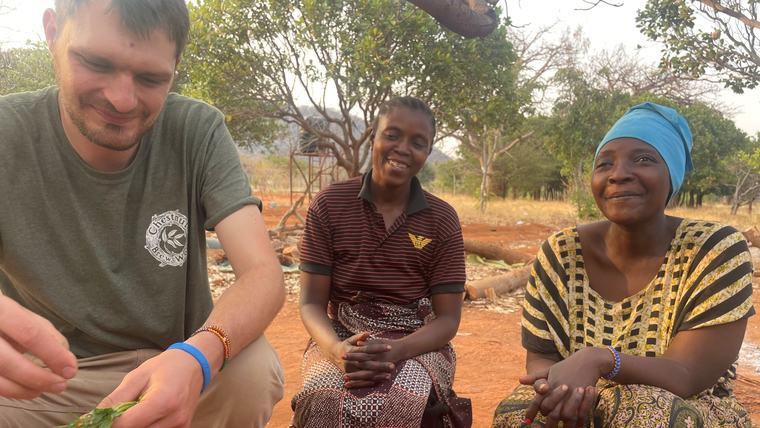
Unlike many Volunteer sites in Tanzania, my community is urban. Within walking distance, I have access to a bank, post office, and well-stocked market. While this may seem beneficial, it was initially challenging to integrate in the community due to its size. However, as time passed, I was able to find opportunities to connect that I may not have gotten in more rural placements. I have attended district-wide teacher celebrations, Labor Day celebrations, and a funeral for the former Tanzanian Speaker of Parliament. I have served as the guest of honor for my secondary school and given a commencement address in Kiswahili. When I travel, I often run into people that I recognize from my town. They are always excited to learn about my travels. The sense of inclusion is strong, despite the short time that I have been her.
6. What are some of the most important things you’ve learned from your community?
Throughout my time here, I have learned how resourceful community members are. As an engineer, I am trained to solve problems, and I have learned a great deal from the locals about how to come up with creative solutions. These solutions may involve different approaches to what I consider to be standard practice. But different is not wrong.
Despite the different languages, religions, cultures, and environments, the community here is not that different from my home in Appalachia. People have a grit and mental toughness that they use each day to overcome the challenges they face. Neighbors care about one another and will lend a helping hand to anyone in need, even to a complete stranger. Witnessing this unconditional compassion makes me want to emulate these acts of kindness.
7. How do you spend time when you are not working on a project?
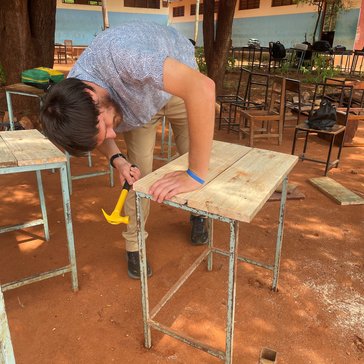
When I am not working on a project, I enjoy relaxing at home, especially reading, or playing with the neighbor children. The kids are full of energy and smiles and are excited when “uncle” has a new game to play with them. Sometimes these activities can be more structured, such as planting a flower garden, or learning math or English, but often we enjoy just running around and drawing in the sand. I also enjoy cooking and sharing new foods with my neighbors, the school cooks, students, and fellow teachers. Recently, I have earned the reputation as a repairman and have worked on several projects at school. This includes working on friends’ motorcycles which was a hobby back in the States.
8. What are you looking forward to in your remaining time as a Volunteer?
I am looking forward to my family visiting near the end of my service. I am excited to show off my site and the community that I have called home for over a year. I am also extremely excited for my family to see the projects that I have worked on. They look forward to encountering a side of Tanzania that few tourists have the opportunity to witness. Furthermore, I am thrilled at the prospect of visiting my father’s school in nearby Kenya, where he served as a Peace Corps Volunteer 4 decades ago.
9. Once you finish service, what will you do differently when you return to the U.S.?
I intend to take some time before returning to full-time employment. The activities that I am most looking forward to are hiking the Appalachian Trail and doing a cross-country motorcycle trip to visit friends and family in different areas of the U.S. Hiking and biking are two of my favorite hobbies, and it has been tough seeing so many motorcycles in Tanzania, knowing that Peace Corps Volunteers can’t ride motorcycles while serving.
As for future employment, I am uncertain of my pathway. Perhaps I will return to the engineering profession, or move towards education, or even pursue a new career altogether. Whichever direction I follow, I plan on spending more time with youth to help inspire their future pursuits in education. I also plan on engaging more with my local community, using the skills and experiences that I have gained through my service.
Learn more about serving as a Peace Corps Volunteer in Tanzania.



