 An official website of the United States government


Featured Volunteer Profile
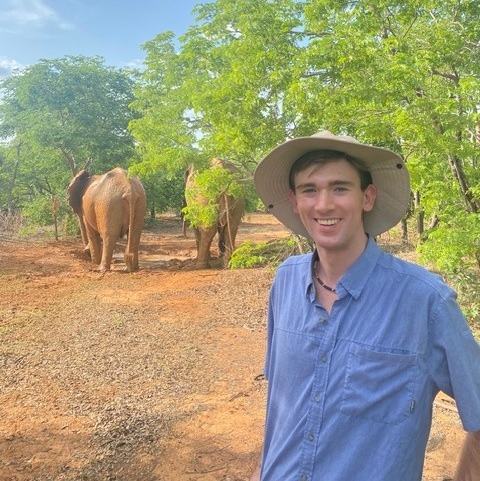
Trey F.
“There are many challenges that come with joining the Peace Corps, but it is a great way to grow and serve others while representing your country. I have had many adventures and have become a much more confident teacher and leader through my experience.”
1. What inspired you to apply for this Peace Corps position?
I was inspired to apply to Peace Corps because I wanted to give back and serve my country and other people around the world.
I was sitting in an auditorium watching a program about American presidents, and there was an excerpt from a speech by President John F. Kennedy where he famously said, "Ask not what your country can do for, but what you can do for your country." It was that spirit that motivated me to apply and serve in the Peace Corps.
I also thought it would be a great leadership and challenging growth experience.
Finally, I also hoped to travel and learn much more about the world than I had known before. I had indicated that I would serve where needed most and in any position, so I am glad I was assigned to be a math and science teacher in Ghana because I love working with youth and teaching them about science. Having never been to the continent of Africa before, I have been able to learn a lot over the past couple of years.
2. Tell us about a moment that sticks with you from your first week.
During my first week, I visited a neighboring Volunteer who was finishing his service as I was beginning mine. We climbed a mountain range with his counterpart and visited a remote village at the top of the mountain. The view of a nearby lake was amazing. Then he showed me around his community and gave me advice on how to be a successful Volunteer. I have had many adventures during my two years with the Peace Corps and have been able to meet and collaborate with new friends as well.
3. What is your main job?
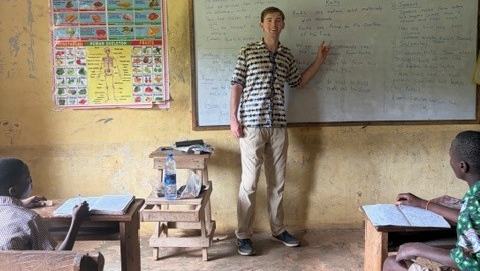
I teach mathematics and science at a junior high school in a rural community in Ghana. I use interactive teaching methods, so my students watch videos and do other kinds of experiments in class.
There was a strong need for a water source at my school, so I carried out a grant project to construct a borehole, providing the school and community members with a source of clean water.
I also started an after-school club, coached soccer and basketball, facilitated environmental and health education sessions, and organized a field trip for students. I have also participated in pen pal exchanges with schools and groups back in the U.S. (one through Peace Corps’ Global Connections), so Ghanaian students can learn about America and American students can learn about Ghana.
4. What strategies have you used to integrate into your community?
Every night, I walk to town to buy things for my supper. Along the way, I greet and smile at every person I see. This has allowed people in my community to quickly learn who I was and have a positive impression of me. I also try to attend weekly church services and many cultural events in the community like funerals. Using the language I learned during pre-service training has also been a great way to show respect and build connections with community members.
5. What’s a typical day like for you?
Ona typical school day, I wake up, take a bucket bath, and brush my teeth. I eat some groundnuts (peanuts) and bread before heading to school at 8 a.m. At school, I teach math or science until 10 a.m., when I usually eat rice with my students. School continues until 2:30 p.m., and then I return home and rest or do some lesson planning at my house. Then, I might play basketball or go to the after-school club with my students. In the evening, I walk around the community and greet community members before going to the assemblyman's house to buy “banku” (traditional Ghanaian dish made from fermented corn and cassava dough) with groundnut soup and okra. I walk to buy some fried eggs, oranges, and bread, and I return to my compound to take another bucket bath and get ready for the night. Sometimes, in the evening, I work on projects or do work with the Peace Corps Volunteer Staff Service Improvement Committee. Finally, when I am tired, I brush my teeth and go to sleep underneath my mosquito net.
6. What is a highlight of your time in service so far?
I wanted to plan something fun for my students before leaving Ghana. My students are not usually able to travel and some of them had never been to a big town or outside of their home area before. Last Friday, I organized a field trip for my students to go to a monkey sanctuary and the tallest waterfall in West Africa near their town. My students loved the outing, and I am glad I was able to give them an experience that I hope they will always remember.
7. What have you enjoyed most about the community where you are serving?
I have really enjoyed getting to know and spending time with children in the community. They are very intelligent and love to learn. They also like to play many games with me, and are always calling out to me, "Sir Kobby, Sir Kobby!" I have a lot of fun with the children, and they have made my service enjoyable. I am sad that I will have to leave them soon, but I am hoping that they will have good memories of my time here.
8. What are some of the most important things you’ve learned from your community?
I have learned about the importance of prioritizing projects, fulfilling needs, and being flexible. When I first arrived, community leaders came to me with the idea of constructing a library in town, but it didn’t move forward. At the beginning of my second year, I asked students about their needs. It seemed like their two biggest needs were a lack of reading materials and a lack of water at the school, which prevented them from using the washroom facility. To address these needs, I worked with an organization to deliver books to the school and wrote a grant proposal to fund the construction of a borehole at the school.
9. How do you spend time when not working on a project?
I often handwash my clothes or dishes or do other things around my compound. I also attend many funerals on the weekends. Funerals are a major event in Ghana, and many people travel from far away to attend them. Attending these cultural events has been a great way for me to integrate in the community. I also play with students and other children in the community. I have been teaching them how to play basketball, which they have loved!
10. Tell us about the strongest relationship you’ve developed while in country.
I have developed a strong relationship with the assemblyman of the town who has been acting as my counterpart during service. He has greatly assisted the borehole project by contacting the necessary engineers and laborers and has served as an important resource throughout my service. Every evening, I go to the place he likes to eat and buy food from his wife, who works there, and we have been working on various projects around the community.
11. What are you looking forward to in your remaining time as a Volunteer?
I am looking forward to my closing ceremony, which will be a chance to say goodbye to the community that I have been living in and a celebration of the time we spent together. It will also be an opportunity to officially commission the borehole and put it to use. Community members, elders, teachers, and students from the community are all planning to attend, and I will invite other Peace Corps Volunteers and Peace Corps staff. I have heard that there may be a surprise for me during the ceremony too. While this kind of attention might feel uncomfortable, I am looking forward to having the opportunity to say goodbye to everyone and bring closure to my service.
12. Tell us your favorite phrase in the local language.
My favorite phrase is: “Me di banku ne nkatekwan ne nkrumah krakrakra.” This means, “I eat banku (traditional Ghanaian dish made from fermented corn and cassava dough) with groundnut soup with a little bit of okra.” This is my favorite phrase because it is what I say every night when I go to eat. The entire community knows my typical order, and they think it is really funny and special that I prefer to eat local dishes. The older ladies I pass and greet every evening love the fact that I always eat the same local dish and can say it in their language. Food is something that unites everyone, so this phrase has helped me form connections with community members.
13. What will you do differently when you return to the U.S.?
I will be much more confident in myself, and it will be easier to take the initiative on projects in my community. I think service will become a much greater priority in my life, and I will have a greater understanding of how to make projects become a reality. I will also place a greater emphasis on travel and learning about different communities across the U.S. My service in the Peace Corps has inspired me to pursue a career where I can serve others and make a difference in their lives.
14. What would you say to someone thinking about joining the Peace Corps?
I definitely recommend serving! There are many challenges that come with joining the Peace Corps, but it is a great way to grow and serve others while representing your country. I have had many adventures and have become a much more confident teacher and leader through my experience. There are many different jobs available, so people can look for positions that match their strengths and goals. It might not be for everyone, especially if they have family or relationship commitments in the U.S., given the intense commitment the Peace Corps requires. If someone is unable to join Peace Corps, I would recommend serving in other service opportunities through organizations like AmeriCorps or community groups.
Learn more about serving as a Peace Corps Volunteer in Ghana.



