 An official website of the United States government


Featured Volunteer Profile
Aidan B.
“If you want to go far, go together. Also, build relationships before making requests. Trust is paramount.”
1. What inspired you to apply for this Peace Corps position?
Initially, I think it was my elementary school principal’s motto that inspired me: “Work hard. Be kind. Help others.”
Later, during university, I was inspired by John F. Kennedy. I wrote my thesis on JFK and his vision for building a better world through service. “Ask not what your country can do for you, but what you can do for your country” is a key part of finding meaning and purpose in our lives.
Finally, I didn’t know what I wanted to do after university, but I knew that I enjoyed adventure, experiential learning, and intercultural exchange. So, I applied for the Peace Corps and was accepted the day after graduation.
2. Tell us about a moment that sticks with you from the first week at your site.
I felt proud of myself for completing pre-service training and ready to start my time at my permanent site; yet I was also sad to leave my friends and host family.
I vividly remember the first day at my permanent site. After a six-hour van journey, I reached my host family’s house and they welcomed me with a surprise birthday celebration. Yes, the first day I arrived at my permanent site was also my birthday!
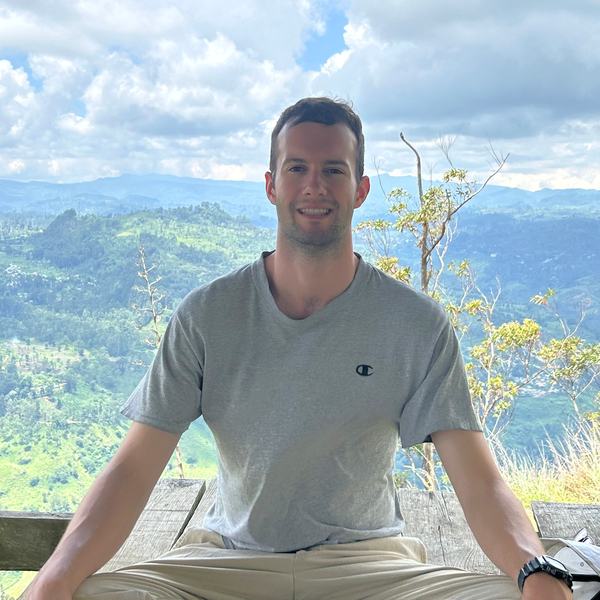
I stood outside my host family’s house, looking at the beautiful mountains, banana trees, and jungle thinking, “This is absolutely brilliant. I could see myself staying here for three years.” And, as it turned out, I plan to do so, as I extended for a third year!
3. What projects are you working on?
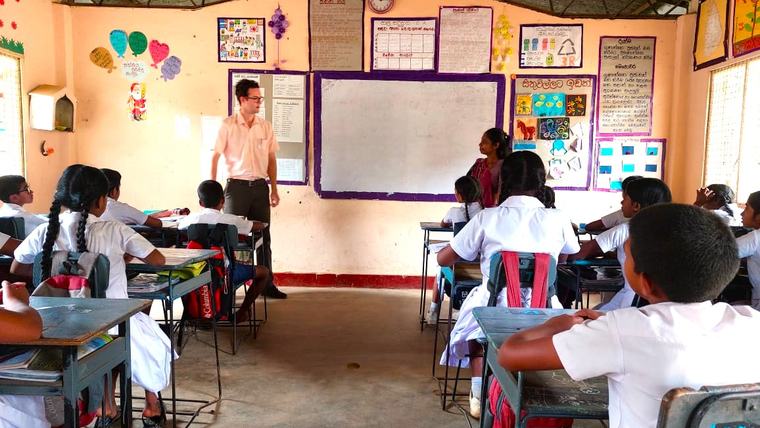
For two years, I taught English to students in grades six to 12 alongside a Sri Lankan counterpart at a village school. We focused on spoken English, critical thinking, and reading. I did projects, including posters, an English club, a reading competition, school news broadcasts, English camp, and an English concert with dancing and plays.
4. What strategies have you used to integrate into your community?
I live in a small village in the mountainous and beautiful Central Province of Sri Lanka. I live with a host family made up of my host mother, host father, and three brothers (18, 15, and 11 years old).
I teach English at a small school of 250 grade six through 13 students. I co-teach with three Sri Lankan English teachers. My school principal is a Buddhist monk.
5. What is a highlight of your time in service so far?
One afternoon during a free period, I was standing on the school playground. A ninth-grade student came up to me, and we started chatting and practicing English. She said, “Before you came, I could not speak English. But now I can.” That was a very heartfelt and meaningful moment for me.
6. What have you enjoyed most about the community where you are serving?
My village is like a neighborhood. Everyone knows everyone else, and they help each other in times of need. There’s always a chance to greet friends in the street, cricket grounds, or local shops.
7. What are some of the most important things you’ve learned from your community?
If you want to go far, go together. Also, build relationships before making requests. Trust is paramount.
8. How do you spend time when not working on a project?
When I’m not working on a project, I’m reading books, practicing Sinhala, playing guitar, drawing, cooking, exercising, and visiting friends and host community members.
9. Tell us about the strongest relationship you’ve developed while in country
My host mother, Lalitha, treats me like one of her own sons. She always helps me, practices Sinhala with me, and makes delicious food for me every day. This is in addition to taking care of her own three boys and waking up at 3 a.m. every morning to cook lunches for 130 students. I try to help in small ways, such as scraping coconut, watering the garden, keeping my room clean, and practicing English with my host brothers.
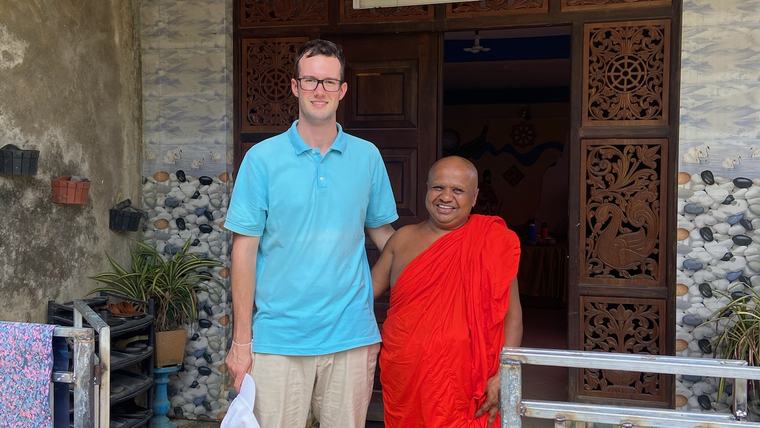
My principal, Ven. Ravanagoda, is a Buddhist monk. He has done a lot to develop the school. Since becoming principal in 2012, our school has grown from two buildings to eight, from 100 to 400 students, and from 10 teachers to 34. His hard work, commitment, and ability to uplift those around him catalyzed our school’s development. Students respect him as a strict yet caring principal, and teachers look up to him. Working in his school was an inspiring experience for me. He is one of the most selfless, hard-working, and energetic individuals I’ve met.
10. What are you looking forward to in your remaining time as a Volunteer?
Now I am in my third year, serving as a Peace Corps Volunteer leader. I’m looking forward to continuing to study Sinhala and Tamil, building connections and teaching at my new school, and helping staff and Volunteers alike!
11. Tell us your favorite phrase in the local language.
“Kamak nae,” which means "no problem."
12. What will you do differently when you return to the U.S.?
I want to create community where I can and let things go if they don’t work out. In the U.S. I felt defined by my individual accomplishments and usually worked independently on various things. I recognize how busy and hectic we can make our lives in the U.S. In the village, life is simpler, slower, and more community oriented. I will try to respect the process and journey, rather than focusing on accomplishments and end points. I will also try to work alongside others, rather than just doing individual work.
13. What would you say to someone thinking about joining the Peace Corps?
I think the Peace Corps is one of the best chances we can take in our lives. I like to say that it gives us unlimited opportunities to make a difference, both within ourselves and for others. I feel a strong sense of purpose in doing my job in my village.
I encourage all those interested in building community, learning more about the world, and engaging in meaningful work to just go for it and apply for the Peace Corps. You have nothing to lose and everything to gain!
Speak to a Returned Peace Corps Volunteer or recruiter about any questions you have. And again… just go for it!
Learn more about serving as a Peace Corps Volunteer in Sri Lanka.



