An official website of the United States government



Just go for it
Starting service in Sri Lanka
Prior to serving in Sri Lanka, I knew the basics of the job I signed up for, which is teaching English to 6th to 11th grade students alongside three Sri Lankan teachers. However, I had no idea that I would become part of such a strong community.
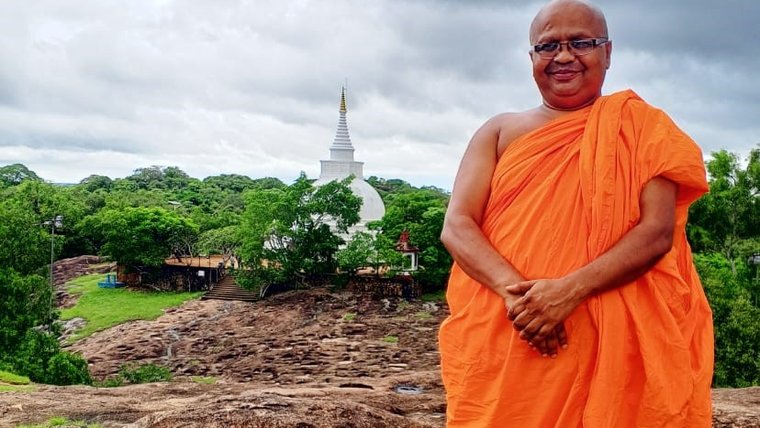
My host village is located in the Central Province of Sri Lanka. During my three-month pre-service training, I didn’t give much thought to who my counterpart teacher or principal would be, despite the fact that I’d spend the next two years working closely with them. So it was a surprise to learn that my principal would be a Buddhist monk. While it is not unusual in Sri Lanka for a monk to be a school principal, it was certainly a surprise to me. My only contact with monks had been to converse with a few of them at temples during my training period.
Meeting the school principal, a Buddhist monk
My principal, the Venerable Ravanagoda Dhammaloka T., is a Buddhist monk with a love of dogs and a beautiful smile reminiscent of the sun breaking through a cloud on a warm summer afternoon. Since becoming principal in 2012, our school had grown from two buildings to eight, from 100 to 400 students, and from 10 teachers to 34. His hard work, commitment, and ability to uplift those around him catalyzed our school’s development. Students respect him as a strict yet caring principal, and teachers look up to him. Personally, I’m inspired by him every day. He is one of the most selfless, hard-working, and honest individuals I’ve met.
But I know all of that now, with the benefit of hindsight. Before meeting my new principal, I was worried that I’d say something that might offend him or be unable to bridge cultural differences.
My fears were realized at our first meeting. After asking him a question, I was quickly corrected by my counterpart, who said, “You can’t address a monk in Sinhala by saying “oya” (you). You should say “Hamuduruwo” (monk) or “ape Hamuduruwo” (our monk).
I’d gotten as far as “What’s your name?” and had already made a mistake. I wondered if I was cut out to have such a well-respected figure as my principal. To make matters more difficult, he didn’t speak much English. A challenge lay ahead of me, but I resolved to take things one day at a time.
The challenge of integration
To meet this challenge I adopted a strategy called “just go for it”—to take advantage of every opportunity I could to spend time and speak with him and other Sri Lankans. In this way I could learn Sinhala, improve my teaching, and integrate into my community. So, anytime Ape Hamduruwo invited me to events at other schools, meetings with educational administrators, or visits to nearby temples, I aimed to “just go for it.” This strategy also helped me meet new people and practice Sinhala with them.
Before long, my principal and I were visiting sporting events at neighboring schools, conversing with other monks, and accompanying the school’s dance team in a parade. I took every opportunity to speak with Ape Hamduruwo in English and he quickly picked up new words. Now when we exchange teaching ideas, he is able to communicate in English. I’m proud of Ape Hamduruwo’s progress and thankful for his support of me at his school.
"Just go for it" pays off
I credit my “just go for it” strategy for the resulting strong relationship with my principal. I also found success applying this strategy with my host family. Once my host family realized I was enthusiastic to do things with them, we planned several fun events. Hiking the famous Sri Pada atop Adam’s Peak and visiting the Kandy Perahera were amazing experiences. But the best part was experiencing them with my host family.
As I look towards the second half of my service in Sri Lanka, I’m incredibly grateful for those who have made my presence here possible. My principal, Ape Hamduruwo Dhammaloka T., is a key part of that process. Together with the school community, I can’t wait to see what we accomplish next.
I hope some of you considering service will take the same chance I did and “go for” the Peace Corps. The potential for challenge, opportunity, and success is truly unlimited.