An official website of the United States government


Tea, tantrums, and true love
Rohan N. began serving as an Education Volunteer in Sri Lanka in December 2024. In this story, he reflects on his unique host family dynamics and being treated like a son himself.
Every morning I wake up at 5 a.m. to an unavoidable—and unsnoozable—alarm in my host family’s home in Sri Lanka. It isn’t roosters crowing, and it isn’t the "kovil" (temple) bells ringing either. Those sounds start at 6 a.m. and are what wake everyone else in the village.
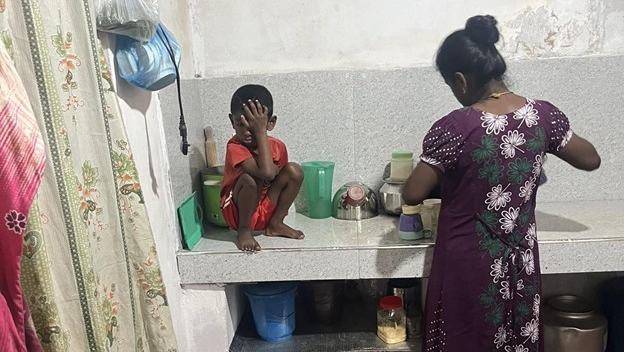
Something different wakes me and my household at 5 a.m. every day. It’s my 5-year-old host brother Tachu who, without fail, every morning, wakes up and begins throwing a huge tantrum. He yells: “AMA! TEETANI UTTITIH VANGA!!! (MOM! MAKE TEA AND COME!)” Every. Single. Morning.
And every morning, my host mom wakes up to do his bidding. Half asleep, with her eyes barely open, she walks to the kitchen like a zombie. She is so tired that she goes on autopilot. On rare mornings when I am up early and studying, I witness the entire process.
But on most mornings, when the house “alarm” goes off, I hear it from my room. The worst part? Tachu doesn’t let up even after he sees his mom get up. He whines and cries until the tea is brewed and the cup is in his hands, which takes about 5 minutes. And in those 5 minutes, everyone in the house is wide awake.
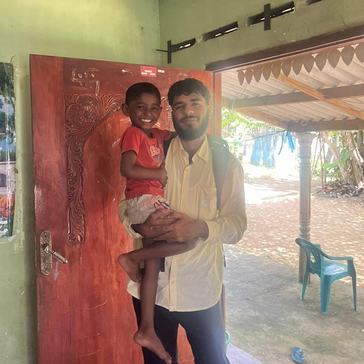
Tachu is one of the most interesting humans I’ve ever met. To be sure, he is naughty, but he is also unbelievably charismatic and loveable. Every adult in the village has scolded him, yet at the same time, he is the most loved kid in the whole community. He is our headache and our heart.
A charismatic feat
A day during the annual village volleyball tournament is one I clearly remember. The whole village gathered to watch the best athletes in action. There were babies, little kids, groups of girls playing their own games on the sidelines, teenage girls sitting around gossiping, moms cheering with every point, village authorities and men lounging in the shade sipping juice, and teenage boys huddled around the loudspeaker—one of them DJing.
During a short break between games, I noticed Tachu suddenly run onto the volleyball court. I was horrified! That court was practically sacred during the tournament. What was he going to do?
Before anyone could scold him or drag him off, he started dancing. Enthusiastically. In front of hundreds of people. I glanced across the court at my host mom, horrified, but she just looked back at me with this satisfied grin—no, not just satisfaction, something deeper, like she was oddly proud of him for doing it.
Soon after, little girls started joining in, followed by teenage girls and boys, all flocking onto the court. His dancing and laughter were contagious. From that point on, every break turned into a mini dance party—with the DJ’s musical support, of course. My younger brother was a natural. To this day, that moment is still one of the most charismatic feats that I’ve ever seen.
But before the dance party had even started, my host mom was proud, confident, and certain that her son deserved encouragement, not punishment.
Becoming a son
My host mom is the embodiment of unconditional love. When I first met her, I only knew a few words in Tamil, and one of them was “nandri" (thank you). The first night at my new home, I kept saying “nandri” as she served me tea and lunch and dinner. At the end of the night she stopped me, and, in broken English and Tamil, conveyed that I didn’t have to say thank you constantly. “You are my son now,” she said.
At the time, it felt like a nice gesture. This stranger welcomed me into her home, and said she considered me a son, but I didn't really know what that meant. But, in three short months, I learned exactly what it meant.
Unconditional love
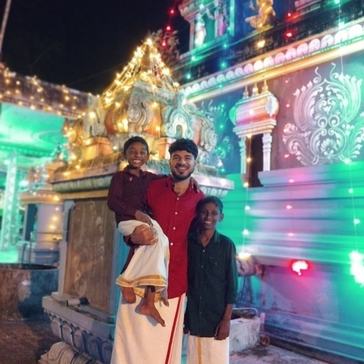
It meant unconditional love. It meant that the same mom who cheered on her mischievous 5-year-old son—because she wanted to nurture the inner flame of that child, because she wanted to water him until he bloomed into his own unique original plant—would give that same treatment to me, her new son. It meant that no matter the problems, baggage, or inadequacies I brought with me from America, that I would be accepted. It meant that in the course of my life-changing journey of learning and growth during service, that I would have someone rooting for me, supporting me, encouraging me, and being there to love me along the way.
When I joined the Peace Corps, I was told that my job was to promote world peace through friendship. At the time, it seemed like a bunch of buzzwords. But my relationship with my host mom and my host family proved to me the importance of our work. It is a friendship that will last forever.