 An official website of the United States government


Featured Volunteer Profile
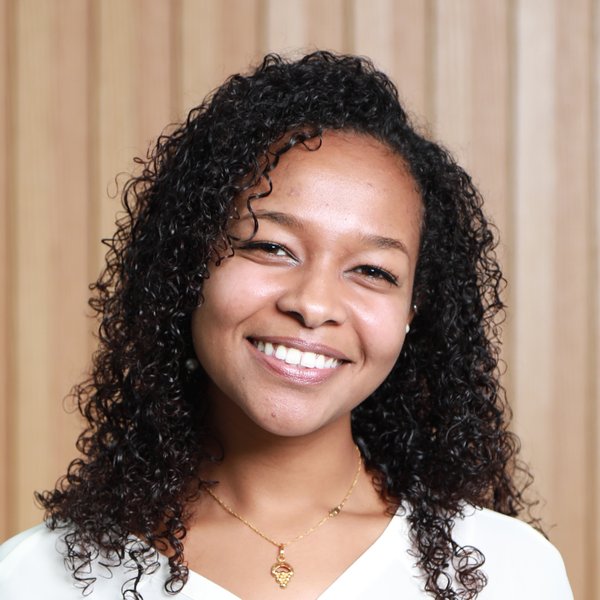
Reida A.
“With an open mind and close relationships to support me, I am able to trust that my experiences in service are meant to help me grow and develop into the person I want to be.”
1. What got you interested in the Peace Corps, specifically the Response program?
I believe that a life living in pursuit of an income rather than making a positive impact or change in the world is wasted. After completing my bachelor’s degree in China, I realized the importance of diversifying my life experiences and learning about the world as much as I possibly could. The Peace Corps seemed to be the best of both worlds; I could learn about new people, places and things and could also facilitate change and make a difference in a community.
While serving in Liberia my cohort was evacuated out of concern for political stability; since then I kept an eye on openings in the math and science field. Given my experience in education, I felt that serving as a Math Assessment Support Officer in the Eastern Caribbean would be a perfect opportunity to learn about education systems at the ministry level. Not only would I be transferring skills and building skills in over a dozen primary schools in St. Lucia, I would also develop a working knowledge of international educational development to help me eventually pursue projects in my ancestral home of Sudan and elsewhere.
2. What projects are you working on with your community?
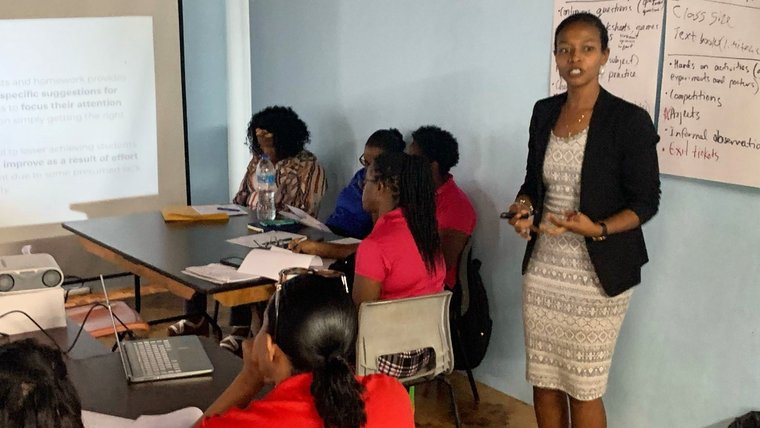
My primary project is rolling out a pilot teacher training program highlighting the use of formative assessments in the teaching process. The goal of the program is to help teachers apply techniques to assess for learning during math lessons and to change the culture of learning in schools overall. In addition to pedagogical tools for use in the classroom, the education team in the district has come together to push for the use of technological tools to help teachers analyze end-of-term results and schoolwide student achievement.
To meet this goal, I developed an online tool to instantaneously provide feedback, calculations, and reports for teachers, principals and students in the district. Most primary schools have had professional development in the use of the tool and have adopted the data analysis method so far; further projects related to creating resources for analysis include school-wide performance tracking (in order for teachers to monitor the progress of lower performing students), performance with continuous assessment, and accounting tools for student banking.
Outside of software, projects include a community group initiative to find sustainable ways to produce hygiene packets for students with low resources, and a school beautification project to update the facilities at a local primary school.
3. How have you leveraged your previous professional experience and skills in your service?
Given my experience as an educator, I feel well equipped to facilitate skills transference to hard-working educators in St. Lucia. In general, I believe that most practitioners enter the education field not because it is easy, but because they understand the value of teachers and want to make a difference where they can. Because my background, I find it easier to empathize with teachers and speak to the challenges and celebrations we all encounter day by day.
In addition to the pedagogical aspects of the work, much of my time is spent networking and making connections and deepening understanding among different groups of people. It something I have worked to develop over the years and factors into almost all aspects of my service. Returning to the Peace Corps has allowed me to the view my work through the lens of putting sustainability above short-term impact.
4. What is a highlight of your time in service so far?
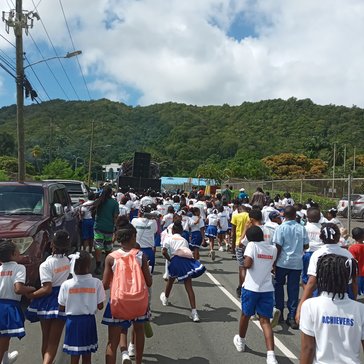
So far in my service, I have been most grateful for the relationships I have developed with all of my colleagues, friends and close acquaintances. It not a matter of the idea would be unable to develop meaningful relationships but a surprise at the depth of and degree of welcoming I have been so lucky to receive. From brief encounters at random moments to what are beginning to looking like lifelong friendships, I feel quite blessed to be surrounded by joy, happiness and genuine connections.
5. What strategies have you used to meet the challenges of a Response Volunteer experience?
One challenge I often face is letting go of my norms and what I am familiar with. Those feelings of expectation ultimately lead to disappointment and frustration, but with a mindset to embrace change I quickly learn that what is unfamiliar can be embraced and made into moments of joy and contentment. With an open mind and close relationships to support me, I am able to trust that my experiences in service are meant to help me grow and develop into the person I want to be. In addition to letting go of expectations, I have learned to forgive myself for not being perfect and meeting every goal I have for myself; while it is my directive to do the best I can to meet the needs of the people in my host country, I have found the space where I can work my hardest and be my best even if there is still room to improve.
6. How will the skills you are developing help you in the future?
The main skills I am developing are listening without making assumptions and taking time to trust my intuition and make the decisions that are best for me. With these skills, I have drastically reduced anxiety and fear about the future and have learned to have faith in myself and my knowledge. Since I have developed this sense of patience and trust, I have been moving through the world with more confidence in why I am doing what I am doing and have been motivated to keep pushing through with my ideas and vision for the future. Without these two skills, I find it hard to keep from being frustrated and believe in my ideas. In essence, I would not have been able to imagine myself here in the Eastern Caribbean.



