 An official website of the United States government




Featured Volunteer Profile
Maya S.
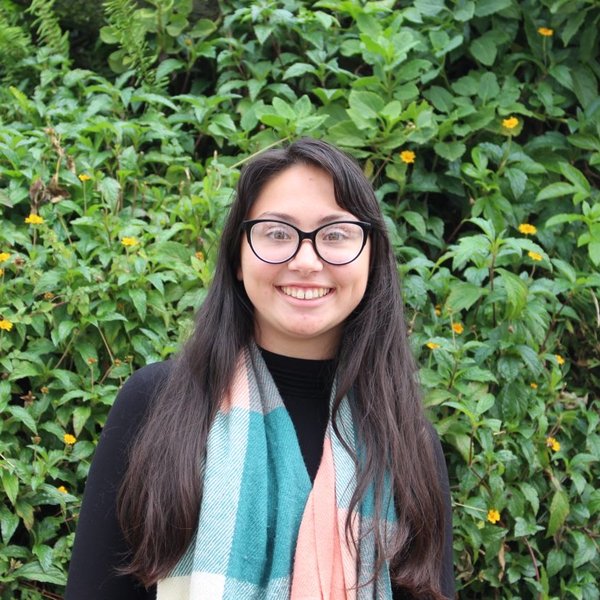
“What I’ve enjoyed the most about service is the friendships and connections I’ve made at my health center and in my community. There’s a group of kids I see every week at the health center, and I’m always so excited to see them.”
1. What got you interested in Peace Corps?
When I was a child, I began to notice homelessness and food insecurity in my community. I was very interested in helping others, so I got involved in volunteering with various community organizations. This passion for serving others grew throughout my childhood and college years where I continued to volunteer and serve my community. In college, I studied global health, so when I learned about the Peace Corps, I realized it was a great opportunity to combine my personal interests and passions with my university studies. I liked that Peace Corps focuses on community integration and local language/culture learning.
2. What projects are you working on?
As a Health Volunteer, my primary projects are under the First 1,000 Days campaign, which focuses on the health and well-being of pregnant women and children in their first 2 years of life. I work at a rural health center, where my main counterpart is the nutritionist. Other people I work with include community health workers, the social worker, mental health leader, and other nurses and community members. I often conduct growth monitoring, which is measuring the height, weight, and MUAC (middle upper arm circumference) of children and analyzing that data to see if the child is malnourished.
An ongoing project is assisting with growth monitoring during vaccine days. Immunization happens at birth, 6 weeks, 10 weeks, 14 weeks, 9 months and 15 months. Since the babies and mothers come in regularly while the child is breastfeeding and then twice more once the child moves on to eating food, vaccination days are a great time for growth monitoring. We track each child’s data in a book, so it is easy to see their progress and enables us to follow up with the family if there is any problem. I perform growth monitoring and analyze the data myself, but I also train nurses and community health nurses on the proper measuring techniques.
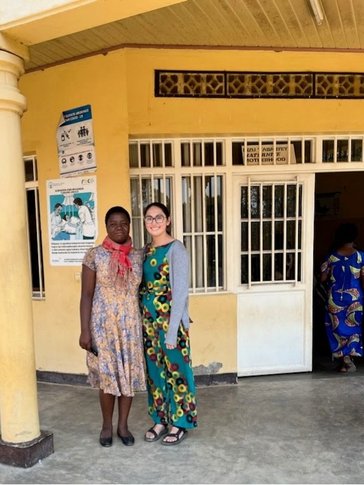
There are government initiatives that provide flour for porridge to qualifying people, and milk to children who are underweight. We give out the flour weekly or monthly and milk weekly. All participants in these programs have or are at risk of having malnutrition. Every time we give out these nutritional foods, we perform growth monitoring and give a short educational talk about a relevant topic. It can vary from what is a balanced diet to preventing common diseases.
Strengthening the skills and knowledge of health center workers, community health workers, and nursing students who study at the health center is another project. In addition to training on growth monitoring, I train health center coworkers on computer skills and basic English. Computers are used at the health center for reporting. Additionally, some forms or documents are only in English or are expected to be completed in English.
My health center often has nursing students completing their internships, so I teach them about growth monitoring and the nutrition program in Rwanda. It will be useful for their future in nursing and improving the health of any patient they see.
4. What strategies have you used to integrate into your community?
Learning and using the local language, Kinyarwanda, while engaging with my community has been the best way to integrate in my community. Very few foreigners learn Kinyarwanda, so even if you make a lot of mistakes and speak like a toddler, community members are impressed and very grateful. As my relationships have grown, my neighbors are quick to tell people who don’t know me that I speak Kinyarwanda and am a part of their community.
I also try to put myself out in the community as much as possible and do the same activities as my neighbors. I go to the big market day every week, where I negotiate for groceries, and have built relationships with the sellers. Transportation is also difficult in my community, as my village is far from the main road on a dirt road, with few buses. While this has been a struggle in my service, it has also helped me to integrate. I wait for the bus with everyone else. When the bus breaks down, I help along with everyone else or sit with them until another bus comes. Sharing this difficulty together has shown how community members and I support each other outside of work. I often will run into people I talked to on the bus who I may not have otherwise met besides a brief greeting.
5. What is a highlight of your time in service so far?
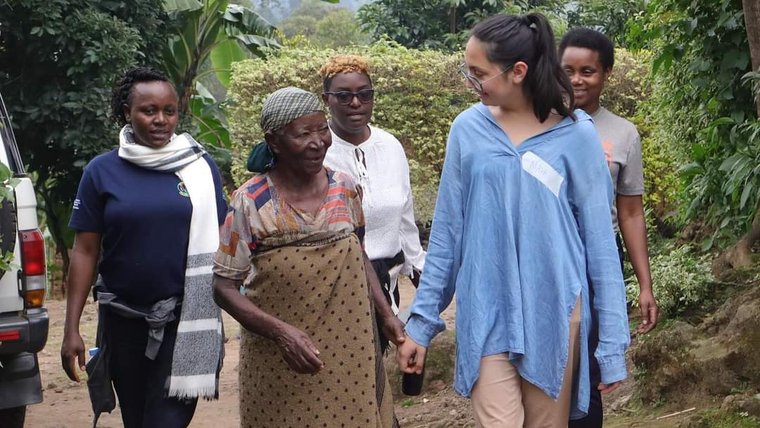
My mom and grandma visited me during my birthday in Rwanda, at the end of my first year. During their visit, I brought them to see the health center and community on a big market day. As we walked around the community, people stopped us every two seconds to talk to my mom and grandma. Everyone was so excited to see them, not only because they were foreigners but because they’re my family. Community members were thanking them for visiting and telling them how much they love me. During service, it’s easy to become discouraged and feel alone. During my family's visit, I realized how many people I know, the relationships I’ve built, and how much my work actually matters to my community. Watching my grandma hug the elderly women in my community and seeing my mom connect with my neighbor, who’s been my site “mom,” has been a highlight of my service. That was one of our favorite days of the trip. It was amazing to see two very different parts of my life combine. Now, my community members often ask me about my family. That day, I felt proud of myself for the life I’ve built here, my community for being so warm and welcoming and of my family for visiting with open minds. It’s something I’ll look back on fondly for the rest of my life.
6. What have you enjoyed most about the community where you are serving?
What I’ve enjoyed the most about service is the friendships and connections I’ve made at my health center and in my community. There’s a group of kids I see every week at the health center, and I’m always so excited to see them. When I wave at them or play little games with them their smiles make me so happy. There are also many kids who I see along my daily walk who call my name (my Kinyarwanda name and American name). We walk together, hold hands, play games, or share guava together.
Then there’s the many elderly women in my community who I see in the same spots in the village or at the health center. Often they will slow down, speak slowly and use simple words so we can have a meaningful conversation. These talks mean so much to me and I look forward to any day when I can walk home with an elderly lady. Or the lady at the market who sells tomatoes and makes sure every other person is giving me the right price of their goods. Even when I don’t want tomatoes, I stop to greet her and it’s often the highlight of my day.
I can't even begin to explain how much my health center community means to me. Most of the employees are women and accepted me so openly. I communicate with all of them through simple Kinyarwanda, English, gestures and smiles, and they always have made me feel included and welcome. All these relationships are what I will remember most about service, and I hope it is what they will remember most about me.
7. What are some of the most important things you learned from your community?
They’ve shown me how to prioritize relationships over productivity. In Rwandan culture, it is less important to be timely than it is to prioritize your well-being and relationships. It’s okay to be late because you ran into someone you haven’t seen in a long time and need to catch up. Or because it took longer to cook a meal and eat than you expected. Often during work, I’ll find myself helping others before I’ve finished my own task. In the U.S., this would be frowned upon in a professional setting, but here it is totally acceptable. My community has also reminded me how to find joy in the small things. A hug from a kid or an extra sweet mango. Overall, my community has taught me how to be less stressed about things that ultimately are not that important, and focus on the important things like relationships and your well-being.
8. How do you spend time when you are not working on a project?
If I’m not feeling social, I love to read. I’ve finished so many books during service. I also love to do little crafts or figure out how to cook or bake things from scratch. Some of my biggest successes have been tortillas, cinnamon rolls, garlic knots, and bagels. My neighbors also love this activity because I’ll sometimes share the goodies with them. If I’m at work not doing a project, I love to visit other specialties and sit and chat with my coworkers if they’re not busy. If not at work or home, I like to visit my landlady. She lives in the same compound next to me and is one of the funniest and coolest people I’ve met in Rwanda. She’s a nurse at a nearby hospital, has a child, but also keeps chickens and farms. Since she’s really busy, sometimes I’ll just sit with her while she’s cooking to chat or we’ll bring each other tea if we’re too busy to hang out.
9. What are you looking forward to in your remaining time as a Volunteer?
I’m in the last few months of service, so I’m trying to make the most of my time left. As I’ll be wrapping up my projects soon, I’m both looking forward to and dreading the beginning of my last weeks at site. While it will be sad, I am looking forward to celebrating my service with my community, giving away my things to community members and ringing the close-of-service bell.
10. Once you finish your service, what will you do differently when you return to the U.S.?
In my community, I have seen how almost nothing is wasted. Almost everything can be useful and you can often find something to serve your purpose without buying a new thing. For example, a used plastic bottle can be cut in half to become a funnel for filling up jerry cans with water. I want to keep this no-waste mentality and be intentional when buying new items and deciding what to throw out.



