 An official website of the United States government


Featured Volunteer Profile
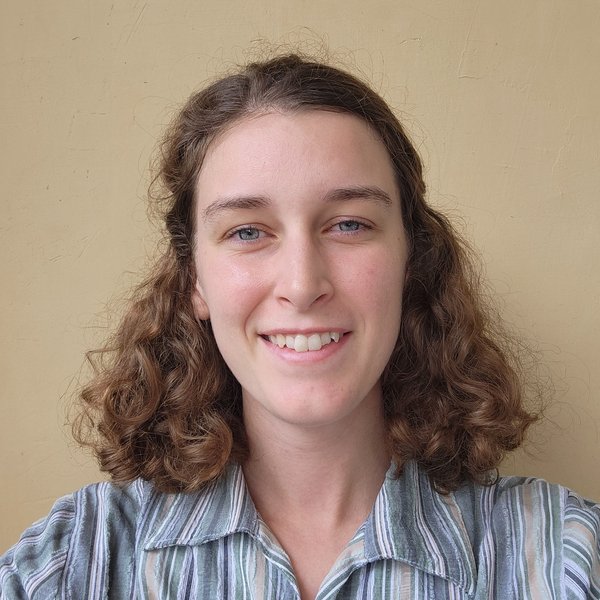
Lucy Y.
“To succeed in the Peace Corps, you have to be very stern with your fear, and knowing that I am capable of overcoming any fear or discomfort is a skill that will carry into the rest of my life.”
1. What got you interested in the Peace Corps?
My swim coach at the University of Richmond served as a Peace Corps Volunteer in Kenya and told me stories about his service. As I started thinking about what I wanted to do after college, I realized that Peace Corps aligned with what I wanted to do next. I was looking for an opportunity to serve and gain experience with an organization that would support my mission of service and a simple lifestyle. I also had a desire both to travel and be rooted in one place. All of these desires seemed to come together in the Peace Corps, so encouraged by my coach, I decided to apply and eventually join. One of my interviews during the application process took place between sessions at our conference championship, so my swim journey and my current Peace Corps journey are very connected.
2. What projects are you working on?
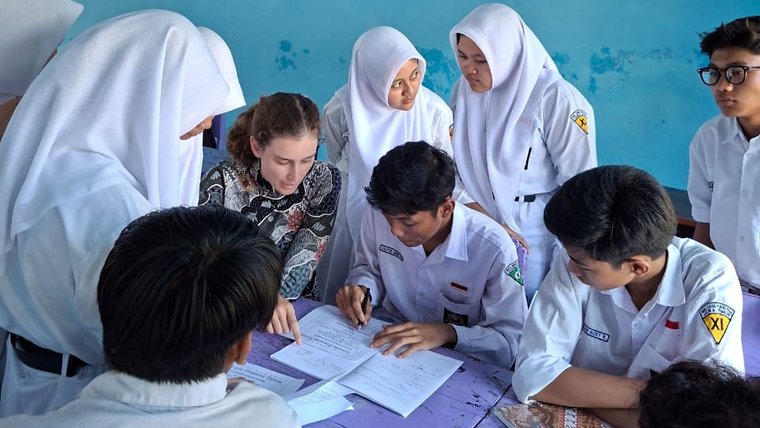
My main project is teaching English at a local high school as a partner teacher.
My passion project is a partnership with our local library. So far, I have taught several sessions of English courses to middle schoolers, reaching around 100 community members. I led a week-long afterschool English camp for elementary school students, inviting several of my middle school students to help as “camp counselors,” so they could practice their English and leadership skills.
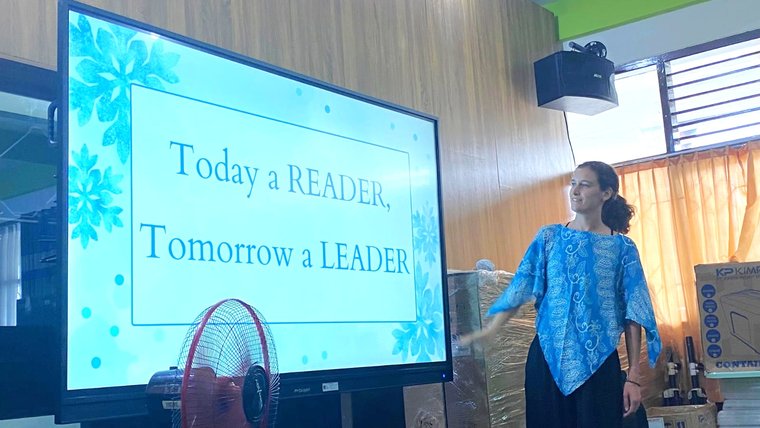
Now, my hope is to create an “English corner” in the library for the community to use after I leave. This project will hopefully be accomplished with support from the library, Darien Book Aid, and Peace Corps small grants. Our dream is to create a comfortable space with a sofa, a computer with online resources, and English books. I plan to continue educational programming to promote the library and the English corner.
Another passion project is my partnership with a local English tutor. He works with many under-resourced schools in nearby villages (I live in the main city in my region) and manages a network of English tutors. We have been able to create opportunities for these students to meet a native English speaker, many for the first time. I look forward to future projects from this partnership, potentially creating opportunities not only for the students to grow, but also the tutors.
3. What strategies have you used to integrate into your community?
During pre-service training, I was committed to mastering the language, which has had a big impact on my integration process. I’ve been able to participate in an Indonesian church and make non-English speaking friends. Seeking opportunities outside of my assigned school, and primarily working with the library, has given me a wide network of local friends who are passionate about education, so I have partners and support for my projects. In addition to language skills, having the courage and confidence every day to speak and spend time with people has shaped my experience. Telling my fear to take a backseat has enabled me to leave my room when I didn’t feel like it, smile before I felt totally comfortable in a new environment, and try things even if I can’t do them well yet.
4. What is the highlight of your time in service so far?
The biggest highlight of my service is meeting people who care. People who care about me, about learning, and about service and education. My partner at the library is always willing to listen to my ideas and share my vision. When an idea I propose takes on a life of its own because it is embraced fully by my community partner, I feel like I am right where I am meant to be. My English tutor partner who has connected me with under-resourced schools inspires me with his passion for providing opportunities to students and his determined energy. I met the mother of one of the students in my library program, and she has started two English speaking schools locally. Her energy and ability to make things happen helps me and many people believe in a better future. These people inspire me to continue giving the best I can.
5. What have you enjoyed most about the community where you are serving?
My town in particular is very quiet – no mountains, beaches, tourist attractions, or natural disasters (rarely, anyways). I enjoy the quietness of the community, and the way the people enjoy and appreciate that quietness. The people here are welcoming, peaceful, and humble. I have never met more welcoming and humble people. I joke that I am never hungry in Indonesia, because people are always feeding me. Even now, I’m sitting in my friend’s house surrounded by snacks. My friend just handed me my next meal, all packaged up and ready to eat. People here rarely live with a sense of dissatisfaction and striving we see so often in the U.S., but with a humble simplicity. Care for your family. Enjoy the food on your table. It makes me feel so comfortable in a place so far from my home. I only hope that I can carry these values with me for the rest of my life.
6. What are some of the most important things you’ve learned from your community?
A big thing that I’ve learned from my community and from Indonesian culture in general is how to simply be together with people. Compared to how hurried and efficient we are in the U.S., my community is slow, prioritizes rest, and takes its time with community. Stopping to pray 5 times a day in a Muslim community forces us into a different pace of life with different priorities. If I am invited to lunch or coffee, it is likely I will spend several hours with the person who invited me, if not all day. People in my community laugh and chit-chat easily. Smiling comes easily, and gratitude is the norm. We laugh at awkwardness instead of running away from it. This community has taught me the value of just being together with people.
7. How do you spend time when not working on a project?
In my community, I love drinking coffee at the local cafes or playing pool with my friends. Somehow there’s always a new café or billiards hall to visit.
If I have more time off, I like to go to the beach and surf. I’ve found a particular beach that is still pretty rural where I return again and again. I've made many friends there, so I can relax into the quiet, hometown feel while enjoying a break from my responsibilities.
8. What are you looking forward to in your remaining time as a Volunteer?
I am looking forward to making good on my word and intentions. I feel like my first year involved a lot of learning, growing, and pushing through, but that first year has laid the foundation for my vision of the second year. I know what I want to do, I have wonderful community partners, and I know the next steps. Completing a project that will last beyond my service is a big challenge for a Volunteer, and I am excited to make it happen.
My family plans to visit me this year, so I am excited to show them where and how I live. I am also excited to discover my next step after service. Personal growth is so important in Peace Corps service. As I go into the final year, reflecting on the ways this experience has transformed me and discovering what that means for what’s next is something I look forward to. Service can be many things, but for me, it feels like just the beginning and I can’t wait to see where it leads me.
9. Once you finish service, what will you do differently when you return to the U.S.?
I expect that I will move forward with more confidence than I have ever had. To succeed in the Peace Corps, you have to be very stern with your fear, and knowing that I am capable of overcoming any fear or discomfort is a skill that will carry into the rest of my life.
I also expect to carry a lot more empathy for foreigners and immigrants. For whatever reason, before I moved to Indonesia I had very few foreign friends, but having been in a situation where I speak a foreign language every day, look different from everyone around me, and am treated differently, I feel that I can give greater consideration to foreigners and immigrants.
Learn more about serving as a Peace Corps Volunteer in Indonesia.



