 An official website of the United States government




Featured Volunteer Profile
Calvin D.
“[My previous service in The Gambia] was invaluable in setting my expectations about what kinds of projects and goals would be useful and achievable. More importantly it instilled in me a love of living amidst new cultures and peoples.”

1. What inspired you to apply for this Peace Corps position?
I previously served a two-year role in The Gambia, which was incredibly fulfilling and enjoyable for me. I wanted to continue serving with the Peace Corps in another region. I found an open position in Guyana that sparked my curiosity, given that I didn’t know much about the country. A little bit of research revealed that Guyana would be a unique and interesting country for service. More importantly, the job description seemed like a good way to build on the literacy education skills I acquired while in The Gambia.
2. What projects did you work on with your community?
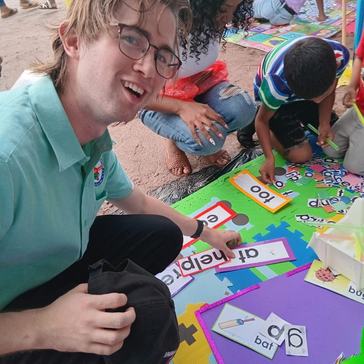
The bulk of my job was visiting schools to monitor and guide grade school teachers on the implementation of Guyana’s new phonics-based literacy curriculum. The rollout of this was an important, locally identified goal that benefited from lots of attention from my region’s literacy committee. The monitoring, however, was only a piece of the puzzle. We also hosted regional workshops and school trainings as a way of ingraining the concepts among a wider group of teachers. Of course, our focus was not only on curriculum implementation; we also hosted activities and competitions for the region’s students, such as a “literacy hat” demonstration, spelling bees, and an annual family reading fair. One of my favorite side projects was an adult community literacy and numeracy program that we held in a mining community near my main town. The participation and enthusiasm encouraged me greatly.
3. What is a highlight of your time in service so far?
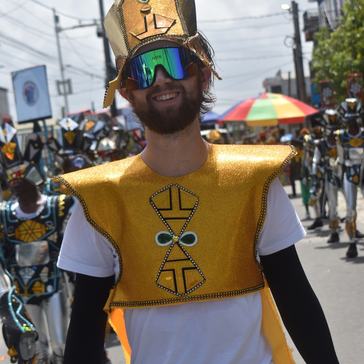
I love the Guyanese holidays, especially all the festivities around Mashramani. It is known for its fun carnival-like celebrations but also involves many days of working together on costumes and displays that showcase Guyanese history and national unity. Even though the main parade in the capital is only one day (the anniversary of Guyana becoming a republic), almost every weekend leading up to Mashramani and even afterward has some sort of other parade or activity. The kids have a parade in the capital representing their regions; the children in my town had a parade where they represented their schools; and there was also an adult parade and a three-day children’s dancing and poetry competition held in the region, with finals in the capital. The list could go on and on. The work required to put it together could be exhausting but the fun celebrations made it all worth it!
4. What strategies have you used to navigate challenges during your service?
Every Peace Corps service comes with its challenges, and while it might seem to be because of the change in lifestyle and loss of amenities Americans are accustomed to, I have found that most difficulties stem from being in a new location and having to make a new set of friends. While it isn’t guaranteed to be easy, the solution is to lean on locals for help and allow friendship to follow. I have found again and again that most locals are eager to be a resource to new Volunteers if they are given a chance. It might just take some time and talking before you find this out.
5. How has your service shaped what you will do in the future?
So far, my stints in the Peace Corps have only inspired me to continue serving in the Peace Corps. But professionally, I have learned a great deal about the value and pedagogy behind phonics-based literacy instruction. Because of this, I am considering a future career in education administration.
On a personal level, I have developed a lot of skills related to world travel. It may seem trivial but knowing how to comport oneself while visiting a new place is something that takes experience. Comfortability here opens up a whole new world of wonder (literally). Regardless of what I pursue professionally, I hope to keep global travel as a significant part of my personal life.
6. Tell us about someone who’s impacted you during service.
I can’t shout out anyone without first mentioning my counterparts Karen and Alister Their support for me in and out of work did not waiver since the beginning of my time in Guyana. They were my bosses, but they treated me as an equal. Their work ethic and passion for literacy was infectious. And not only did they help guide me in the office, but they took the time to help me integrate outside of the office. Jamal, Samantha, and Tamika also deserve special recognition as Peace Corps staffers whose hard work and guidance made my service a success.
7. What is the most interesting thing you’ve learned about your host country?
Guyana is a very diverse country. Any social studies textbook mentions the six ethnic groups that make up Guyana: Afro-Guyanese, East Indian, Amerindian, Chinese, European, and Portuguese. You learn this with a quick internet search, but the ways in which the different ethnicities have melded the country was a very interesting thing to learn on the ground. Some traditions like Indian religious functions, or African dress styles, or Amerindian village setups have been well preserved within the ethnic groups, which was fascinating to witness. Other elements of culture, like food or language, originated from one ethnic group but are currently shared widely around the country.
8. How did you share the culture with family and friends back home?
I was lucky to have a group of friends visit me in Guyana. Visting does more to illuminate the virtues and wonders of the country than anything I could say or write. I hope in the future I will get the opportunity to host friends of mine from Guyana in the States to further foster the cultural exchange.
9. What would you say to someone thinking about joining the Peace Corps?
Despite whatever stereotype you may have heard, I have found that most people around the world are eager to interact with and befriend Americans, especially those open to people and willing to work alongside a community. You’ll learn a lot about society by witnessing other ways of doing things. It has been refreshing for me living in a town where everyone from the mayor, businessmen, and politicos to teachers, nurses, and painters shop in the same market, send their kids to the same schools, and eat and drink at the same restaurants. If you are just willing to step outside your comfort zone, you too could be a part of that fabric and experience the most fulfilling and memorable years anyone could ask for.
Learn more about serving as a Peace Corps Volunteer in Guyana.



