 An official website of the United States government




Featured Volunteer Profile
Marie S.
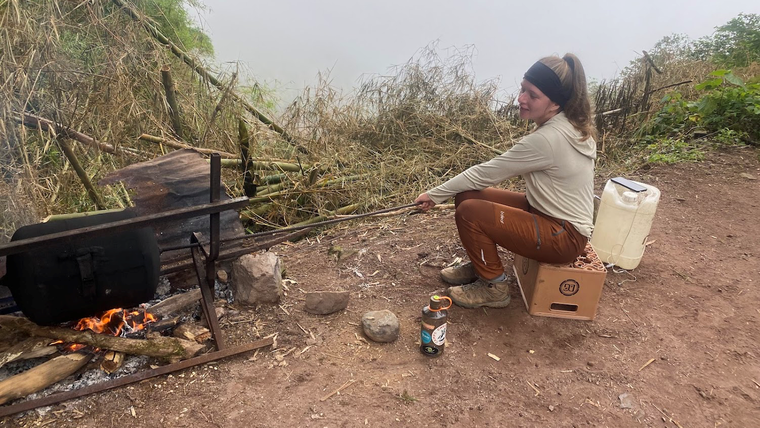
“On a practical level, I have learned how to roast coffee in a recycled can on an open fire, farm with only a machete, and cook some incredible Jamaican dishes.”
1. What got you interested in the Peace Corps?
The first thing that sparked my interest was hearing from Returned Peace Corps Volunteers (RPCVs). I stumbled across a Peace Corps blog in high school and found myself reading the entire website in one go. I was so fascinated by the concept and from that moment, a seed was planted and it became something I kept in my mind as a post university plan.
The idea did not feel serious until my senior year of college, when I interned at The Carter Center and later worked there fulltime after graduation. This experience really deepened my interest in getting field experience in international development. The large number of RPCVs on staff at The Carter Center was incredibly encouraging. Several of them supported me in my application process, sharing their stories, answering my questions, offering advice, and even writing recommendations.
Had I not been surrounded by so many passionate RPCVs, continuing their service through the third goal and encouraging others to serve, I might not be where I am at today. I hope to carry the same legacy forward after my own service.
2. What projects are you working on?
Agriculture Volunteers in Jamaica support the Sustainable Agriculture Livelihoods Initiative (SALI), which strengthens the capacity of farmers to improve agricultural productivity and increase income, and supports agriculture-focused organizations.
Community farmers’ groups are supported by the Ministry of Agriculture and the Rural Agriculture Development Authority (RADA). Often Volunteers' scope of work will be based around the needs of a farmers’ group and individual farmers within the group. I work closely with a farmers group on several key initiatives to support sustainable agriculture and income generation. These include developing a demonstration plot to showcase best farming practices, building a community compost system to provide organic and affordable fertilizer, and designing a livestock project to promote higher-income, environmentally resilient farming. In addition, my counterpart and I are working to strengthen the group’s organizational capacity and facilitate workshops in collaboration with various stakeholders.
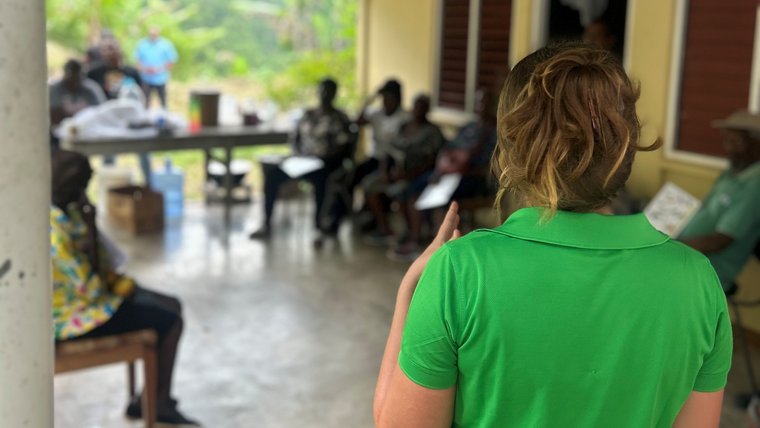
I also work at the local primary school, where I co-facilitate the 4-H Club, Environment Club, and Literacy Club. Through 4-H, we promote youth involvement in agriculture by developing a productive school garden, with the goal of using the harvest to support nutrient-dense school lunches. The Environment Club encourages environmental education and stewardship, while the Literacy Club, which I started as a secondary project, supports efforts to improve primary literacy rates. This summer, I’m also working with the principal to revitalize the school library, which has not been active since before COVID.
3. What strategies have you used to integrate into your community?
Anyone who knows Jamaica understands how deeply the game of dominoes is woven into the culture. On the very first day I met my counterpart, he told me he had just started a community domino team—and that I was expected to join. I said yes and began my journey, “six love”-ing my way into community connection. Playing dominoes quickly became a fun and unique way to meet people, learn Patwa, and immerse myself in the culture. Along the way, I also sharpened my fast math skills.
Rural Jamaicans are naturally social and community-oriented, which is beautiful but an adjustment for me as someone who tends to be more introverted. Finding a balance between America’s hyper-individualistic culture and Jamaica’s hyper-social culture was initially challenging. But I realized that integration happens in that balance. I had to push myself outside my comfort zone and leave the house even when I just wanted to read a book alone. Interestingly, the moments I least wanted to go out were often the times I found new friends and a fuller sense of community.
4. What is a highlight of your time in service so far?
In the months leading up to my birthday, I found myself in a bit of a slump. It had been raining almost nonstop for three months, and I was grieving the loss of someone back home. Many people in my community were aware of how I was feeling, and to my complete surprise, my friends, supervisor, and domino team came together to organize a birthday party for me. It was incredibly thoughtful—one of the most fun nights of my life—and a memory I’ll treasure forever.
That night was a turning point. It was an ah-ha moment that reminded me the deep sense of community care I see around me every day extends to me, too—even as a foreigner. I felt an overwhelming sense of gratitude for being accepted here, and a deep peace in knowing I’m exactly where I’m meant to be.
5. What have you enjoyed most about the community where you are serving?
I live in the Blue Mountains, deep in coffee country. Roasting my own coffee, easy access to stunning hikes to rivers and waterfalls, and panoramic mountain views make my site feel like a dream. But above all, what makes this place truly special is the warmth and openness of the community. My community is small and remote, with a population of around 250–300 people. Everyone knows everyone, and there’s a strong sense of looking out for one another. The kindness and care I’ve received—even from people who barely knew me at first—has far exceeded my expectations. I’ve built real friendships and deep connections here that I know will last a lifetime.
6. What are some of the most important things you’ve learned from your community?
On a practical level, I have learned how to roast coffee in a recycled can on an open fire, farm with only a machete, and cook some incredible Jamaican dishes. On a deeper level I have witnessed incredible examples of community care and stewardship. In a tightknit community like mine, mutual aid is a way of life- nobody gets left behind. The community consistently shows up for one another, advocates for one another, and offers help time and time again. A beautiful reflection of humanity that can feel increasingly rare in today’s world.
This has been the most meaningful thing I have learned, both personally and professionally. It is shaping who I am becoming: a better, kinder, and wiser human, but also as I enter a career in international development work.
7. How do you spend time when not working on a project?
In my free time, I try to strike a balance between being social in the community and exploring personal hobbies. I spend time playing dominoes, going to the river, and taking walks—sometimes with neighbors, sometimes on my own. I’ve also gotten more into running, reading, cooking, and baking. The unstructured nature of life here can take some adjustment, but one of the biggest gifts is the space it gives you to dive into interests you’ve always wanted to explore—books you’ve been meaning to read, topics you’ve wanted to learn about, recipes you’ve wanted to try.
8. What are you looking forward to in your remaining time as a Volunteer?
Right now, I’m really focused on savoring the time I have left—building on the work I’ve already done and continuing to deepen the impact. In the coming months, I have some exciting projects planned. This summer I’m organizing an environmental education summer camp in partnership with a local environmental NGO, assisting in revitalizing the school library, and I’m also working on a community three-bay compost system. Additionally, I have several workshops planned for the farmers’ group. These are the initiatives I’m especially excited about as I wrap up my service.
9. Once you finish service, what will you do differently when you return to the U.S.?
Spending time in a new culture inevitably shapes your outlook, and this experience has been no exception. One thing I’ve discovered is a real passion for literacy—especially teaching literacy to children. It’s a powerful gift, one that many of us take for granted, and I can absolutely see myself continuing to volunteer in this area in the future.
Beyond that, the spirit of service and community care I’ve witnessed throughout my time here is something I hope to carry forward in both my personal and professional life. And finally, I’m pretty sure curry chicken, brown stew chicken, and rice and peas will have a permanent spot in my dinner rotation for years to come.
Learn more about serving as a Peace Corps Volunteer in Jamaica.



