 An official website of the United States government




Featured Volunteer Profile
Dee D.
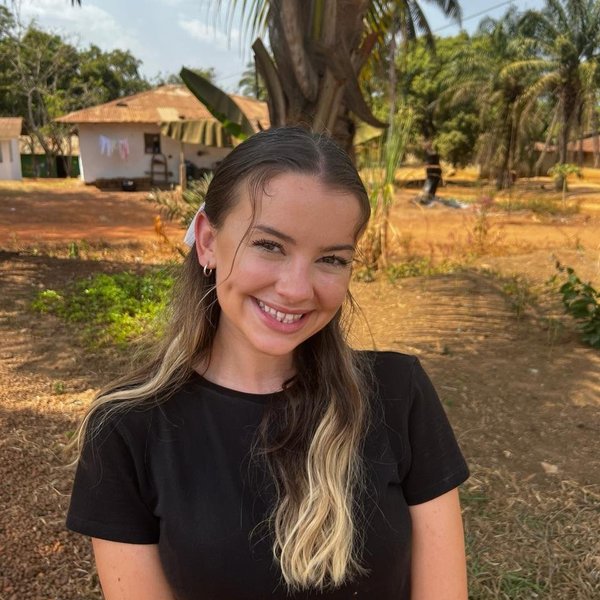
“The way my community has welcomed me, taken me in as one of their own, and continue to teach me what it means to be Liberian has shown that above all, we are all family and are working together on our shared planet.”
1. What got you interested in the Peace Corps?
I grew up in a rural farming community in California and experienced many types of education and different cultures. These experiences made me appreciate the beautiful diversity of peoples and cultures that exist on our shared planet.
I became interested in joining the Peace Corps early in my college career at UC Berkeley. After learning about the opportunities offered by the Peace Corps at a job fair, I knew it was the perfect way to satisfy my desire to share my knowledge of and passion for the sciences. I also felt it would be a great way to help create a more unified world by forming relationships with people from different cultures and learning about an entirely new way of life.
2. What projects are you working on?
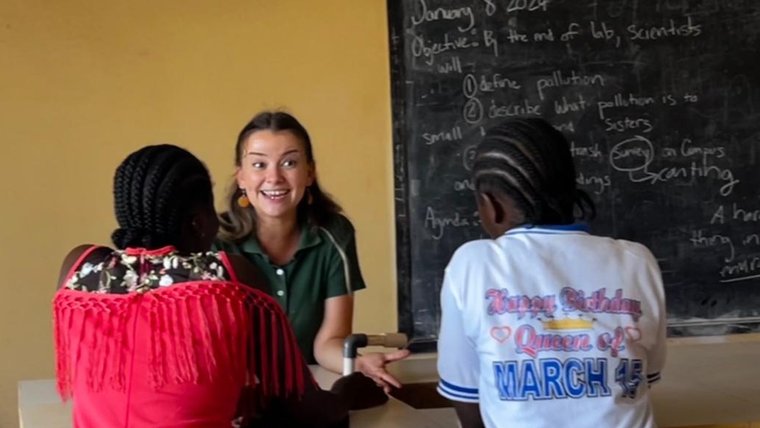
Working alongside the chemistry, biology, and physics teachers, I co-teach science laboratory for grades 10 through 12. My Liberian counterparts and I are helping to prepare students for careers in the sciences as well as cultivating positive, curious, and analytical mindsets in aspiring scientists through hands-on experiments.
At the request of students and with support from teachers, I am currently working on building a project-based student-centered learning program. This afterschool program covers subjects selected by students, including engineering, environmental science, health, and information technology. The program encourages students to explore their passions, gain skills in their career of choice, and pursue projects and experiments related to their interests.
3. What strategies have you used to integrate into your community?
The most helpful integration strategy has been sharing in the tasks, activities, daily routines, and small acts of kindness I have learned from community members.
I learned that handwashing clothes and cooking are almost always social activities that take place on the front porch of houses, so I do the same. I observed that people always stop to greet each other and take time to sit and “lecture” (as the Liberians say) with their neighbors, so I do as well.
At first, being in an entirely new culture was shocking and difficult. It was hard to understand practices so different from those I knew. Taking the time to learn these practices and practice them myself has helped me make friends, learn from my community who have been so eager to teach me, and expand my understanding of what it means to live in Liberia. Being humble enough to ask for help, eager to learn, and expressing gratitude to those who have helped me has made my community feel like family and Liberia feel like home.
4. What is a highlight of your time in service so far?
The highlight of my service so far, and the aspect that I am most certain will impact my life after service, is my students. Having grown up in an impoverished area with few resources for the sciences, I understand some of the many challenges students with a passion for science may face in Liberia. Despite these hurdles and difficulties, my students come to class every morning with their uniforms pressed, smiles on their faces, and excited for the opportunity to learn. Seeing their looks of surprise as they complete a chemical reaction and observe a new color, their concentration as we collect data and make observations of our environment, and their eagerness to ask and answer questions make my service fulfilling every day.
5. What have you enjoyed most about the community where you are serving?
Forming friendships and learning from the people in my community is what I’ve enjoyed most.
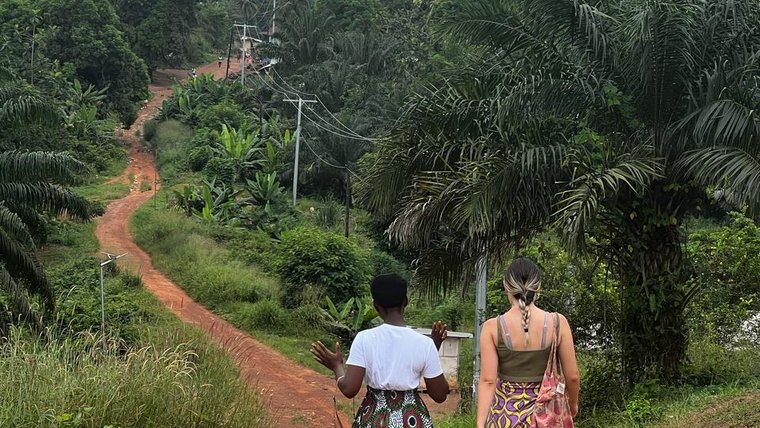
On my first day at site I woke up at sunrise, with roosters singing, and the sound of clanging pots about to be put on the fire. From the second I stepped outside that morning, complete strangers whom I had never met helped me all day long. Children helped me pump water; strong women carried it on their heads to my house; and strangers helped me mop and clean, walked me to the market, helped me buy ingredients, taught me how to cook on a coal pot, and ate with me. The kindness of my community who have been so willing to share their way of life with me has been so enjoyable. Strangers who helped me on my first day are my neighbors who I now greet every morning, friends who make me laugh until my sides ache as we cook together, and wise elders who’ve taught me what it means to be part of their community.
I am overwhelmed with the way people give to and share with each other; they bring bowls of rice to friends when you cook extra, help pump someone else’s buckets of water, and simply stop by to visit neighbors to check in on them.
6. What are some of the most important things you’ve learned from your community?
Besides the everyday necessities like how to draw water, where to buy food, and how to speak the local language, the most important things I have learned from my community is that we are all family. The way people address each other in my community mirrors this belief—everyone is a sister, brother, auntie, uncle, ma or pa. As a Peace Corps Volunteer, I wanted to be of service and give to those around me. Liberians have done the same for me. The way my community has welcomed me, taken me in as one of their own, and continue to teach me what it means to be Liberian has shown that above all, we are all family and are working together on our shared planet.
7. How do you spend time when you are not working on a project?
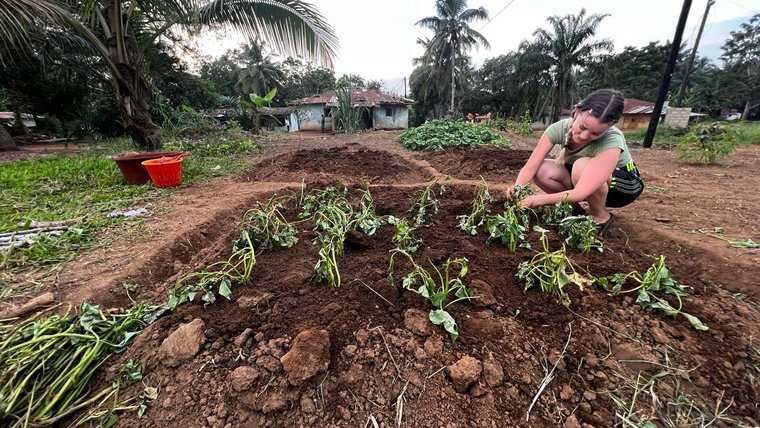
When not working on a project I spend my free time studying for the MCAT, working in the community garden, attending school sporting events, walking to the market, learning to cook new Liberian soups from my neighbors, and spending time with my fellow Peace Corps Volunteers.
Being in Liberia has given me an appreciation for an entirely new pace of life! I have learned to slow down and appreciate every moment.
Without the usual activities I enjoyed in America, I have had the chance to explore new interests and activities. Cooking with my neighbors each week has been one of my favorites! Choosing which soup we will cook, walking to the market, buying the ingredients, and coming home to cook and eat has taught me so much about my community. Food is such a large part of the culture here and something that we all share.
8. What are you looking forward to in your remaining time as a Volunteer?
I am most excited to expand the projects I am working on at my school. As one of the first Volunteer cohorts in Liberia to include Science Lab Trainers and Co-Teachers, our work is building the foundation of science lab at our schools. The longer I'm here, the more teachers I’ve been able to teach with and plan experiments alongside, and the more students have had the chance to learn and reach their goals. With the help of supportive teachers and administration, this work is being expanded to train more teachers in laboratory techniques so every student has the chance to perform experiments and practice scientific skills in their secondary education. This kind of work is only possible through collaboration with Liberian teachers and counterparts as well as working with fellow Peace Corps Volunteers, whose dedication has inspired me to continue on despite the challenges.
9. Once you finish your service, what will you do differently when you return to the U.S.?
Once I complete my service, I plan to attend medical school to become a pediatrician. My experience in the Peace Corps is the major motivation for this decision to commit to a life of service. I will return to the United States with an entirely new perspective; a new pride for my country after seeing how my fellow Americans serve others, and a new appreciation for a way of life and culture I had never experienced before. Above all, I will return to the United States knowing that my short time in Liberia with the Peace Corps, is helping to make a more unified world. As my community has taught me, I hope to share with my fellow Americans back home that we are all family.



