 An official website of the United States government


Featured Volunteer Profile
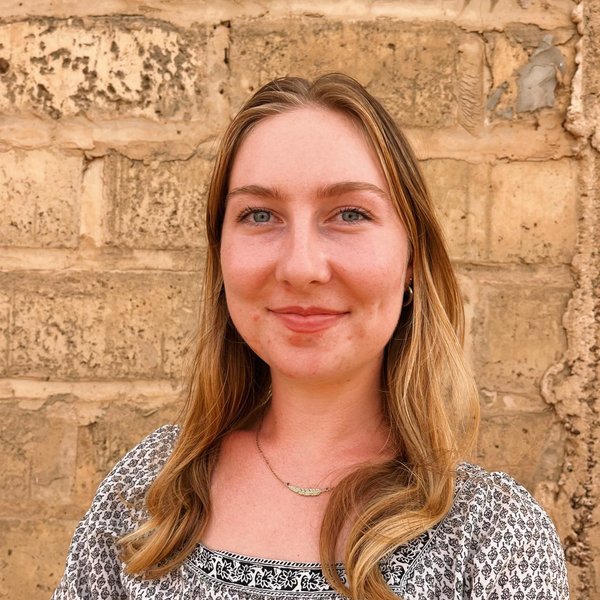
Maggie L.
“Both in good times and difficult, when it really matters, people come together to support one another, are willing to set aside personal disagreements, and everyone chips in for the benefit of the community.”
1. What got you interested in the Peace Corps?
Ever since I was young, I have heard stories about Peace Corps from my father, who was originally a Peace Corps Volunteer in Honduras and later a Peace Corps administrator in Albania. The stories of service, collaboration, and adventure inspired me. In high school I became involved in community service, which brought me joy and broadened my world view.
Once in college, I built on this with the knowledge I gained from my international studies major. I was fortunate to have the mentorship of Professor Lauren Honig, a Returned Peace Corps Volunteer (RPCV) who served in Burkina Faso. Through my work as her research assistant I learned more about the politics surrounding natural resource management in West African countries, which further my interest in the field of international development. Hearing about her Peace Corps experience and talking with other RPCVs from Senegal made Peace Corps sound not only like a great opportunity to see another part of the world and learn about a new culture, but also a great way to get hands-on development work experience.
When I saw Senegal had an opening for Environment Volunteers I decided to apply, as environmental politics in development was one of my main interests at university and I had done research on Senegal with Professor Honig, so wanted to see the country in person.
2. What projects are you working on?
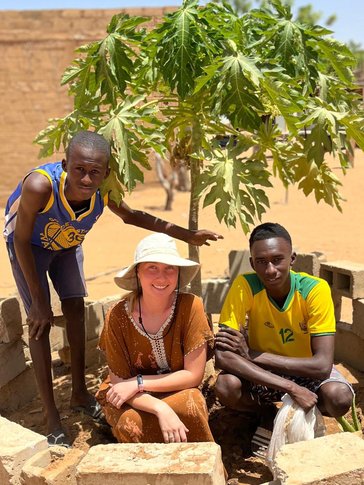
While I have worked on several smaller-scale projects throughout my service, my main focus has been working with the primary school in my village. Along with partner teachers at the school I developed an environment club in March 2024 for students ages 9-12. As a part of the vision for the club, the school staff hoped to start a scholar’s garden. Initially I wrote a grant for this purpose, but it soon expanded to include a solar pump for the school well, the re-establishment of a women’s garden in the community, and the rehabilitation of a classroom in disrepair, which included bringing electricity to the school for the first time.
The results of the grant are reverberating across the community. Every day, kids are excited to come learn in the garden and watch their produce and tree nurseries grow. Women in the community are already harvesting their produce to bring home to their families and to sell. Even NGOs have taken notice of the new garden spaces. I, along with the school director and my partner teachers in the environment club, have begun collaborating with an international NGO to create after-school programming and agro-ecological education programs in the scholar’s garden. These sorts of partnerships give me hope that my project will continue to flourish long after my Peace Corps service ends.
3. What strategies have you used to integrate into your community?
I tried to spend time with people as much as possible when I first arrived at site, whether sipping ataya (hot sweet tea) with my host brothers and their friends or helping my sisters-in-law mop or sweep. If I heard words in conversation that I did not know, I wrote them down and asked someone to explain them. By asking questions I was able to find people in my host family and throughout my community who were patient and wanted to get to know me just as much as I wanted to get to know them.
I also tried to say yes to things as much as possible. If there was a baptism, a wedding, or a funeral I would be there, helping women cut up vegetables in preparation for the large lunches, participating in the hotesse (matching outfits for a ceremony) and greeting people or saying the proper prayers for a healthy baby, a happy marriage, or my condolences. Though many of my closest relationships in the community are with my host family, these events helped me to branch out and get to know more people. Putting effort into learning the language and sharing activities with people helped me demonstrate that while I certainly cared about my work as an Environment Volunteer, I also cared about getting to know them.
4. What is a highlight of your time in service so far?
The highlight of my service so far has been watching kids grow throughout their participation in the environment club. Initially, kids were sometimes shy to participate in club activities, or had trouble focusing. As I got to know them better, however, and my language skills improved, we gradually formed a rapport.
My dynamic with my partner teacher also improved as we created better strategies for planning lessons.
I noticed an increase in enthusiasm once students had a physical space to garden. Kids who previously had trouble focusing in class became exemplary garden caretakers and during their breaks or outside of school, kids began asking for one-on-one lessons or additional club meetings. We have all grown together from this experience and I am grateful to have had the opportunity to work with some of Senegal’s future environmental stewards.
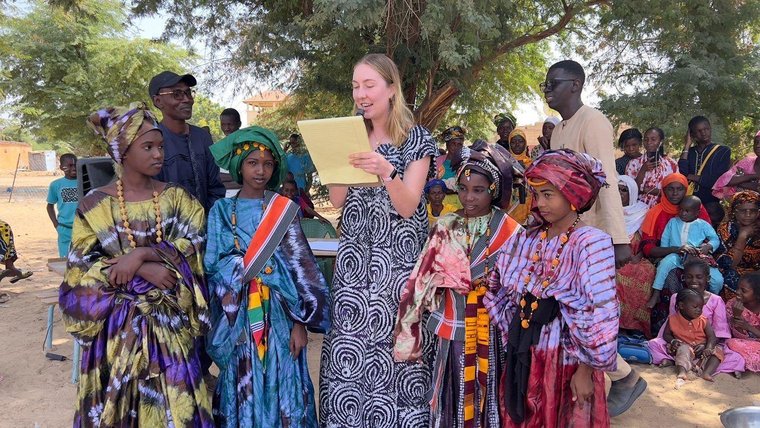
5. What have you enjoyed most about the community where you are serving?
One thing I love about my community is the concept of “ko ennen dendi” in Pulaar, which means “we are all together.” During my Peace Corps service, in October 2024, seasonal floods intensified in my region, destroying homes and displacing people, as well as destroying fields, an important source of income in this agricultural area. Communities came together to support those who had to leave their homes, allowing them to charge phones at their houses and helping them salvage what belongings they could.
Additionally, during the hottest times of the year, when temperatures can reach up to 117 °F, people remain generous, sharing lunch with salespeople traveling by foot through the village during the hottest time of the day. When a child is born, all women in the community come to offer their prayers and celebrate together. When a family loses a loved one, the entire community comes together to cook for them and accompany them in their grief for up to a week. When someone needs to borrow something from a neighbor, the response is often, “No problem, we’re in this together.” Both in good times and difficult, when it really matters, people come together to support one another, are willing to set aside personal disagreements, and everyone chips in for the benefit of the community.
6. What are some of the most important things you’ve learned from your community?
Patience and empathy go a long way when things don’t go as planned. When scheduling meetings for people, I have learned that it is important to tailor the meeting to the schedule of participants. Additionally, I adapt my expectations to the culture. If there is a scheduled meeting and no one shows, I have learned that usually means people have gone to a baptism, wedding, or funeral. I understand that culturally, these are important celebrations to attend, so I will reschedule the meeting and double check before the next meeting that there is no conflict. I understand that for mothers with multiple children at home and sometimes exhausting responsibilities to maintain their homes, it can be hard to leave the house on time for a meeting. I usually will sit patiently underneath a shady tree on a mat and expect that people will show up anywhere from a half an hour to an hour late. In the U.S., this would be considered unprofessional and a sign of low motivation or care, but here having people show up at all, no matter how late, is a huge demonstration of motivation here. Adjusting my cultural lens, being patient and understanding of the various circumstances of life, and having empathy, has gone a long way in helping me maintain good relationships with my community and maintaining motivation in the face of what might otherwise be discouraging.
7. How do you spend time when you are not working on a project?
When I’m not working on a project, I enjoy waking up early to beat the heat for a run, reading books under the shade of an mbara (an outdoor shade structure), or checking in with my fellow Volunteers or friends and family back home. I also try to find time to keep my room clean and organized, as in the north of Senegal it can become dusty very quickly.
Besides those solo activities, I enjoy spending time with my host family and friends in my community. I love exchanging American and Pulaar music with my host siblings, watching Pulaar dramas on television with my host sisters-in-law, and helping out with the household work. Sometimes I’ll help my host family with yard work, other times I’ll help cut up vegetables for lunch or mop. Of course, if the kids want me to participate in a game or teach them ballet or yoga, I will almost always say yes. No matter what the activity may be, if I’m not busy with work and I’m feeling up to it, I try to spend time with people, as togetherness with family and friends is an important part of Senegalese culture.
8. What are you looking forward to in your remaining time as a Volunteer?
I continue looking forward to watching the scholar’s and women’s gardens flourish and holding my final club meetings and trainings for both. As the last Volunteer who will be placed in this village I hope to set them up for longterm success and the possibility to collaborate with other partner organizations in the future. As my time wraps up, I know I will not take any day for granted, and I am excited to continue to build on my relationships in smaller-scale collaborative projects, like the creation of home gardens and tree planting. I also hope to master the art of making marro e liddi or theiboudienne, the national dish of Senegal, with my host family and continue to set a good example for the kids in my community by exemplifying kindness, good humor, curiosity about the world around me, and a strong work ethic.
9. Once you finish service, what will you do differently when you return to the U.S.?
Something I will take back with me from service is the flexible mindset I have gained in the face of setbacks. The moringa tree, a “miracle tree” of sorts, with nutrient rich leaves and nitrogen-fixing roots, provides an apt metaphor: sometimes if a sapling tree trunk is broken, it appears as if the tree may die. I have found that with continued care and watering, the tree usually finds a way to grow new sprouts and leaves. Even when a situation may seem impossible, things often work out with thoughtful and holistic problem solving, and taking a momentary step back to re-think, recharge, and try again.
Want to learn more about serving as a Volunteer in Senegal? Connect with a recruiter today.



