 An official website of the United States government




Featured Volunteer Profile
Katherine H.
“Peace Corps trainings have helped me learn how to approach difficult conversations in a culturally appropriate way, so I feel enabled to communicate my needs and boundaries.”
1. What got you interested in the Peace Corps?
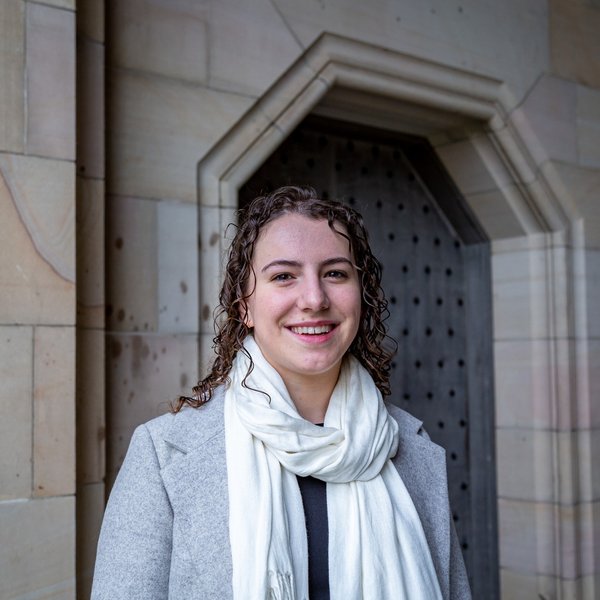
I have always been interested in other cultures and service. After high school, I lived in Moldova to study Russian during my gap year. That was my first experience living in another country for a long time, and I loved integrating into my local community through volunteering as an English teacher. In university, I studied international relations at a university in Scotland for two years, and again, I loved learning about and integrating into a new culture.
In my fourth year at university, I wasn’t sure which jobs to apply for, and a few of my professors recommended that I look into the Peace Corps because of my interests and past experiences. When I got the offer to be a Volunteer, I knew Peace Corps was the perfect combination of my love for service and interest in other cultures. I was interested in Peace Corps specifically because of its emphasis on community integration and participation in service. My school in the Kyrgyz Republic requested a Volunteer for years before I arrived and my service feels more impactful because I know that people in my community worked so hard to get a Volunteer.
2. What projects are you working on?
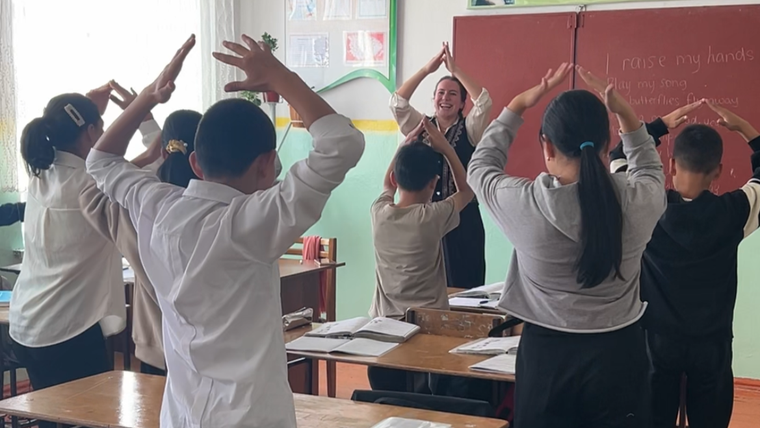
I teach English to 6th-9th grades alongside two local English teachers in the Talas region of the Kyrgyz Republic. When I’m not teaching or planning with my counterparts, I also conduct clubs. I have clubs for students from 5th-7th and 8th-11th grades, and I am looking forward to starting a 4th grade club and a club for teachers who want to learn conversational English. I also host sessions to help prepare students for important exams, like the national Olympiad competition and the end-of-school national exam “ORT.” I also hope to start a project with my community partners to bring more resources to our school community and help students achieve their educational goals.
3. What strategies have you used to integrate into your community?
The main strategy I have used to integrate into my community is just trying to always be friendly and approachable. Although I have worked to improve my Kyrgyz, it’s still hard to have deeper conversations in Kyrgyz, because I’ve only been learning it for eight months. However, I have found that even if I can’t express myself with words, I can use my facial expressions and maintain an open and friendly attitude, which has helped me make connections in my community and has facilitated my integration.
4. What is a highlight of your time in service so far?
The small wins. It’s easy to think of my service in terms of big goals, like helping my counterparts improve their English and teaching methods, or helping my students improve their English. However, it’s impossible to feel like you’re always making progress on the big goals. Small wins have kept me motivated. For example, in lessons, whenever a student who has been struggling with a concept gets a question right and is excited, I feel rewarded and it’s the highlight of my day. Another time I was at my local store, buying chocolate (a regular occurrence, so I see the shopkeeper frequently). The shopkeeper’s three-year-old grandson was there, and since I live close to their house, the shopkeeper asked me to walk him home. I was very happy because it was a sign I had gained his trust. These little events make me feel like I am a valuable member of my community and they are the highlights of my service.
5. What have you enjoyed most about the community where you are serving?
My community is quite large—more than 7,000 people live here. Sometimes it feels intimidating to be the only American in a village that large, where I see people I don’t know every day. However, people have been very welcoming. For example, on my birthday, students from a few grades at school pitched in to buy me cakes, and other students made me cards and helped me celebrate. It was so sweet, and it made a day that I was missing my family and friends at home much easier. Living in a bigger village has also made me feel like my impact is larger. For example, another Volunteer who lives in my region was at a party attended by a man in my village. Although he had never met me, he was excitedly telling the other Volunteer about me. My community has been so welcoming and excited to have me here, which makes me very grateful.
6. What are some of the most important things you’ve learned from your community?
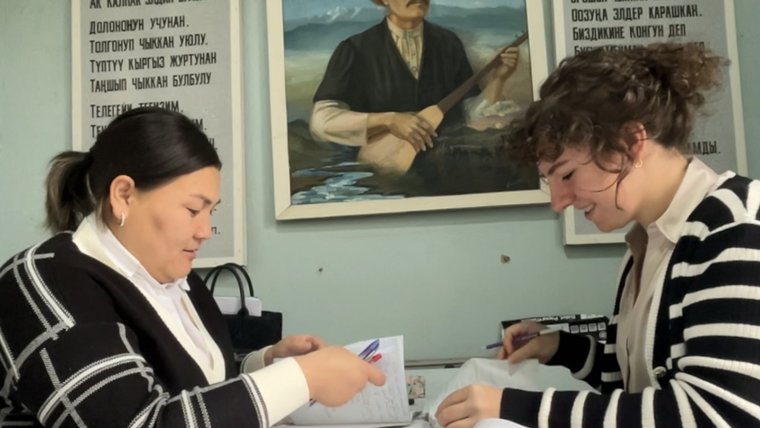
For one, I love how social everyone is. In America, my family doesn’t frequently have guests over for tea or meals, but here, being received as a guest in the village or region is very common. Even though there is always work to do in the village, members of my community make time to build and maintain connections with their neighbors and friends. Sitting around, drinking tea, eating food, and chatting is one of my favorite things to do. Also, people in my community are always interested in how other people in the community are doing. It’s important to ask how someone is, how their health is, how their work is, if they have news, and properly catch up before getting down to business. I appreciate how people in my community are invested in the lives of each other and want to make sure everyone in the community is doing well.
7. How do you spend time when you are not working on a project?
When I’m not working on a project, I love to spend time with my host family. I am not the best cook, so my host mom has taken me under her wing and is trying to teach me how to cook. I haven’t graduated beyond peeling potatoes and cutting carrots, but I hope that after two years I will be able to cook some Kyrgyz dishes. Spending quality time in the kitchen with my host mom is a really nice way to unwind after a day at school. I also like to go for walks around the village when the weather is warm; catch up with the other Volunteers and friends from home; exercise; and read.
8. What are you looking forward to in your remaining time as a Volunteer?
I am excited to continue integrating and being a positive force in my community. This summer, I am excited to conduct summer camps for my students and spend lots of time with my counterparts to help them improve their English. Next year, I am looking forward to building on the progress my students have made this year and becoming even more involved in my school community. I am also looking forward to traveling around Kyrgyzstan by myself, with my family, and with friends from home to show them this beautiful country! And I am excited to continue to grow, both as a Volunteer and as a person.
9. Once you finish service, what will you do differently when you return to the U.S.?
During my service, I have tried to focus on my personal growth and have appreciated how service has created conditions for me to grow. Before coming to Kyrgyzstan, I expected there would be challenges but I didn’t know what they would be. As challenges arise, I try to see them as an opportunity to grow and become a better person, because otherwise the challenges can be discouraging.
I’m also becoming more flexible. I love having a clear, defined schedule, but Kyrgyz culture tends to be less rigid in planning. Sometimes classes are cancelled or unexpected guests come; I try to embrace the unstructured nature of life here, which creates a better balance than being stuck on a schedule all the time.
I have also become better at communicating. Peace Corps trainings have helped me learn how to approach difficult conversations in a culturally appropriate way, so I feel enabled to communicate my needs and boundaries. I know I have grown in the last eight months and am excited to see how much more I will grow over the next year and a half. I hope this growth will help me approach life differently when I return to the U.S.
Want to learn more about serving in the Kyrgyz Republic? Connect with a recruiter today.



