 An official website of the United States government


Featured Volunteer Profile
James G.
“Prior to service I tended to observe from the outside, but some of my most laugh-inducing moments in Zambia have been when I saw something and jumped in.”

1. What got you interested in the Peace Corps?
A few of my professors at Oklahoma State introduced me to the Peace Corps and international work. My first advisor was a Returned Peace Corps Volunteer who actually steered me into forestry. He later retired and did Peace Corps again with his wife. Another professor gave a lecture about his work with an NGO that taught fuel efficient cookstove construction in South America.
Later on in college, I began working at a food and resource center. I started in the community garden and then later went on to co-create a mobile food distribution program. During that experience I thought a lot about food: where it came from, the politics of it, large-scale systems, and also how people, on a more micro-scale, interact and plan around food.
As I approached graduation, I thought about how I could use my degree and experience in food systems. Peace Corps seemed like it could combine all the things I had been thinking about throughout my time in undergrad.
2. What projects are you working on?
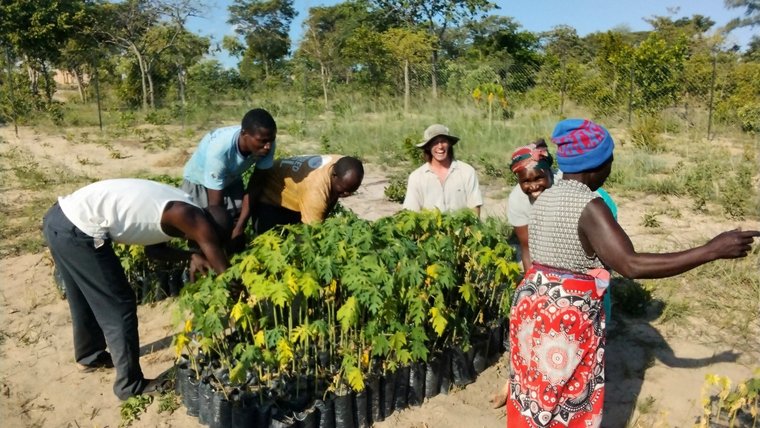
I live in Southern Province, Zambia. My village’s main project at the moment is a community tree nursery and garden. I replaced a Volunteer in 2023 who had received a grant to help create the space and supply some materials. We are mostly focused on fruit tree production and have over 1500 seedlings! The main idea is to have a protected and central place for the community to learn different aspects of tree planting and gardening. Many of the technologies we learn as Volunteers are based on organic methods and utilize the surrounding environment as much as possible.
3. What strategies have you used to integrate into your community?
I walk around the village to interact with different families and farmers in the area. I try to spend as much time getting to know people and their circumstances as talking about programs. I try to play football (soccer) and typically look like a goof. I try to use the local language as much as possible, though I end up doing a lot of miming. I attend PTA meetings at the school and help my host family weed their fields. I guess I try to be “around.”
4. What is a highlight of your time in service so far?
The biggest highlight of my service is undoubtedly my resource family. They are the light of my day-to-day in the village. My resource mother especially is an incredible person. Though she speaks very little English, we joke around and share laughs. We do chores together and some of my most memorable moments have been shelling groundnuts (peanuts) while we watch the sunset.
Occasionally I make popcorn and we watch a nature documentary as a whole family. We all share a love for elephants so anything featuring them is highly requested.
5. What have you enjoyed most about the community where you are serving?
Beyond community members, many of whom deserve their own stand-up specials, I love exploring the area. It reminds me of home but also surprises me in little moments. I love watching birds flutter about in the morning. I love going on walks through the forest and finding snail shells or a unique view. It is generally quiet but is often punctuated by cow bells and laughing children. My village is rather spread out, which can pose some challenges, but also affords me more time in going from place to place.
6. What are some of the most important things you’ve learned from your community?
I have learned what it looks like to be truly resilient. My community members interact with and rely heavily on the physical environment and weather, both of which are becoming increasingly less predictable and are changing rapidly. I see people fear their circumstances but continue to work. Giving up is not really an option and it is both incredibly inspiring and slightly painful to see people make the decision to try every day. I also have realized how powerful and important a community can be. A lot of people volunteer their time and effort to make the community better. When I return to the U.S., I want to find a way to be involved in whatever community I live in.
7. How do you spend time when you are not working on a project?
A big personal project during my community entry was to make a small pizza oven. I made a brick form and with the help of my resource brothers and sister made about a hundred bricks. I hand-shaped and set each brick into what I think is a rather aesthetic little oven. So far, I’ve baked bread and cookies to varying degrees of success.
I enjoy drawing with children and trying to improve my local knowledge. A fair amount of time is spent reading and having a cup of coffee. Somedays I chit-chat with my counterpart and explain various aspects of life in the U.S. When I’m truly exhausted, I lay on the floor of my house and watch the lizards that live in my roof.
8. What are you looking forward to in your remaining time as a Volunteer?
My community has big goals for the expansion of our nursery. I’m excited to continue improving the project and strengthening the community’s capacity through teaching. I love when a community member takes ownership of an aspect of the project or teaches me something new for us to try in the nursery. I’m looking forward to more of those moments.
Personally, I’m excited to go on safari and possibly climb Kilimanjaro. This area of the world is so spectacular and vibrant I want to soak up as much as I can. Lastly, my parents want to visit me, and I can’t wait for them to see my home and experience a little bit of what my life is like in Zambia.
9. Once you finish your service, what will you do differently when you return to the U.S.?
One large impact my service has had on me so far is improving my comfort in uncertain situations. I feel I am more decisive and likely to stick up for myself. I am also now more likely to see something fun or interesting happening and investigate. I want to do more of that in the U.S. Prior to service I tended to observe from the outside, but some of my most laugh-inducing moments in Zambia have been when I saw something and jumped in.



