 An official website of the United States government


Featured Volunteer Profile
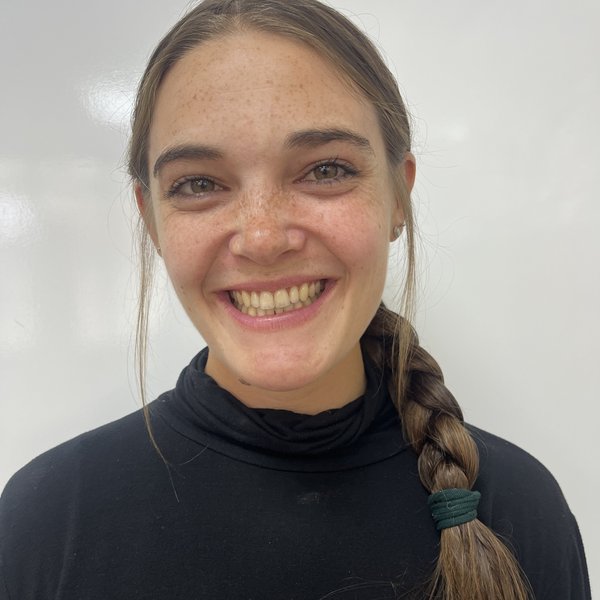
Lucie R.
“In the U.S., life often feels rushed, and we rarely take the time to have long, impromptu conversations. There is always someplace to be, something to do. Where I live in Peru ... those spontaneous conversations are the heart of daily life.”
1. What got you interested in the Peace Corps?
I grew up hearing about the Peace Corps, as my dad served in Mauritania back in the late 1980s. After attending one of his Peace Corps reunions during high school I knew it was something I wanted to do. Every Returned Peace Corps Volunteer I met spoke about how their service not only propelled them into their career, but also changed their lives and created connections with people across the globe. It was an energy I wanted to be a part of.
I can also thank my mom for where I ended up, as she inspired my interest in public health and Spanish from a young age. Those three passions—international work, public health, and Spanish—naturally brought me to Peru as a Community Health Volunteer. It has been the perfect opportunity to use my studies in a different context while fully diving into Spanish and learning about Peruvian culture. There are few opportunities out there which allow you to fully, 100% commit to such learning.
2. What projects are you working on?
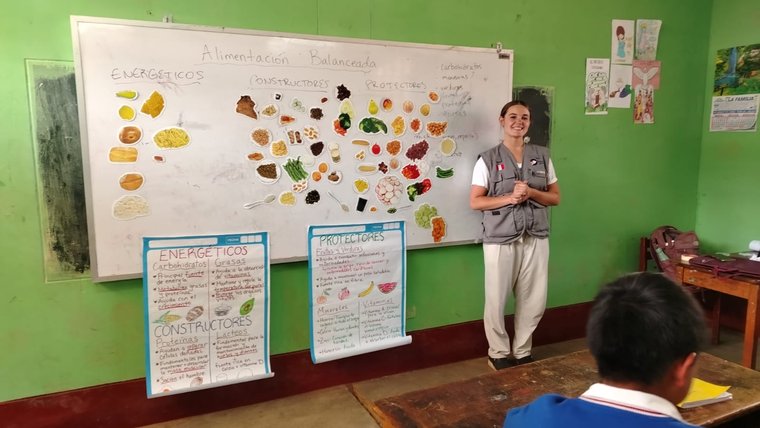
For the past two years, my work has centered around two areas: anemia prevention and youth health promotion. The youth work included classes on nutrition, mental health, and sexual and reproductive health for students 12-17 years-old, while the work against anemia – one of the most serious health challenges in rural, mountainous Peru – focused on nutrition sessions and campaigns for pregnant women and children under 5.
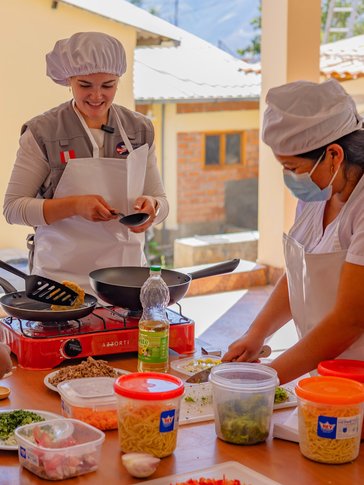
I also focused on trainings for community health workers (CHWs), emphasizing the importance of iron-rich foods. In my second year, I received a Peace Corps grant to implement CHW training sessions in each of the six health posts across the district. We used affordable, iron-rich, locally available ingredients to cook dishes such as blood fried rice and liver omelets (don’t knock it ‘til you try it!). The project culminated in a district-wide nutrition fair where health personnel and CHWs from each health post presented their dishes to local authorities and community members. It was a huge success, and one of the highlights of my service.
This year looks a bit different, as I extended for a third year as the region’s Peace Corps Volunteer Leader. I now live in the regional capital and work at a larger health center as part of their health promotion team. So far, we’ve trained more than 30 CHWs and coordinated with 8 schools—from preschool through high school—to provide health training to teachers, parents, and students during the coming school year.
3. What strategies have you used to integrate into your community?
Looking back on the past two years, I think I can boil successful relationships down to three ideas: being curious, being kind, and allowing myself time to recharge. I truly wanted to get to know people and learn their stories. And I allowed people to get to know me. I was as transparent as possible with who I was, why I was there, and where I came from. Little by little, I and the people around me let our guards down.
Soon enough, women in town were yelling greetings to me in Quechua because they knew I could respond (even if it were one of just 10 phrases I knew). I would play with kids I knew after school. My health colleagues knew I wanted to stay a bit longer to prep for the health campaign the following weekend.
At first, I said yes to just about anything—food when I was full, events when I was tired, conversations with my elderly neighbor when all I wanted was to turn my Spanish brain off. Peace Corps taught me a whole new meaning to “burn-out.” You are socially “on” almost all the time. And that is why, after a few months, I learned to take time to myself. Whether it was time in my room, a run, or a phone call home, those moments of recharge were essential to being fully present with the people around me.
4. What is a highlight of your time in service so far?
As the youngest of five in my family, and the only girl, I always wanted a little sister. During my time with my first host family in Peru, I gained two: Elena and Miriela. I will never forget their names. On my first day in town at a school bingo event I sat next to a little girl who kept side-eyeing me and giggling. Elena eventually worked up the courage to ask who I was, so I taught her how to play bingo. Miriela was part of my host family who lived down the road, and I would visit her at least once a week to prep for her English class or hang out during family lunch on the weekends.
I found myself seeking out Miriela and Elena at community events. These little 7- and 9-year-olds were my safe haven, my family, my friends. Especially when I felt like the odd one out. It’s funny to say, but these little girls did more for me than they’ll ever know. I plan to stay in touch with them and cannot wait to see them grow up. If I’m lucky, I’ll even get an invite to their quinceñeras one day.
5. What have you enjoyed most about the community where you are serving?
As a third-year Volunteer my new community is much different, but one thing has stayed the same – the views. They are absolutely unmatched. My favorite thing is going to the roof early in the morning before the town wakes up, or late in the afternoon when everyone is back home or out in their farms.
From the rooftop, I can see steep hills and snow-capped mountains on the other side of the valley. At night, I can see cars driving high up in those mountains, or house lights so high I initially mistook them for stars. I don’t think I will ever again have the privilege of living in a place like this, and I truly don’t take it for granted.
6. What are some of the most important things you’ve learned from your community?
First, there should always be time for people. In the U.S., life often feels rushed, and we rarely take the time to have long, impromptu conversations. There is always someplace to be, something to do. Where I live in Peru—and likely in many Volunteer sites—those spontaneous conversations are the heart of daily life.
Second, there's a saying in Spanish, "a barking dog doesn’t bite, a silent dog does." I heard it many times, but never truly believed. Unfortunately, after being bitten three times during service—which may be a Volunteer record—I learned the hard way. Two of those three times, the dog snuck up behind me and bit without making a peep. It’s a lesson I won’t forget.
7. How do you spend time when not working on a project?
I’m currently training for a marathon, so outside of work you can usually find me huffing and puffing up the many hills around town—at over 10,000 feet of altitude. I also have a 6-month-old cat that I adopted last year, and he can be quite the handful. And finally, since moving into my own place this year, I’ve rediscovered my love of cooking. I didn’t get to cook much while living with a host family, so I have been spending lots of time experimenting with all the fresh ingredients Peru has to offer.
8. What are you looking forward to in your remaining time as a Volunteer?
I’m looking forward to soaking up as much of Peru as I can. Now that I live in the regional capital, there is even more to see and do. Walking through the streets, there are the constant sounds of music, laughing, honking. Sometimes it can be overstimulating, but I know it is something I’ll miss when I leave. I want to stay present and savor these next 10 months because I know they will fly by.
I’m also excited about all the learning opportunities at the new health center. While I still work within health promotion, the work here is broader: coordinating with multiple schools, training a larger group of community health workers, holding larger-scale nutrition sessions, and digitizing health records. The work is faster-paced, an exciting switch-up.
9. What will you do differently when you return to the U.S.?
I hope to bring a bit of Peru’s energy back home with me. I want to dance more, laugh more, go out of my way to talk to my neighbors.
I also want to be more intentional about the food I consume. Where I live in Peru, you buy directly from the person who sowed the crop, whereas in the U.S., accessing local food can be more expensive and less convenient. I think staying connected to the source of what we eat is important, and it’s something I don’t want to lose once back home.
Learn more about serving as a Peace Corps Volunteer in Peru.



