 An official website of the United States government




Featured Volunteer Profile
Rian S.
“Embrace your curiosity, embrace discomfort, and have confidence in yourself to do the hard thing because [the Peace Corps] will change your life in the best way possible!”
1. What inspired you to apply for this Peace Corps position?
I have always wanted to do the Peace Corps and have a passion for health-related topics. Therefore, when I saw this opportunity, I knew it was for me. I learned about the Peace Corps from a very early age and the idea of completely immersing myself within another culture on a different continent was so exciting. I also knew that I wanted to work in a supportive role, and the Peace Corps framework and timeline spoke to me because I wanted to make a lasting impact which can only be achieved through a deeper understanding of a community. I knew that anything short of one year would not be enough time for me to cultivate lasting relationships. Peace Corps checked every box I could possibly think of and now that I am here, I’m starting to wonder if two years is too short!
2. Tell us about a moment that sticks with you from the first week at your site.
A moment that sticks out to me from the first week was my welcome ceremony. Women and drummers arrived at my house, and then we then paraded through town, gathering community members as we went. We ended our tour at the chief’s palace, where community elders and prominent figures awaited us. With the whole community gathered, women began performing a traditional Dagomba dance and the chief formally welcomed me as a new member of my community. It was such a beautiful ceremony, and I instantly felt the love from my community. It set the tone for the rest of my service, and I am still so grateful for how quickly I was taken in.
3. What projects are you working on?
My main job is working on health promotion and health education projects. I primarily focus on working with women and children through clubs, support groups, and assistance at the local clinic. I am currently working on installing boreholes to supply a water source at the school and adding a maternity ward to the community clinic.
4. What strategies have you used to integrate into your community?
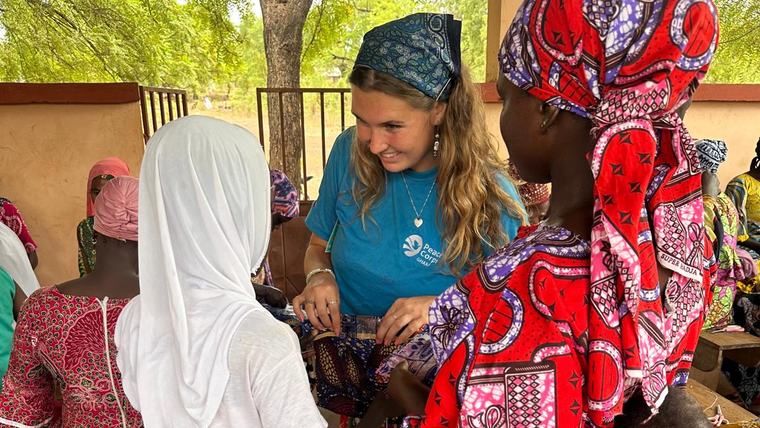
My favorite strategy is to shadow a community member throughout their day. Many days I will greet people in the morning and then find a community member I haven’t spent time with recently and spend the day helping them with daily tasks. Typically, we will farm, prepare food, wash clothes and bowls, shell peanuts, and see more people. This activity helps me strengthen relationships and gain a greater understanding of the rhythms of daily life.
5. What’s a typical day like for you?
Depending on the day, I either start my day at the clinic, the farm, or the school. I work on activities until the sun starts to come out around noon. Then I go home to cook myself lunch, and in the afternoon, go to the school or clinic, both of which are inside so I stay out of the sun. After school or when the heat begins to lessen, I walk around and greet community members. In the late afternoon or early evening, I typically have health club meetings with various groups. By evening, there is usually some sort of celebration, such as a wedding or naming ceremony, and I always attend these festivities.
6. What is a highlight of your time in service so far?
My highlight so far has been working with the kids at the junior high school. I help teach at the school and have an after-school health club which nearly all my students also attend. They are so full of energy and have a beautiful passion for learning new things. Their spirit is what uplifts me on difficult days. They have made my own journey as a Health Volunteer more fun and exciting.
7. What have you enjoyed most about the community where you are serving?
One thing I have enjoyed the most about my community is cooking and eating with people. Preparing and eating food is an activity that helps bring people together. Not only do you eat with friends and family, but you eat out of the same bowl, which emphasizes the feeling of togetherness. The food that is prepared is also a team effort. Women take turns stirring the “tuo zaafi” soup, sharing the responsibility of making sure it is tasty. Meal preparation is not just a time for cooking but a time to come together, laugh, and unite with a common purpose. I love being part of it.
9. What are some of the most important things you’ve learned from your community?
One thing I have learned from my community is the practice of constant care and support for the people in your life. Everyone truly looks out for each other. Helping a neighbor, friend, or family member isn’t a burden, but a privilege. If a child is crying, any woman will immediately start tending to that child without a second thought. If someone is struggling to carry a heavy load, whoever is nearby will instantly rush to help. There is never the expectation of a reward for helping; it is given out of a deep sense of mutual support.
10. How do you spend time when not working on a project?
When I don’t have anything official on my schedule, my favorite activity is shucking peanuts with women in my community. Peanuts are one of the main crops harvested in my community and to make peanut butter, they have to be shelled. It’s a manual process done primarily by women. Shelling usually takes place under a large tree, out of the midday sun. It is the perfect activity to do in the shade, while talking and joking with other women. I can spend hours shucking peanuts and have established some of my strongest relationships with women through this process.
11. Tell us about the strongest relationship you’ve developed while in country.
My strongest relationship is with my “grandmother” Sharatu. I met her on my very first day. She knocked on my door, locked arms with me, and led me through the town to my welcome ceremony. The second she took my arm in hers, I knew I was safe, and she has been my safe space ever since. Sharatu was the first person I went to farm with, the first person I cooked with, and the first person I went to a community celebration with. She completely took me under her wing and, even though she doesn’t speak English, we get along and laugh as if we were related. Our favorite thing to do together is dance with each other at community celebrations. Although I am not the best dancer, she cheers me on and gets just as excited as the first time we ever danced together. Sharatu has a smile that lights up this whole world and it’s impossible to be sad when you are around her.
12. What are you looking forward to in your remaining time as a Volunteer?
In my first year I was focused on developing relationships within my community. Now that I am in my second year, I am really excited to strengthen those relationships. Everyone has been so welcoming and kind to me, and I want to reciprocate that love and appreciation. I think the best way to do so is to keep spending quality time with people and show up to support them just as they have done for me.
13. Tell us your favorite phrase in the local language.
My favorite phrase in Dagbani is “tidima,” which translates to “let’s eat.” Whenever someone is eating, they will invite anyone to share their meal, no matter how small. Even if it is a few peanuts, if there are people around, they will announce “ti dima” to express that everyone is welcome to have some. Even if it is someone’s last piece of food, without second thought, they will give it to someone else if asked. This ensures that nobody ever goes hungry or feels left out during meals. I find this so beautiful and now always invite people to share whatever I am eating.
14. What will you do differently when you return to the U.S.?
There are so many things I have learned from my community that I want to hold onto for the rest of my life. One thing will be the practice of unconditional support and sharing. There is no obligation to share or support one another in my community; it is a deeply ingrained practice that is done without second thought. Whether it is food, clothes, toys, farm supplies, or bikes, the idea of “what’s mine is yours” is so strong. I also think that placing less importance on material items and redistributing material wealth to others is such a beautiful and happy way to live. I want to bring this philosophy back with me and incorporate it into my everyday life because it really strengthens relationships.
15. What would you say to someone thinking about joining the Peace Corps?
I would say DO IT!! If you are even a little bit curious about experiencing a different lifestyle, discovering new foods, learning new languages, and making new friends, then the Peace Corps is waiting for you. It has helped me understand how much the world has to offer and how much opportunity and excitement there is in getting out of your comfort zone. Embrace your curiosity, embrace discomfort, and have confidence in yourself to do the hard thing because it will change your life in the best way possible!
Learn more about serving as a Peace Corps Volunteer in Ghana.



