 An official website of the United States government


Featured Volunteer Profile
David K.
“Creating a business that will create jobs for Liberians and help reduce their dependence on foreign oil is deeply rewarding.”

1. What got you interested in the Peace Corps?
I want to provide service to my country. I also want to support the Peace Corps’ primary goal: to help developing countries meet their need for trained people. In my case, to help instruct technical and chemical professionals and develop the physical (i.e., lab) and intellectual (i.e., syllabi and classroom lecture materials) resources for such training. I also want to help this developing nation make job-creating businesses based on industrial chemistry.
2. What projects are you working on?
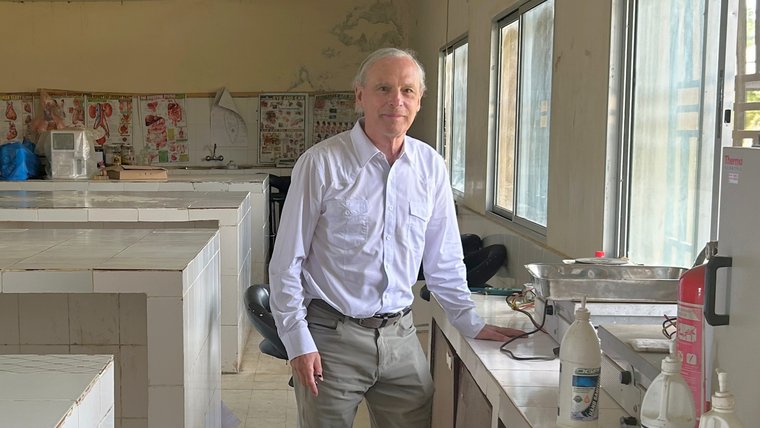
I am helping a university evolve from a 2-year community college to a 4-year college. I will be teaching multiple upper division chemistry and biochemistry classes, some offered for the first time at this university. And I will assist in the design and construction of new laboratories for advanced chemistry and natural science classes.
I have initiated and facilitated a project to synthesize diesel fuel from vegetable oil (i.e., biodiesel). At the university, we have demonstrated both the synthesis of biodiesel from palm oil, and the efficacy of the fuel to power a generator engine. I have coordinated a relationship with Nikua Training Center (Corvallis OR) to provide a pilot-scale reactor (50-gallon batches; initial production 150 gallons per week, scalable to 600/week), which will ship in January 2026. The university and Nikua will then coordinate on a 100-gallon reactor. This will be a 100% Liberian-owned and operated for-profit business.
I have also worked with a local lumber supplier, Liberia Logging and Specialty Woods Company, to evaluate Liberian woods as lutherie materials (i.e., to construct guitars, violins, etc.), determining workability, aesthetic, tonal, and physical property characteristics. This will open a new market for lower volume, higher value wood products.
3. What strategies have you used to integrate into your community?
Stopping and talking with everyone who greets me. Trying to learn more about the land, the food, the local agriculture and mining. I have attended a local church to meet new people from the community.
Listening. Hearing the needs of the community and then applying Silicon Valley experience to offer technical solutions.
4. What is a highlight of your time in service so far?
- Teaching sophomore, junior and senior-level chemistry and biology courses. Getting to know the students and imparting a love of science and engineering.
- Demonstrating the synthesis and performance of biodiesel derived from Liberian palm oil. Establishing the foundation for a for-profit Liberian-owned and operated job-creating business.
- Designing a lab for my host university, which will include the first chemical fume hoods on-site, a necessity for advanced chemical experimentation.
5. What have you enjoyed most about the community where you are serving?
I have most enjoyed the warmth, kindness, and friendliness of the people here and the genuine welcome that they have given me. And their singing. I have gone into the schools and church with my guitar and banjo. I’ve had a wonderful time with the students and fellowship.
6. What are some of the most important things you’ve learned from your community?
To be friendly and open; to take interest in others and give the time to be so.
7. How do you spend time when you are not working on a project?
Sleep. I read. And I play my guitar and banjo.
8. What are you looking forward to in your remaining time as a Volunteer?
Just as in the U.S., I am very excited to teach the university classes, to discuss advanced chemistry with the students, and to share with them my love of chemistry and applied science.
I am doubly excited to help build and supply a new laboratory and to leave the university with a new capability for teaching.
And the biodiesel project. Creating a business that will create jobs for Liberians and help reduce their dependence on foreign oil is deeply rewarding.
9. Once you finish service, what will you do differently when you return to the U.S.?
I know that I will have changed and grown from my service. I hope that I can share my knowledge and experience with others in the U.S. to promote understanding.
I’m going to learn how to make guitars at the Roberto-Venn school in Phoenix. Maybe I’ll come back to Liberia to make guitars, to build a business. Liberia has excellent wood, very cheap labor, and an excellent port for export. It may be possible to build guitars in Africa, with African woods, by African hands, and of course, I will ensure that any business will be 100% African-owned.
Find out more about serving as a Peace Corps Response Volunteer in Liberia or elsewhere.



