 An official website of the United States government


Featured Volunteer Profile
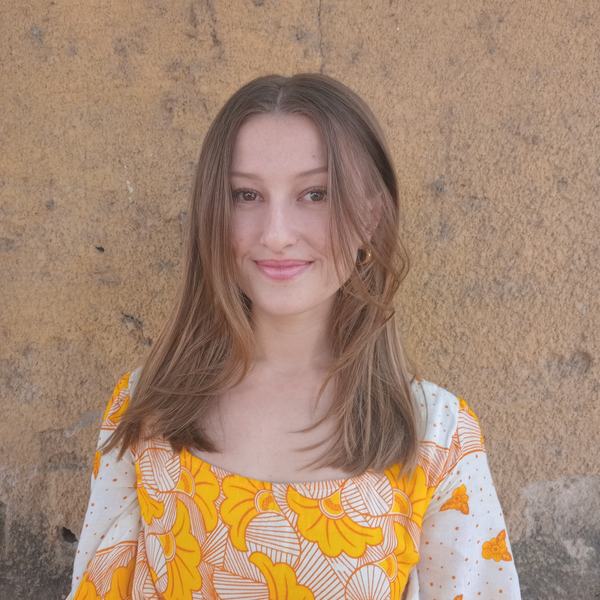
Ella M.
“As a woman serving a community that adheres to strict gender roles, I have learned how to adjust my self-presentation in order to communicate respectfully and collaborate effectively while maintaining my own authenticity.”
1. What inspired you to apply for this Peace Corps position?
Growing up in a tiny town on the coast of California, I had never travelled outside the state, let alone the country, nor could I really imagine doing so. I distinctly remember my third- grade self, eavesdropping on the adults' conversation, as a family friend described his time in Morocco as a Peace Corps Volunteer. He told a tale of weekly bath house visits and foods I had never heard of, and spoke of a new language and new friends. It sounded daunting, like an entirely different world separate from my own small one; I remember thinking, “That's cool, but it’s not for me.”
Throughout my teenage years, though, I had the privilege of pushing myself to go beyond my comfort zone in measured steps: backpacking throughout California, attending college on the other side of the country, and conducting field research in the jungles of Belize. These experiences stoked my curiosity and built my confidence, and the world expanded before my eyes. I had developed a lasting appetite for the feeling of accomplishment that comes from overcoming my self-imposed limits.
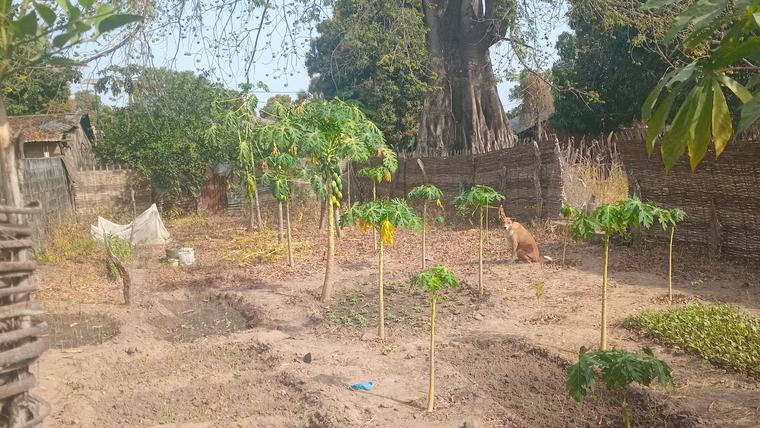
As a college senior facing down the prospect of entering “the real world,” I knew that I wanted to apply myself to the issue of environmental sustainability in theory, but I wasn't sure how to make a meaningful impact in practice. Searching for direction, I applied to the Peace Corps post that best fit my professional interests, regardless of location, and here I am in southern Senegal. As I write this, a hot wind is rustling the leaves of the mango tree overhead, and my host sisters are joking in Mandinka as they cut up a papaya from our garden to share. My route to the Peace Corps was not a linear one, but after a year and a half at site, I wouldn’t exchange this path for any other.
2. What projects are you working on?
My work centers around environmental education, with a focus on increasing community capacity for sustainable natural resource management. The farmers in my village are incredibly knowledgeable and resourceful, and finding ways in which my skills and resources could best serve the community meant talking to just about everyone. I visited neighbors, schools, and women's gardens, I attended weddings and Kankuran parties, and I listened. My host family and I established a family garden modelling agroecological techniques such as soil amending and alley cropping. Then, as community interest grew, I partnered with women's groups and schoolteachers to co-facilitate skills training.
One of the first trainings we held was a shade tree planting class at the village elementary school, with a local farmer and two dozen students. That first training was organized chaos: dirt was flying and children were clamoring to help place the sapling’s roots in the ground. The students’ excitement was infectious, and by the end of the training, 24 children could all explain why trees are important, knew how to take care of them, and had together planted three saplings in front of their classrooms. Over the following weeks, one tree thrived, one struggled, and one was obliterated completely by an especially animated game of soccer. I outplanted a replacement sapling in the predecessor’s place and returned the next day to find it had been snapped in half as well, though I was struck to see that the students had reinforced the protective fencing and bandaged the damaged trunk, which survives to this day.
I am currently partnering with the school director to pursue a grant that will support a project I am eager to work on in collaboration with the village elementary school: the installation and maintenance of a school garden. This project connects the school director, teachers, farmers and a women's group to produce nutritious fruits and vegetables on site through sustainable agroecological methods; will expand the school canteen program to meet the demands of a quickly increasing student population; and deliver hands-on classes on sustainable natural resource management techniques. As I build trust with my community and we deepen our ability to collaborate effectively, I am excited to see our school garden project through to an impactful conclusion that can be sustained and developed long after I leave.
3. What strategies have you used to integrate into your community?
I recommend abandoning any feelings of embarrassment entirely. Integrating into my Mandinka-speaking community after just two months of training, I made my fair share of missteps as I learned the language and navigated cultural expectations. The joking culture of Senegal is quite conducive to newcomers with easy going attitudes, and I quickly realized the most appropriate way through these moments was recentering myself in my humility and having a good laugh at my own expense. Novel activities soon became routine, from waking up early to join my neighbours milking their herd of cows before breakfast, to playing chicken with the village kids and the resident machete-wielding, bark-clad forest spirit known as the Kankuran.
As my Mandinka improved, suspending my own cultural assumptions in order to prioritize those most important to my host community allowed me to continue to deepen my integration. “Terango,” the Mandinka word for hospitality, is central to Senegalese culture. It means not only treating guests like family, but also with generosity and acceptance. In moments where cultural differences feel especially pronounced, and setting aside jokes for a more in-depth conversation feels appropriate, my host community and I are quick to offer each other empathy and an open mind, creating opportunities for deeper mutual understanding and respect.
4. What is a highlight of your time in service so far?
I had the opportunity to connect my community-level work to broader international initiatives as a Volunteer representative at the annual Peace Corps partner meeting, discussing Senegal's current development objectives and how to best serve them. With the dust of my village still coating my shoes, I stepped into an air-conditioned, fluorescent-lit room and was met by the buzz of French, English, Wolof, Pular and Mandinka spoken among 60 people. The room quieted and the conversation narrowed to French as representatives of gathered agencies and ministries delivered opening remarks. I presented my work at site in Mandinka and English, which my director translated to the room in French. In this presentation, I applied my experience to assess and demonstrate current program efficacy, and to identify opportunities for stronger collaboration between Peace Corps Senegal and its government and non-government partners. Over the course of two days, we discussed the intersectionality of environment, agriculture, health, and community development, and opportunities for collaboration to deliver bottom-up solutions to the complex issues that communities are facing.
I was moved by the dignity of five different languages being represented around one table, and the inherent strength of initiatives that are rooted in comprehensive representation and community empowerment. This was a pivotal moment for me as I began to understand how my work as a forestry and environmental change agent actively contributes to global solutions, and the significance of everyone's small role within this larger picture.
5. What have you enjoyed most about the community where you are serving?
In Senegal, lunch is the most important meal of the day. It is the most social meal, when family and friends break from work to eat together around one bowl. The bowl is filled every afternoon with rice, and goodies are piled at the center—generally fish, sometimes vegetables, and chicken or goat on special occasions. We sit shoulder to shoulder and eat from the space directly in front of us while one person, usually a child, is assigned to dole out whatever is in the middle evenly. Adults correct children on their manners if they overstep the invisible line between their rice and that of the person next to them or, most grievously, if they inadvertently pull the bowl closer to them, disrupting the entire circle’s dining experience.
I have most enjoyed my host community’s commitment to the group over the individual, an ethos whose importance is exemplified in this ritual. Breaking up and distributing the fish, sweet potatoes and bitter tomatoes with the fingers of my right hand and reaching across the bowl to place them in front of each member of my host family was one of the first times my host mother remarked, “You’re Mandinka now!” Transitioning from guest to community member, it has been an honor to be welcomed into a tight-knit community that celebrates and supports one another, demonstrating a capacity for resilience and joy that inspires me.
6. What are some of the most important things you’ve learned from your community?
In a village as tightknit as mine, personal and professional responsibilities are inextricably intertwined, making balance essential. My host compound alone houses multiple generations and family lines, my host father is the village chief, two of my host aunts are the presidents of local women’s groups, and our next-door neighbor is the school director. Growing up in a tiny town, I was already familiar with the generous reciprocity of a deeply interconnected community, but translating that give and take to collaborate professionally was new to me. To do so in an unfamiliar language and culture, my host community challenged me to rise to a new level of self-awareness and adaptability.
My community has taught me how to exercise flexibility in my own cultural viewpoints and tendencies. As a woman serving a community that adheres to strict gender roles, I have learned how to adjust my self-presentation in order to communicate respectfully and collaborate effectively while maintaining my own authenticity. As a newcomer, I learned to incorporate the unspoken rules of my village into my expectations and expressions, facilitating more conducive professional partnership. I distinctly remember sitting dejectedly in the shade of a mango tree waiting for the elementary school teachers to arrive for our project planning meeting. After 30 minutes I was sure they wouldn't show, only for ten men in crisp boubous and one woman in a flowing dress to stroll through the gate 15 minutes later, greet me warmly and look to me expectantly for our meeting to commence. It is widely understood that meetings start up to an hour later than specified, and are automatically cancelled in the event of a baptism, wedding or funeral. Neighbors and family are eager to lend each other a helping hand, but if one must say no, “yes, tomorrow” is the most polite way to say "unfortunately, never.”
7. How do you spend time when not working on a project?
Most evenings I enjoy walking my host family’s dogs along the river a few kilometers from my village. My route winds through millet fields and cashew orchards, though my strolls have been cut short recently due to a booming baboon population. After my first troop encounter, I sought advice from a farmer returning from his field deep in baboon territory. He was driving his moto down the dusty sand track, trailed by three shaggy brown and white dogs who detoured to greet mine. He informed me that while baboons are generally not aggressive towards people they do attack dogs, and after I politely declined his initial suggestion that I acquire a flare gun, he pulled a large handmade sling shot of woven plastic out of his bag. Sensing my skepticism, he picked up a large rock from the edge of the path, and with just two swings of his arm sent it sailing at least one hundred feet across the cracked mud flats. He grinned as I clapped with glee and assured me I could master the skill myself. Outside of work, I hope to capitalize on this unique opportunity to achieve sling shot proficiency.
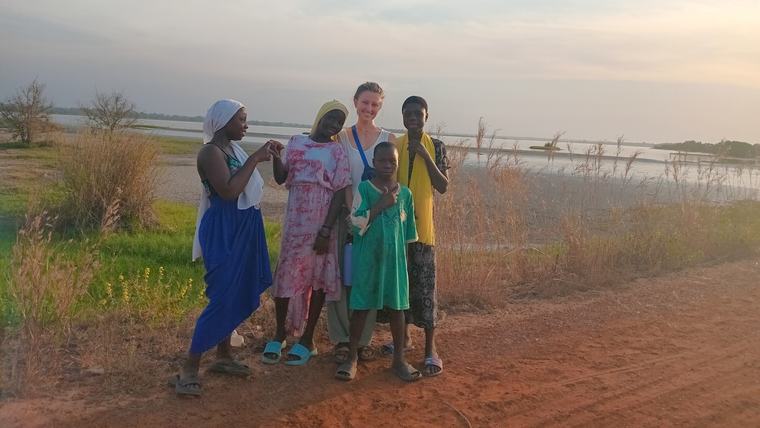
8. Tell us your favorite phrase in the local language.
When I first arrived at site my host sisters helped me install a curtain over my window by hammering nails through the top two corners of the fabric into the cement wall behind. I asked them how to say that in Mandinka and they replied, giggling, “Prekko peng peng boon bala.” I began to giggle as well, because I absolutely loved the way it sounded when I spoke it out loud. I asked if I could tell people to “go hammer a nail into a wall” as a joke, wondering if the phrase was perhaps the Mandinka equivalent of “go kick rocks.” Grinning, they responded, “yes, you should!” I proceeded to tell everyone I deemed a little too entertained by my shaky Mandinka, “Go hammer a nail into a wall” receiving reactions ranging from slight confusion to raucous laughter.
A few weeks later I was back at the Thies Training Center with the rest of my cohort for in-service training. I mentioned to my language instructor that I had a new favorite phrase in Mandinka: “Ta prekko peng peng boon bala!” He let slip the same giggle my host sisters had, informing me that it was indeed a common saying, but with an innuendo of a very different kind. One I had now unknowingly said to about half of the village.
9. What will you do differently when you return to the U.S.?
When I first arrived in Senegal life felt so different and difficult compared to my life back in the U.S. But gradually, the similarities began coming into sharper focus than the differences. When I introduced my dad and my host father over a video call I was gratified by the mutual understanding on their faces when I translated that both are masons by trade. I had largely forgotten my own reality of growing up in a cabin powered by a lone solar panel prone to running out on cloudy days, until I found myself trudging through the deep sand to exchange a grapefruit for the use of my host neighbor's coveted solar battery to charge my phone.
Having pushed through my initial discomfort, Peace Corps service has allowed me a clearer view of myself, others, and the realities of effective international environmental work. I have identified the direction I was searching for: building international partnerships to foster environmental sustainability on a global scale. I am constantly inspired by the strength my host community demonstrates in their resourcefulness and capacity for joy in an unforgiving climate, and the hopeful implications of that resilience for the future of environmental sustainability. After the Peace Corps, the thing I will do most differently is incorporating the purpose and perspective that my two years of service has given me, not only in my world view, but in my work moving forward. I am currently exploring options to extend my service to a third-year transfer post when my time in Senegal concludes. I want to apply the lessons my host community has taught me to environmentally sustainable projects on accelerated time frames in new locations.
10. What would you say to someone thinking about joining the Peace Corps?
In my view, being curious, flexible, and resilient is more likely to help you succeed on a daily basis throughout your service than a relevant academic background. Relevant experience is what will inform a great deal of your work as a Peace Corps Volunteer, and that definition may be broader than you think. For example, I spent a year between college and the Peace Corps working on an ambulance as an EMT, a profession completely unrelated to agroecology. However, walking through the door to treat my first patient and stepping out of the car to meet the Mandinka family I was to live with for the next two years were two situations with one thing in common. Despite months of training, in both of those wide-eyed moments I felt wildly unprepared for the responsibility I was entering into. Developing a practice of situational judgement, self-awareness, and empathy when interacting with patients and their families continues to serve me in my ability to stay calm and effective in the inevitably challenging moments of Peace Corps service. In pre-service training, as you and your fellow Volunteers prepare for service together, I think you’ll find that discussing how best to meet different challenges is better informed by a more diverse set of backgrounds and skills.
Learn more about serving as a Peace Corps Volunteer in Senegal.



