 An official website of the United States government




Featured Volunteer Profile
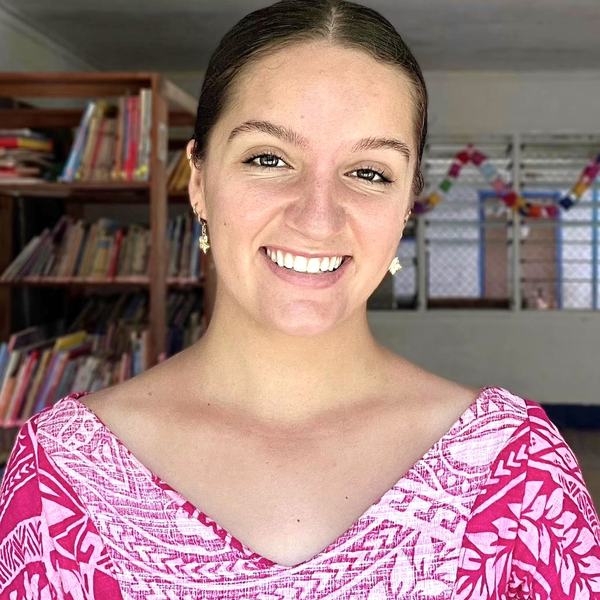
Elizabeth H.
“Some days we collect cocoa beans to make Samoan chocolate or pick lychee and mango at our family’s plantation up the mountain — other days I might go fishing with my host dad on our paopao (wooden canoe) or explore the reef with the kids.”
1. What got you interested in the Peace Corps?
My interest in the Peace Corps grew from my experiences living and working abroad during high school and college. I realized I wanted a career that involved more than just learning about global issues — I wanted to be directly involved in communities. Peace Corps stood out because it offers a unique chance to fully immerse yourself in a new culture and work alongside people over an extended period, and that kind of deep connection is what drew me in. I’m excited that my time in Samoa is already giving me hands-on experience and insight into global health challenges, which are guiding me as I plan to pursue a master’s in global health after my service. For me, Peace Corps is about combining service, real-world learning, and personal growth in a way that shapes both my career and my perspective on the world.
2. What projects are you working on?
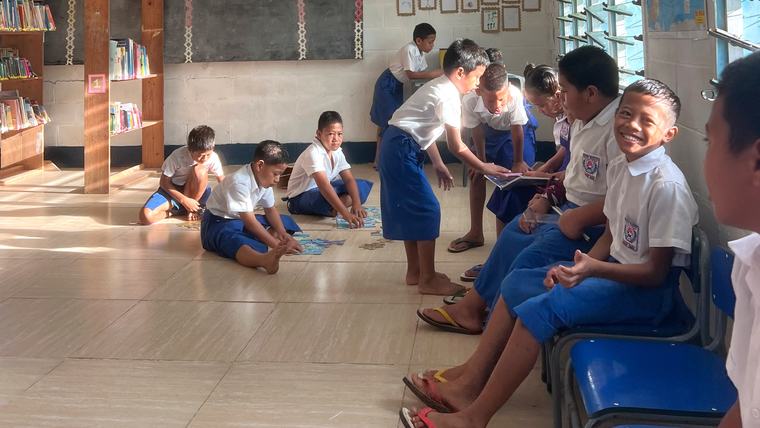
My main project is teaching English pull-out groups to low skill students in my village’s primary school. I have 50 students from grades 4 through 8 and they are the sweetest! I co-teach essay writing to students in grades 5 to 8 alongside a local teacher and also 8th grade geography, where we are currently working on a world map project. I’m also creating a school library — collecting book donations, sourcing laptops, and gathering basic school supplies to make it a functional learning space for students and teachers. I started an after-school math club for students in grades 7 and 8 to help prepare them for their national exams at the end of the year, and I also started a girls’ leadership club, which creates a safe space for girls to talk about topics like confidence, leadership, education, and health. Sometimes I tutor students after school, especially in English and math, which also gives me a chance to build personal relationships and see where they need more support. In the coming months, my principal and I will be working to build a new school! I intend to extend for a third year, and plan to work part-time at the primary school in my village and part-time at a family health clinic in the capital.
2. What strategies have you used to integrate into your community?
Building relationships has been a top priority for me since the day I arrived. I’ve made it a point to attend church services regularly and help out at church activities — these gatherings are so central to life here and have helped me connect with people of all ages. I spend as much time as I can with my host family and attend all their events, from birthday parties to funerals to Sunday feasts. Learning to speak Samoan has been one of the most impactful steps in helping me feel at home and making others feel comfortable with me. I also go on daily walks or runs through my village, which has become a natural way to meet neighbors and say hello to kids playing outside. Just being visible in your community and showing that you’re putting in effort is a huge part of integration. In my year here so far, people have come to recognize me as part of the community (not just as a “palagi” [Volunteer]), and that means the world to me.
3. What is a highlight of your time in service so far?
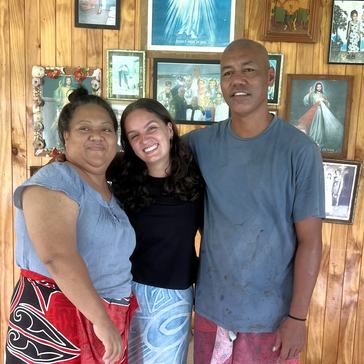
One of the biggest highlights of my service has been living with my host family. I live with my host parents and three siblings (ages 21, 13, and 7) and over time I’ve truly become part of the family. My host dad is a chief in the Samoan Head of State’s family, which has given me a rare window into both everyday village life and national events. In 2024, my village played a significant role in Samoa’s hosting of the Commonwealth Heads of Government Meeting, and I had the opportunity to attend the ‘ava ceremony for King Charles III. It was surreal to witness such an important event in Samoan and global history, and to see firsthand how Samoa integrates traditional customs into international diplomacy. I’ve also been able to attend birthdays, weddings, funerals, and saofa’i (chief title bestowals) in my village. These events are full of respect and community pride, and participating in them has given me a meaningful understanding of the fa’asamoa (traditional Samoan values and way of life). Additionally, I love spending evenings reading books with my 7-year-old host brother — his English has improved so much in the past year and I am so proud of him!
3. What have you enjoyed most about the community where you are serving?
I love how connected I feel to the people around me, especially my students. They walk home with me every day after school and stop along the way to climb trees to harvest fresh coconuts, mango, or sasalapa for me. These small moments mean so much to me — they show the generosity and closeness that define my community. My village is also incredibly beautiful, with mountains on one side and a reef on the other. But what’s moved me most is the deep sense of commitment people have to their families and to Samoa as a whole. Here, family and community always come first. That strong sense of duty and pride, so central to the fa’asamoa, has taught me a lot about resilience, respect, and what it really means to belong. This place has become home in every sense.
4. What are some of the most important things you’ve learned from your community?
One of the biggest lessons I’ve learned is the importance of patience and presence. Life in Samoa moves at a different pace than in the U.S., and I’ve come to appreciate that taking the time to sit, talk, and just be with people is just as important as completing any task. I’ve also learned a lot about the strength of community, which is deeply embedded in the culture, and it’s inspired me to think more about how I engage with people back home. Every day here teaches me something new about what it means to live in connection with others.
5. How do you spend time when not working on a project?
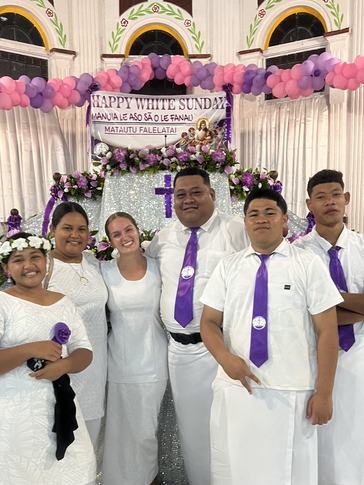
In my free time, I like to run a lot, and sometimes the kids will join me! There’s a beautiful mountain road in my village where I do my long runs, and I often participate in races around the island as well. Other than that, I spend a lot of time reading and hanging out with my host family. Some days we collect cocoa beans to make Samoan chocolate or pick lychee and mango at our family’s plantation up the mountain — other days I might go fishing with my host dad on our paopao (wooden canoe) or explore the reef with the kids. I help with a lot of church activities. We recently celebrated White Sunday, a children’s holiday where students led a church service and performed songs, dances, and skits. It was so much fun helping them rehearse and seeing all their hard work pay off. There are two churches in my village, so between both congregations, I stay busy with Sunday school, attending song practices, and helping with church social events.
6. What are you looking forward to in your remaining time as a Volunteer?
I’m most excited to continue building deeper relationships with my students, my community, and my host family. These connections are the heart of my service and the reason I feel so invested in my community. I’m also looking forward to seeing my projects come to life, especially building the new school and starting my new role in the health clinic. And I just want to enjoy the time I have: playing soccer with the kids after school, going on long drives with village friends around the island, chatting with my host mom while cooking new recipes, visiting my cohort in their sites, and exploring new villages. This is such a special chapter in my life and I want to be present for it all.
7. What will you do differently when you return to the U.S.?
I’ll definitely bring back a much bigger appreciation for community and the value of personal connection. I’ve learned to slow down and be more intentional in my relationships — really listening and making time for people. I hope to stay involved in international work, but even in my everyday life I want to carry the fa’asamoa values I’ve learned here, especially gratitude, resilience, and community. And of course, I’ll keep in touch with my host family; they’re a forever part of my life now!
Learn more about serving as a Peace Corps Volunteer in Samoa.



