 An official website of the United States government


Featured Volunteer Profile
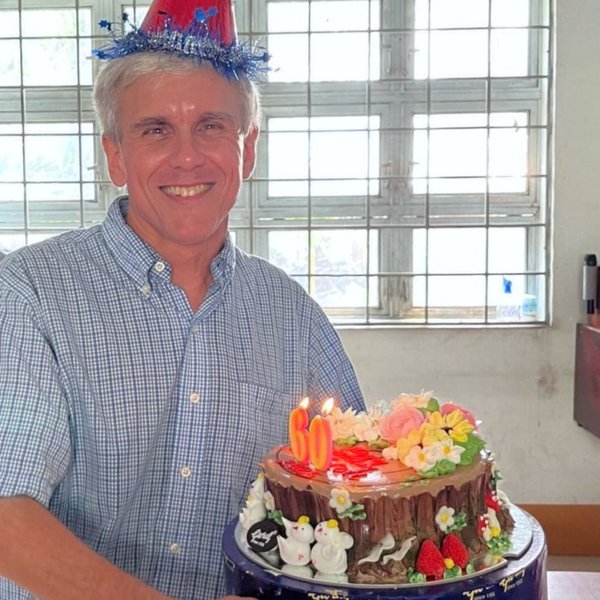
Scott N.
“Students know they might be the first in their family to go to university and what it takes to get into the more prestigious ones. As a teacher, it is a genuine honor and privilege to work with such students.”
1. What got you interested in the Peace Corps?
I first became interested in 1976 when I was 11 years old and read about Lillian Carter’s Peace Corps service in her late 60s. This was something I aspired to do upon retirement and maintained that dream for 46 years. After retiring from my career as a high school history teacher and our youngest son was in college I decided to fulfill that dream. Viet Nam was my first choice because I wanted to do my part in helping to transform the difficult past relationship between our two countries into something peaceful and positive for the future. Serving our country in such a peaceful way and building positive international relationships would be a way for me to fulfill my ideals of faith, patriotism, and service. Helping others has always been a big part of who I am and learning about foreign cultures has always been a passion of mine.
2. What projects are you working on?
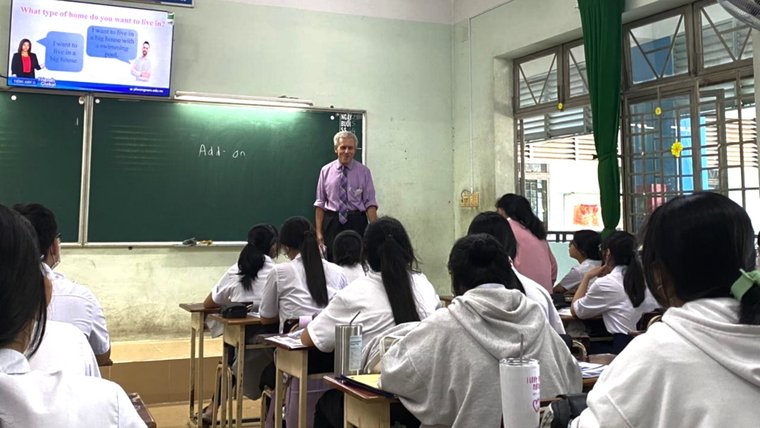
I’ve been working as a co-teacher with my Vietnamese counterparts in English classes over the past couple of years. Usually they will focus on the Vietnamese explanations for English grammar while I will focus on pronunciation, listening, and speaking. However, our roles vary greatly depending on the lesson, and we practice a seamless give-and-take. I also am very active during the non-school day hours with small group student pronunciation sessions; our English club; teaching the children of colleagues; online lessons; and various school activities. I’ve become a vital part of the school community and it has become my home away from home.
3. What strategies have you used to integrate into your community?
I’ve participated in every weekend and after-school activity that was appropriate, such as meals with colleagues at school and local restaurants; being emcee at events; singing both Vietnamese and U.S. songs at formal events; singing karaoke during informal gatherings; having frequent conversations in local eateries and at the bus stop; etc. Sitting in the garden near my school residence has allowed me to have conversations with students at the tables in addition to students who frequently strike up conversations in the hallways between classes. My school has provided me with lunch daily, giving me opportunities to learn more about my colleagues and their families. Teaching some of their small children English in the evenings has helped build deeper bonds with colleagues and the school community in general.
4. What is a highlight of your time in service so far?
The after-school pronunciation sessions have been the most effective and meaningful. While my impact has been felt in our regular English classes of 40-50 students, it has been in these smaller groups of 7-10 (each group on a different day) where more individualized instruction can take place. Working on particular strengths and weaknesses is even more efficient with smaller class sizes. For example, the Monday afternoon sessions became like a little family where everyone could actively participate through sharing personal experiences and encouraging the others to take chances in practicing their English speaking. They allowed me to get to know each student better and establish even stronger teacher-student relationships. That was one of my greatest strengths as a U.S. high school teacher and has become the same here in Vietnam.
5. What have you enjoyed most about the community where you are serving?
The students—it has always been and will always come down to them. There is a hunger for education in Viet Nam and what that education can mean for the family and future financial success. Students know the importance their parents place on education and the respect they have for teachers and the school. Students know they might be the first in their family to go to university and what it takes to get into the more prestigious ones. This is certainly a way to support the student and their whole family long-term. As a teacher, it is a genuine honor and privilege to work with such students.
6. What are some of the most important things you’ve learned from your community?
The Vietnamese are very polite and resilient people. They are welcoming to foreigners and always concerned about whether these visitors have eaten before quickly sharing their food. However, while an American will make friends quickly, the Vietnamese are careful not to let anyone in too close, too fast. I have been treated with politeness and kindness right from the beginning.
7. How do you spend time when you are not working on a project?
I’ve tried to immerse myself in the various cultural opportunities available here in Ho Chi Minh City (HCMC). From singing weekly with the choir at the Notre Dame Cathedral to visiting numerous historical Buddhist temples; from attending free concerts along the Saigon River and the Nguyen Hue walking street to chamber music, orchestral, and ballet performances at the Saigon Opera House and the HCMC Conservatory of Music; from exploring various neighborhoods to enlightening conversations while enjoying smoothies in its many cafes. HCMC has so very much to offer.
8. What are you looking forward to in your remaining time as a Volunteer?
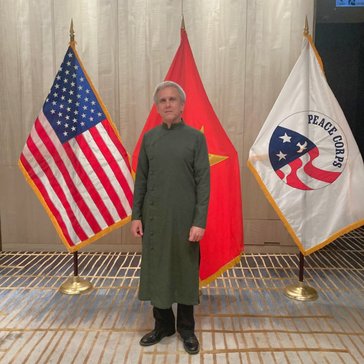
There are so many students I’d love to teach before I leave but time is flying by. When people ask me to describe the main difference in teaching Vietnamese and American students, I say that it is the level of respect for the teacher in the classroom. While I always felt I had to earn the respect of my American students, in Vietnam I feel respect the moment I enter the room. The status of the teacher is much higher here, and therefore the teacher rarely has to worry about discipline. Instead they can focus on the purity of teaching and maximizing the effectiveness of learning in the classroom. As a teacher, this cultural respect and student hunger for knowledge leads to great professional satisfaction. Having a family back home patiently waiting for my return, am I selfish to say that the desire for more such teaching opportunities increases as the number of days before my close of service decreases? It is complex.
9. Once you finish service, what will you do differently when you return to the U.S.?
I know that a description of personal transformation is suggested by this question but, I must honestly say that this experience for me has been more of a reaffirmation than a transformation. The ideals that kept my dream of Peace Corps service alive for 46 years have only been strengthened by my actual experience. After living through the sacrifice of leaving my beloved husband, two adult children, elderly parents, cherished friends, comfortable home and community, etc. for two+ years of service to my precious country, my ideals are even more deeply entrenched than I ever imagined possible. Even without the comforts of home and with the challenges of living abroad, my desire for a life of Christian faith put into action has only increased. My belief that education and international cooperation are the ways to lift our country and world to greater heights has only increased. My belief that difficult past relationships between nations can be transformed into positive and forward-looking ones through multiple and individual cultural exchanges has only increased through my experience here in Viet Nam.
Learn more about serving as a Peace Corps Volunteer in Viet Nam.



