 An official website of the United States government




Featured Volunteer Profile
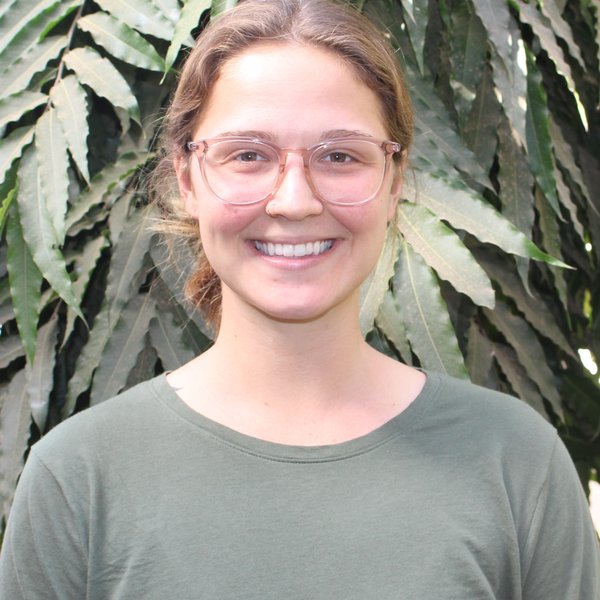
McKenna M.
“The beauty of having two years in your community is that you almost always get another shot at something that doesn’t work the first time!”
1. What got you interested in the Peace Corps?
When I was in 7th grade, my best friend’s mom would tell us stories about her adventures serving as a Peace Corps Volunteer in Ecuador. I thought to myself, “Wait, you’re telling me the U.S. government will send people to these cool places to live and work for 2 years? Sign me up!” Since then, I made up my mind: I would join the Peace Corps as soon as possible. Even as a middle schooler, I had an urge to travel, learn, and help people along the way. Turns out the Peace Corps will allow you to do all of that and more.
2. What projects are you working on?
I have an array of projects going on at the moment, and though I am an Agriculture volunteer, I don’t limit myself to only Agriculture related work. I think that is one advantage of working in a village- if you see a need and have the tools to contribute, you can!
The biggest project that I am working on is establishing a community garden. When I arrived in the village in November 2022, the village was suffering from water scarcity, as well as lack of space for their gardens. In June 2023, I submitted the first part of a two-part grant to build a community garden for women. The fence, reservoirs, and taps have been built. We are waiting to receive funding for the second part of the grant, which will include the borehole, water tank, and solar system.
My counterpart and I have also created a tree nursery with over 400 trees. Over half of those trees have been dispersed and planted throughout the village. The others will be planted this coming rainy season. I also have my own personal garden where I am growing tomatoes, cabbage, lettuce, eggplant, onions, carrots, cauliflower, ginger, beans, and cucumbers!
Lastly, I work at the primary school, where I use my art skills to make teaching aids for the teachers. I also have painted a few murals and other things on school grounds.
3. What strategies have you used to integrate into your community?
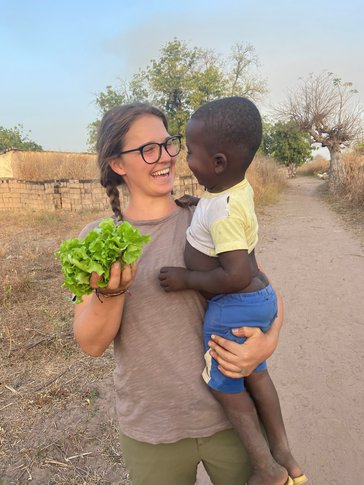
I think the most effective strategy I used was simply to be present. If I was invited to the peanut farms, I went. If I was invited to a wedding, I went. If someone invited me for lunch, I went. Each time I brought a small notebook and pencil and wrote down what I heard or observed. This really helped me in my language acquisition and helped my community get to know me. My village is really small, only about 150 people, so after a few months I knew just about everyone’s name. Just showing up and putting your best foot forward will get you far!
4. What is a highlight of your time in service so far?
During pre-service training I made a long journey with my counterpart to the isolated village that would be my permanent site. Upon arriving, I was dog-tired from the long day of traveling. As we exited the main road and turned onto the dirt road leading to my village, I was so nervous, but excited with the anticipation to start service. The whole village was waiting to greet us. The women banged sticks on plastic bidongs, singing, and dancing and welcoming me to their home. I felt accepted right from the start, and to this day that feeling remains.
5. What have you enjoyed most about the community where you are serving?
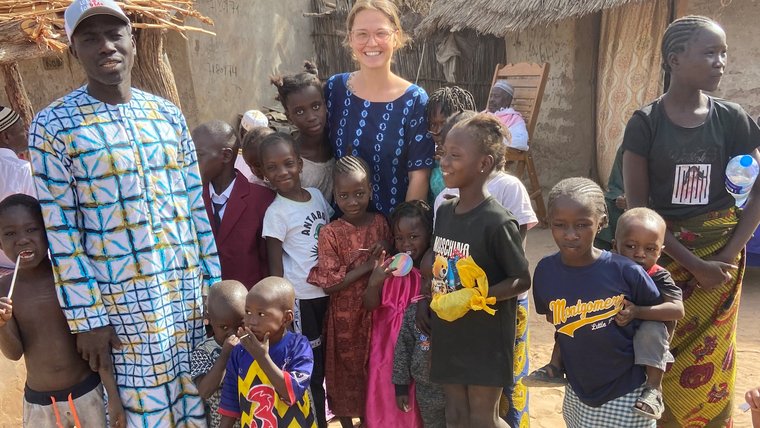
I am living in a very small community. I grew up in a small town in the U.S., but like most kids, I wanted to get out and explore the world. Now, I have landed in a small, rural Gambian village, and love how tight knit it is. Everyone knows me, and I know everyone. This has enabled me to understand what my community needs, and how I can be of assistance. The kids are also a light in my life. When I’m having a bad day or feeling homesick, I walk outside my room and the kiddos will yell my name and want to play a game with me. Lastly, I love the scenery. When I walk outside the village and into the bush the land is dense with baobab, mango, cashew, and many other trees. It has been so neat learning all the different tree species growing in the area.
6. What are some of the most important things you’ve learned from your community?
Gambians have an innate kindness. If you visit someone’s home here, they will bend over backwards to make sure you feel comfortable. This is treatment of visitors is something I really want to carry with me back home.
I also really admire how folks here are always laughing and cracking jokes, even though they might not have much. It is quite remarkable how people who have the least are the ones who give the most and are the most grateful for what they do have. One time I gave my host brother a toy from America. He not only used the toy to play with, but the box it came in was just as much of a prize! It goes to show that we don’t need a lot of things to be happy. We just need community and a sense of belonging.
7. How do you spend time when you are not working on a project?
My various projects keep me quite busy, but when I am not at school or working in my garden, I like to spend time drawing or painting. It has been such a joy getting back into this hobby. Back in the States I never found the time to really tap into my creative side.
I also spend a lot of time reading and have been able to check a lot of books off my “to read” list.
Another habit I've adopted is journaling at the end of each day, as well as writing a poem a day. I think this will be a great way for me to look back on service and recall all the moments I had in The Gambia.
Lastly, I like to go on walks in the evening. This is a great way to wind down from the day, process my thoughts, listen to the birds, and recharge my battery.
8. What are you looking forward to in your remaining time as a Volunteer?
The Peace Corps really hit the nail on the head when they say that service is a rollercoaster of highs and lows. I have had my share of high high and low lows, but as I am nearing the end of my service, I can’t help but realize how fast it goes by. In my final year of service, I am looking forward to putting all the lessons I’ve learned from failed projects into action. The beauty of having two years in your community is that you almost always get another shot at something that doesn’t work the first time!
I am trying to be very conscientious of making every moment count as I near the end of service. I think the only way to slow down time is to be truly present in every moment. From chatting with my host family in a language that I learned only a year ago, to walking through the Gambian bush, and playing soccer with my three 13-year-old best friends. Living in The Gambia has impacted my life in countless ways, and as my time here comes to an end, I want to continue embracing all these beautiful moments.
9. Once you finish service, what will you do differently when you return to the U.S.?
It’s too early to fully understand the impact that living in The Gambia has had on my life. I do know that when my service has concluded, I will forever be grateful for the people I’ve met in this little corner of the world. Living away from home has also given me a new appreciation for my people back home in the U.S. When I go back, I want to make sure all the people in my life, from America to The Gambia, know how important they are to me.
I also think I’ll be more focused on taking life as it goes, slowing down, and enjoying the endlessly beautiful moments. Living in The Gambia has taught me that I can’t control everything, and life cannot always be planned perfectly. It is a wild ride, and I am just grateful to be on it.



