 An official website of the United States government




Featured Volunteer Profile
Roshana G.
“The biggest lesson I’ve learned from my community can be summed up by the Jamaican proverb, 'One, one coco full basket,' which means that small, consistent, and patient efforts eventually lead to meaningful, long-term success.”
1. What got you interested in the Peace Corps?
The opportunity to join the Peace Corps deeply interested me because its core expectations align with my own commitment to service. Virginia Tech’s motto, Ut Prosim (That I May Serve), taught me the importance of living a life centered around service, and I became dedicated to embodying that value both during college and after graduating. At the same time, I developed a strong interest in environmental stewardship. Growing up around the D.C. region, a hub for political activism, I attended marches and speeches that made me more aware of the urgency of environmental issues. I came to believe that promoting sustainable human interaction with the natural environment remains one of the critical challenges facing societies around the world.
This realization motivated me to dedicate my time to empowering myself and others with the knowledge and skills needed to understand complex environmental problems and develop lasting solutions. I am especially interested in supporting less developed communities, which are often hardest hit by environmental change. The Peace Corps Agriculture sector offers a meaningful opportunity to help equip communities with the resources needed to promote sustainability.
After college, I struggled to find my purpose and realized I did not have to follow the traditional path of entering the corporate world if it did not align with my values. When I began researching the Peace Corps, it felt like the perfect way to combine my desire to give back with gaining practical skills in sustainable development while doing meaningful, hands-on work in a new cultural environment.
2. What projects are you working on?
A farmers group and I are currently working on the “On-Farm Water Security” program made possible through funding from the United Way of Jamaica and a Peace Corps small grant. The project addresses a community-identified priority: the urgent challenge of water insecurity among smallholder hillside farmers who rely entirely on rainfed agriculture. This leaves them highly vulnerable to environmental change, prolonged droughts, and the absence of adequate water storage systems, often resulting in crop failure, shortened growing seasons, and income instability.
The project’s goal is to establish a scalable, climate-resilient model that improves water security and strengthens agricultural productivity. To achieve this, we are installing four rainwater harvesting systems on individual farms, each including a zinc roof catchment, PVC conveyance, a concrete base, a 1,000-gallon water tank, and a 1/4-acre drip irrigation system. At the same time, the project is building local technical capacity by training farmers in system construction, operation, and maintenance through hands-on modules with agricultural experts— we just finished our second training the other day.
Expected project outcomes include increased water availability for irrigation during dry periods, improved crop yields and planting consistency, and the ability to grow higher-value crops. For long-term sustainability, each beneficiary contributes a portion of their system’s cost to a revolving development fund that will support future installations. This project strengthens livelihoods and environmental resilience by addressing water insecurity and creating a replicable model that farmers can sustain beyond the grant period, which is especially important after events like Hurricane Melissa.
3. What strategies have you used to integrate into your community?
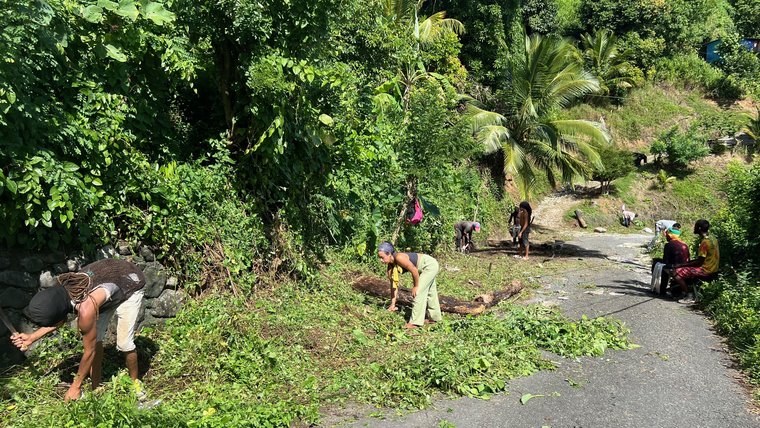
Luckily, my house is the location of the main shop in my small rural community. Therefore, I never had to travel far to socialize. Simply just sitting outside the shop morning and night helped me ease into community dynamics very easily. Additionally, I take regular walks around my community and neighboring communities often, always taking the time to pause and chat when someone flags me down. These walks introduced me to people I do not think I would have had the pleasure of meeting otherwise. Another important way I have connected with people is by working on local farms. Whenever community members introduce me to new people, they often mention how much I love helping out on the farms, whether it’s in the hot sun or pouring rain, when most people would typically take cover. Showing that I’m willing to work alongside others no matter the conditions helped build trust and strong relationships (and often a pretty gnarly sunburn). Finally, just being myself has helped integrate as well. I can be soft spoken at times, but also loud and sassy, and I’ve found that my community members appreciate both sides of my personality — especially when I’m joking around and heckling the men in the community!
4. What is a highlight of your time in service so far?
One highlight is experiencing the vibrant culture of the parish where I live, which has a large population of people of African descent. A significant part of this culture is Kumina, a musico-religious practice rooted in communication with the ancestors of the Congo people and their Jamaican descendants. Although the tradition has been largely forgotten across much of the island, it remains alive in my parish and is most often performed at funerals, though it also serves other spiritual purposes. The first Kumina I attended was held to bless the land and set intentions of peace and freedom.
The night was unlike anything I had experienced before: as the drummers and singers from the community began, some participants appeared to enter a deeply spiritual state. Priestesses, who maintain close relationships with the ancestors, moved through the crowd delivering powerful interactions and messages. When I was invited forward, they warned me to be careful when entering new places and performed a protective ritual using ground eggshells and Florida water. They also encouraged me to start a daily meditation practice.
The drumming was electric, and the singing—mostly in a Congolese mother tongue I didn’t understand—resonated deeply as people called out the names of their ancestors in gratitude. The celebration continued until about 5 a.m. Being welcomed into this sacred space was an unforgettable honor, and the experience even inspired me to begin a daily meditation practice.
5. What have you enjoyed most about the community where you are serving?
My community has some of the best views on the island. From my veranda, I can see the mountains, and it truly doesn’t get much better than that. Whenever someone new travels up to my site, they immediately hand me their phone so I can take a photo of them in front of the view. Just beyond the veranda is the road that runs through my community, and right beside it you can hear a massive river rushing through the valley. Not only is there one river near my house, but there are actually two. A few miles away, there is even a natural hot spring where sulfur-rich water flows directly out of the rocks.
The jungle that surrounds my community is breathtaking, and traveling to other parts of the island has made me realize how easy it is to take that lush vegetation for granted. Another unique aspect of my community is that coffee grows here. I never imagined that I would learn how to grow and harvest coffee, let alone understand the full process of preparing it. Going through that process has given me a much deeper appreciation for the final product and for the hardworking farmers who produce it.
Most of all, I truly enjoy the people in my community. From the elder who always jokes and makes every visitor feel at home with his mischievous questions, to the farmer and his wife who graciously welcome me into their home for long gossip sessions, to my soft-spoken supervisor whose intelligence and humility the entire community admires, to the Rasta who met my family once and never fails to ask how they are doing. Although they sometimes frustrate me, they also bring me great joy. They have become my family.
6. What are some of the most important things you’ve learned from your community?
The biggest lesson I’ve learned from my community can be summed up by the Jamaican proverb, “One, one coco full basket,” which means that small, consistent, and patient efforts eventually lead to meaningful, long-term success. When I first arrived at my site, I knew I shouldn’t expect success overnight, but I did assume that progress would be more linear. Instead, there were times when I felt deeply fulfilled in my work and integration, and other moments when it seemed as though I had taken five massive steps backward.
I remember feeling particularly discouraged around mid-service training because I hadn’t made the progress I had envisioned for myself. Still, I continued to show up for both myself and my community. When it would have been easy to shift my focus to secondary projects, I chose to keep investing my time and energy into my farmers’ group and the wider community. I kept networking, building relationships, and strengthening connections.
All that effort has led us to where we are today: securing two grants that will significantly improve the livelihoods of many people in the community. I’m grateful that I kept persisting because, as they say, one, one coco full basket fi chru!

8. How do you spend time when not working on a project?
Another thing that has grown during my time here is my love for food. Without the convenience of food delivery services here, I had to become much more serious about cooking, and I am glad I did. Now I can cook almost any Jamaican dish with ease, from curry chicken and brown stew pork to ackee and saltfish (although I often make my own version with tuna instead). I have also continued nurturing my passion for Ethiopian cuisine; since I am half Ethiopian, I brought spices from home and regularly cook dishes like doro wat, oftentimes pairing them with local staples like rice and peas.
I have also had the pleasure of working closely with the Rural Agricultural Development Authority’s mome economics instructor, learning how to make a variety of value-added products such as wines and jams—skills that were originally part of trainings for my farmers group but have become valuable for me personally as well. These experiences have deepened my appreciation for how much you can learn about a culture through its food. When I’m not cooking, I enjoy exploring new dishes and restaurants around the island. So far, I have been especially impressed by Ital food, the vegetarian cuisine popularized by the Rastafari movement.
9. What are you looking forward to in your remaining time as a Volunteer?
I am looking forward to traveling to some of my favorite places one last time before I leave. My community members often joke that I have seen more of the island than they have. Whether that is true or not, one thing is certain—I love to travel. I enjoy discovering new communities, especially those with vibrant artisan cultures or great local food.
Jamaica has a booming tourism industry; however, like many others, I have come to feel frustrated with aspects of it, particularly the ways it can overlook or neglect local communities. Because of this, when I travel around the island, I prefer to do so with locals and visit locally owned spots.
Some of my favorite places across the island include Winnifred Beach, Boston Beach, Treasure Beach, Reggae Falls, Cane River Falls, and One Drop Falls. I feel incredibly privileged to have had such easy access to these beautiful places, and I am really looking forward to visiting them one last time before I depart.
10. What will you do differently when you return to the U.S.?
Once I return to the U.S., I plan to prioritize leading a more holistic lifestyle, building on the lessons I have learned during my service in Jamaica. My time working with a center for ecological learning and stewardship reinforced the importance of eating organic and locally sourced foods, practicing mindfulness through meditation, using natural body care products, practicing gratitude, and fostering social connection through communal living. Although these values were not new to me before my service, living in the Caribbean helped me see how closely they are connected through daily practice and cultural tradition. Jamaica, in particular, has had a significant influence on global conversations around natural living, plant-based diets, and organic agriculture, and experiencing this culture firsthand deepened my appreciation for those principles.
During my service, I also led trainings with farmers and community members about the overuse of pesticides in modern food systems and the importance of adopting more sustainable and organic agricultural practices. These experiences strengthened my belief that holistic living is closely tied to environmental stewardship and the health of both people and ecosystems. When I return home, I hope to continue incorporating these practices into my daily life while also sharing what I have learned with others. I also plan to be more mindful about consumption and live with less, as spending two years with relatively few material possessions has helped me reflect on how unnecessary much of my previous consumption was. Moving forward, I hope to carry these lessons with me and continue supporting healthier, more sustainable ways of living in my own community.
Learn more about serving as a Peace Corps Volunteer in Jamaica.



