 An official website of the United States government




Featured Volunteer Profile
Rebeca C.
“Agriculture is a big part of life in my village, and getting involved in it has been incredibly rewarding. No matter how much effort I put into lesson plans or projects, being out there working alongside the community speaks volumes.”
1. What got you interested in the Peace Corps?
Growing up in a multicultural household made me deeply curious about cultures. Our home was a melting pot of traditions, each celebrated with fervor and friendly rivalry, from my Mexican grandma's customs to my American grandpa’s strange meal hours, and the diverse ways holidays were celebrated among my school friends. I felt like a social scientist in my own home. I’ve never lost the pride I feel in my cultural inheritances.
My mom, a social worker in Mexico, showed me early on how some people have more opportunities than others, and how huge disparities in social privilege could be. This early exposure fueled my passion for creating social programs aimed at bolstering local economies, empowering women, and aiding migrants with legal matters, among other causes.
My dream is to one day work in policymaking around development and social programs, in order to make the world a better place for all, regardless of race, nationality, identity, or gender. While I've had the privilege of working alongside remarkable leaders at institutions like the International Criminal Court, the Mexican Embassy in the Netherlands, and the local government in Monterrey, Mexico, I came to realize the significance of gaining hands-on field experience.
So, why the Peace Corps? Simply put, I was tired of sitting at a desk. At 25, I was brimming with ambition, yet felt confined by an office setting. I wanted to channel my energy into meaningful action, to learn through immersion, and to proactively engage with communities. Peace Corps presented me with the opportunity to immerse myself in a country I might never have visited otherwise. I sought to deepen my understanding of a completely different culture and collaborate with a community towards shared goals.
2. What projects are you working on?
Currently, I spend half of my day teaching English at a local high school. I really enjoy getting to talk about important topics like gender, global warming, diversity, happiness, and human rights—stuff I wish I'd learned about when I was younger. I also like sharing bits of my own culture with the students, like celebrating Halloween.
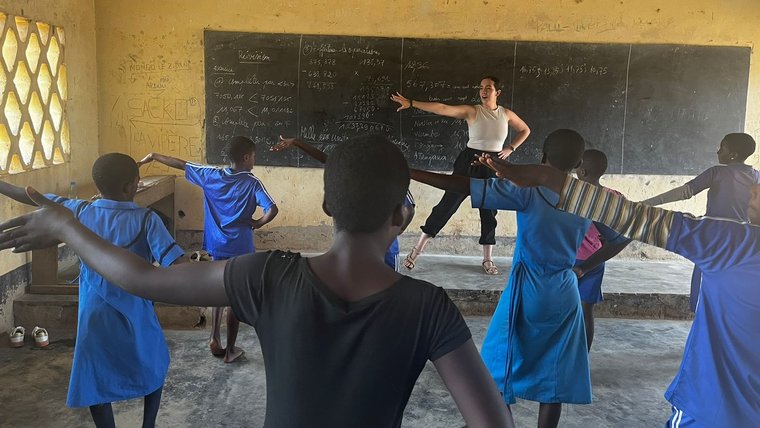
Seeing how much the students love sports, I started a dance club and a track and field club. It's about exercising but it's also a way for them to practice English in a more relaxed setting and to feel comfortable expressing themselves. It's been great for building trust and communication and helps steer them away from the violence they often see around them. These clubs are open to all kids in the community, not just my students.
I try to spend at least one day a week working on a farm with members of the community. It's a nice way to get to know my students' families better and learn more about their culture. Plus, it's encouraged parents to take a more active role in their kids' education—I often get asked about how their children are doing in school now.
Because of the work I've been doing, the local farmers' organization asked me to help them with a business English course so they can improve their communications with vendors. They also requested an administration course to help them manage their finances better. I'm designing the courses now.
In a survey I did with the students I discovered that over 80 percent of students exclusively read textbooks, due to the lack of resources. But over 90 percent have an interest in reading and when given the opportunity, enjoy books. So, I'm working on bringing books to our village and applying for a grant to fund a library.
Lastly, I'm teaming up with an Agriculture Volunteer to start a project aimed at increasing protein sources in the village. Nutrition is a big concern here, so we're talking to the community and the agriculture council to figure out the best way to get started, hopefully during the next rainy season.
3. What strategies have you used to integrate into your community?
Learning the basics of the local language was crucial for me. It showed that I was keen on becoming a part of the community.
I kicked things off by stepping out of my comfort zone and introducing myself to the folks in the village. Hanging out at the local market was another key move—market days are bustling with activity, so I made it a point to strike up conversations and connect with people. I hit it off with the village chief early on, often spending time chatting with him, or sitting beside the road and soaking in the lively atmosphere of the streets.
I made sure to approach every interaction, whether it was a casual chat or working on a project, with professionalism and dedication. I wanted to convey how much I valued people’s time and how seriously I took my role in the village, which helped build trust and confidence among the locals.
One piece of advice from a Returned Peace Corps Volunteer really stuck with me: get your hands dirty. Even though I wasn't much of a gardener before joining the Peace Corps, I embraced the opportunity to learn. Agriculture is a big part of life in my village, and getting involved in it has been incredibly rewarding. No matter how much effort I put into lesson plans or projects, being out there working alongside the community speaks volumes.
And then there's dancing—a nod to my Latin roots. Whenever I bust out some moves, it never fails to win people over. It's like the icing on the cake of community integration!
4. What is a highlight of your time in service so far?
It might sound simple, but it's been the chance to truly immerse myself in my village and its culture. It wasn't an easy journey for me. Other Peace Corps Volunteers told me stories about how they were showered with food by their village when they first arrived, but my experience was different. Integration took time. Some of the kids had heard scary stories about White people before I arrived, so I was seen as a bit of an outsider.
Over time, the real highlight has been the warmth with which the community has welcomed me into their homes. I've had the privilege of discovering beautiful traditional masks, pottery, and other household items. My students have taken me to their favorite spots in the village, and I've gone hiking with members of the community, sharing our love for nature along the way.
What's truly special is the friendships I've formed—knowing that if I happen to get sick, there are people who care and will come to my aid with their home remedies. Being invited to participate in traditional ceremonies and being treated as a member of the village has been incredibly meaningful. And listening to the chief tell traditional stories you couldn't find on the internet—those moments are priceless.
Another incredibly special highlight for me has been witnessing the growth and development of my students, not just academically, but in terms of their confidence, leadership, creativity, and problem-solving skills.
One student, in particular, stands out. He was struggling with English and felt disheartened. One day, I noticed his speed while playing football, despite being frequently sidelined due to his skill level. I encouraged him to try out for track and field.

As we trained for the upcoming competition, he constantly doubted himself, saying, "I can't do it, I'm not good enough." But each time, I reassured him and urged him to keep going. When he won the local competition, he remained skeptical, convinced he couldn't win at the divisional level. Yet, I persisted in encouraging him to try.
When the divisional competition arrived, he surprised himself by winning again, leading him to say, "Maybe I am fast, maybe I can do this." Not only was he selected for the regional competition, but he also gained newfound confidence, a desire to train harder, and improved English-speaking abilities along the way. It's moments like these that truly showcase the transformative power of encouragement and perseverance.
5. What have you enjoyed most about the community where you are serving?
One of the most rewarding aspects of my service has been the opportunity to truly become a part of the community and immerse myself in its deeply traditional culture.
Additionally, I'm captivated by the stunning landscape surrounding my village. To reach my community I take a one-hour moto ride from the nearest town, winding my way through the mountains. Eventually, I enter a breathtaking valley, where my house sits atop a hill. The views are absolutely incredible.
6. What are some of the most important things you’ve learned from your community?
Some of the most significant lessons focus on the importance of valuing our land and resources. Living among them has taught me to appreciate the hard work behind every product and the necessity of using resources wisely.
I've also picked up valuable agricultural skills. Before joining my community, any plant I tried to care for would inevitably die. Now, I'm confident that I can nurture plants successfully even after my service ends.
I've also learned to let go of stressing over time and planning. Instead, I've embraced the spontaneity of life and learned to adapt to whatever plans come my way.
Additionally, I've become comfortable with the quiet moments, simply observing the world around me without feeling the need to engage in conversation.
Lastly, I've learned the practical skill of butchering a chicken. While it's not something I particularly enjoy, knowing how to do it allows me to enjoy chicken when I crave it.
These lessons, both practical and philosophical, have enriched my experience and broadened my perspective.
7. How do you spend time when you are not working on a project?
Once a week, I dedicate a day to staying at home, allowing myself to rest and recharge. It's a time when I deliberately avoid social interactions and recharge my energy for the week ahead. I engage in activities that nourish me—reading, writing, dancing, and cooking. By disconnecting from electronics and focusing solely on my well-being, I reconnect with myself and foster a sense of inner peace.
Additionally, at least once a month, I visit fellow Peace Corps Volunteers who are an essential support system for me; being in their company rejuvenates my spirit. We indulge in activities that bring us joy, sharing activities we liked doing back home, whether it's celebrating holidays like Thanksgiving, Christmas, and New Year's together or simply enjoying movie nights with popcorn.
8. What are you looking forward to in your remaining time as a Volunteer?
I'm eager to secure a grant and collaborate with the community to establish a real library. This initiative will promote a culture of reading and also foster a positive attitude towards learning among students.
I'm also excited about participating in the various training sessions and engaging in the multitude of projects that the Peace Corps offers. These experiences will enable me to bring even more fantastic opportunities and projects to my community.
Lastly, I can't wait for the countless special moments I'll share with my fellow Volunteers. The bonds we've formed are invaluable, and I look forward to cherishing each moment we spend together.
9. Once you finish your service, what will you do differently when you return to the U.S.?
When I return to the U.S., I know my friends and family will be curious about my time in Cameroon. My first instinct will be to challenge stereotypes and share the beautiful experiences and cultural shocks I encountered, always with dignity and respect. My aim is to broaden perspectives and encourage them to look beyond the narrow lens often portrayed in the media.
On a personal level, my approach to everyday tasks like grocery shopping will be different. I no longer want to mindlessly consume as I once did. Instead, I'll be mindful of my water usage and grateful for the luxury of reliable electricity every time I charge my phone. Consequently, I anticipate spending less time glued to my screen.
I've learned to appreciate solitude. Upon my return, I'll treasure the moments I have to myself even more.
Lastly, I plan to cultivate a garden to grow some of my favorite herbs and vegetables. This will not only provide me with a deeper connection to the food I consume but also remind me of the complex process behind their production.



