 An official website of the United States government




Featured Volunteer Profile
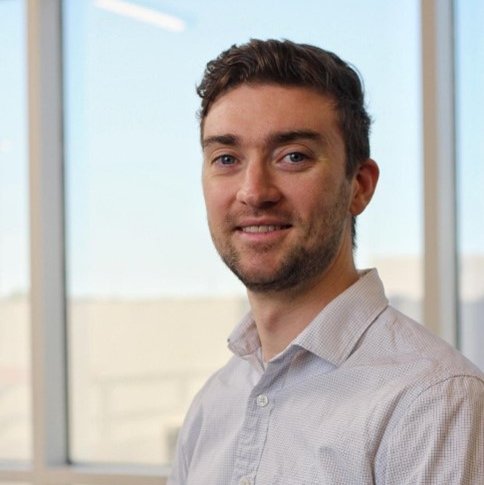
Nick L.
“Most Namibians are truly grateful for what they have. That is an attitude that I have tried my best to inhabit and something I think would benefit many people back home.”
1. What got you interested in the Peace Corps?
Peace Corps service was never a part of my original plan. In fact, I had never considered it until less than a year before I left for Namibia. At the time, I realized that a career in finance wasn’t the right fit for me, so I began exploring other opportunities. I stumbled across an advertisement from the Peace Corps and decided to call my local recruiter. I originally believed Peace Corps only had Education and Health Volunteers. When I discovered that Community Economic Development Volunteers are also a part of the Peace Corps, I was immediately intrigued. I was looking for more meaningful work and a fulfilling experience and Peace Corps has provided that. It is a great organization, and I am happy I made the decision to spend two years in Namibia!
2. What projects are you working on?
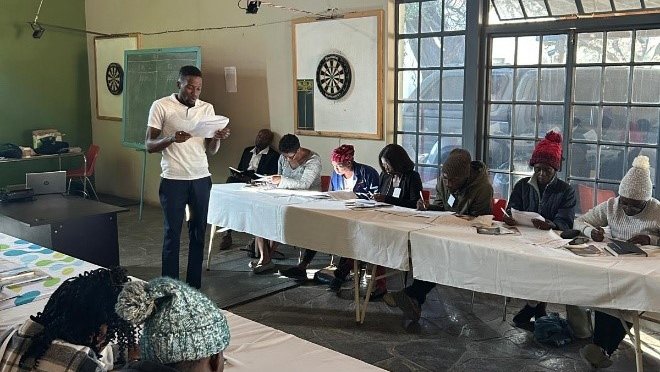
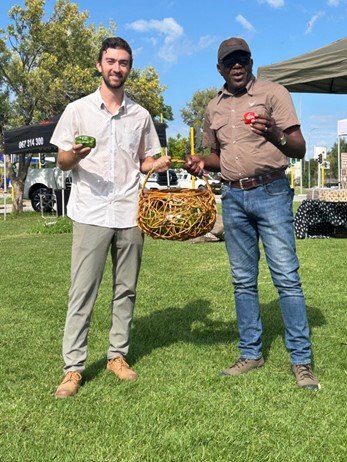
As an Economic Empowerment Program (EEP) Volunteer, our focus is on training and enabling our communities to practice their business and entrepreneurship skills. My first six months of service have consisted of three primary projects and one secondary project. My first project is one many EEP Volunteers establish in their towns – a help desk. The desk is designed to assist community members with CVs, cover letters, and general employability skills. The second project was creating a farmers’ market for local producers. The third project is a workshop for local micro, small, and medium enterprises (MSMEs), which has trained 30 established and aspiring entrepreneurs thus far. For my secondary project, I have been working with the community center for orphaned and vulnerable children to plan both fundraisers and educational trips.
3. What strategies have you used to integrate into your community?
Integration has been one of the most difficult aspects of service for me. When I think of integration, I think of positive daily interactions and creating a fulfilling social life with members of the community. This can be difficult at times because the way people spend their time in my community is often very different from how I am used to spending my time. However, I have slowly built a base of friends and good relationships with colleagues that has improved my time in the country. I think the keys are as follows:
- Don’t be afraid to try something new. Failing at some new activity can show people that Americans are just like everyone else and are open to new experiences
- If something doesn’t exist in town (e.g., a running club), be proactive and create it yourself
- Ask coworkers and community members if you can join their clubs or sports teams
- Walk around … a lot. Meeting people on the streets and within businesses has opened up both professional and personal opportunities
4. What is a highlight of your time in service so far?
One of many highlights that I have experienced was an educational trip. I collaborated with the head of the center for orphaned and vulnerable children to plan an educational trip for some of the kids. We put a lot of work into getting sponsorships and planning the whole day out. The kids really appreciated the trip and asked when they could have another outing!
5. What have you enjoyed most about the community where you are serving?
What I have enjoyed the most is the amazing relationships that I have built and the lovely Namibian sun!
6. What are some of the most important things you’ve learned from your community?
My community has taught me how to be appreciative of the things around me. I have a roof over my head, a bed to sleep in at night, a loving family, and even a hot shower! These are things that can be taken for granted, especially in America. Most Namibians are truly grateful for what they have. That is an attitude that I have tried my best to inhabit and something I think would benefit many people back home.
7. How do you spend time when you are not working on a project?
I have essentially five activities that I do when I am not working on a project: reading, running, spending time with friends, playing a sport, or working on something around my apartment. Days and weeks often feel busy even if there isn’t too much going on. Living on your own while maintaining your health and personal relationships ends up taking more time than you would expect!
8. What are you looking forward to in your remaining time as a Volunteer?
I am looking forward to building more meaningful relationships with community members. Additionally, I am hoping to create an atmosphere in town where people want to come here and stay here. We are reminded by Peace Corps Namibia staff during Peace Corps trainings that we should think about our service as if we are planting the seed of a tree we may never see mature. I want to be the first of many Volunteers who supports the community in flourishing and creates meaningful work and experiences for all. I know that I and my community partners can support community members to make this happen.
9. Once you finish service, what will you do differently when you return to the U.S.?
I have three big takeaways from service so far. The first is that you shouldn’t be afraid to start something new, in work and in your personal life. Sometimes it takes one person to start a new project or create a new initiative in the community. The second is the importance of persistence. One of my projects happens weekly, but I didn’t get any engagement from the community for the first three weeks. However, I did not give up. Instead, I determined why there was low engagement and brought the project closer to the people, and now have people engage with me every week. The third takeaway is that I will be taking life as it comes at me and not rushing things. You can take the first 30 minutes of the day to greet people and build relationships. In America, we are often rushing from one thing to the next and don’t take the time to connect with the people around us. Sometimes you can take a step back and enjoy what is in front of you.
Interested in learning more about serving in Namibia? Connect with a recruiter today.



