 An official website of the United States government


Featured Volunteer Profile
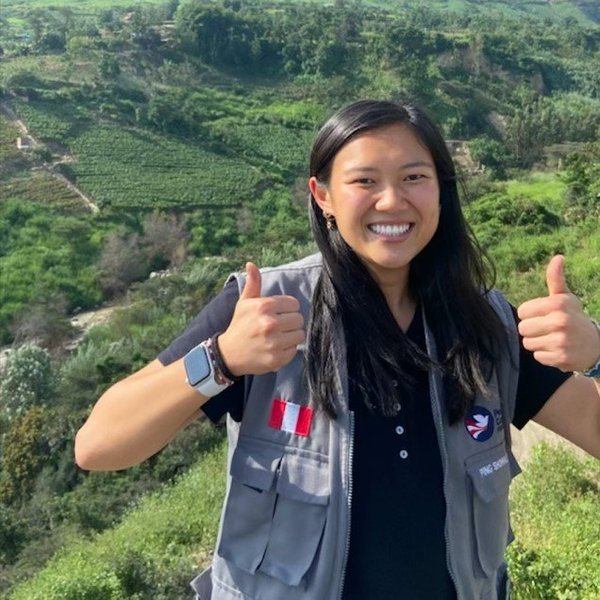
Naomi Ping S.
“Soccer is a truly beautiful game that brings people together. ... Through soccer, I have bonded with parents and earned their trust, shared ideas with professors and earned their respect, and learned all the local slang from teenagers.”
1. What got you interested in the Peace Corps?
Peace Corps first caught my attention after I attended a Peace Corps send-off party for an older friend. I admired her life-changing choice, but did not begin to consider it as a choice I might potentially make until I got to college. At Indiana University I took courses in international studies, Spanish, and justice. I began to dream that I might take everything I learned not only outside of the classroom but outside of the country. I felt the pull of the classic yet powerful trifecta: the motivation to serve, the desire to travel, and the hope to improve foreign language and cultural competency.
2. What projects are you working on?
As a Youth in Development Volunteer, I work primarily in the two local high schools and with the municipality’s Defense for Women and Children sector. Currently, I am wrapping up summer camps and workshops. These include English classes combined with cultural lessons, a soccer camp, and a small chess club. This school year, I will continue with adolescent development work that includes life skills and leadership workshops as well as a variety of vocational orientation sessions. I am also planning a world map project, restorative justice workshops for students, a soccer club, and a schoolwide contest focused on art and the environment.
3. What strategies have you used to integrate into your community?
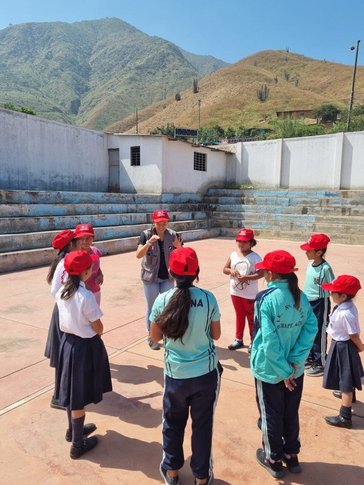
Soccer is a truly beautiful game that brings people together. On Saturdays, I find myself among a group of men in their 40s and 50s, professors and parents of students. Sundays, it’s a motley crew of guys from teens to older adults. During the week I play with a group of women, some of whom have become my close friends. Through soccer, I have bonded with parents and earned their trust, shared ideas with professors and earned their respect, and learned all the local slang from teenagers.
I was so nervous at first, surrounded by a group of strangers and nearly mute, feeling pressure to prove myself. Now, I greet these soccer friends enthusiastically on the way to the market, I’m invited to birthday parties and asked to do workshops on such-and-such theme for their students. My willingness to join, initially as an outsider to these soccer games, has earned me a spot on the field and a place in the community.
4. What is a highlight of your time in service so far?
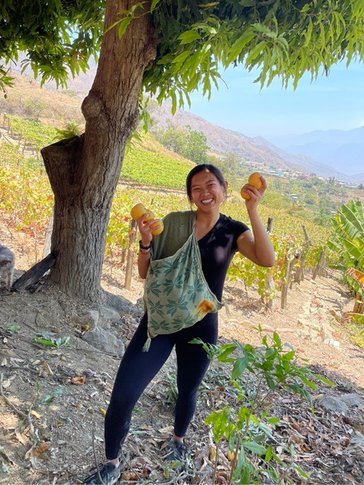
Among many, one highlight that keeps on giving is the time my host family and I spend at our farm. I once described the farm to a friend as a “sprawling amalgamation of fruit surprises.” Depending on the season, you never know what is going to be ripe and ready for picking—oranges, mangos, papayas, pomegranates, dragon fruit, figs, starfruit, strawberries ... the list goes on. Recently, I found my first chirimoya tree. My family and I often go to the chacra (farm) on Mondays for a picnic and to tend to the grapes, as they have a family business making and selling wine. There, we plant or pick this or that and eat fruit after fruit, as cumbia music plays in the background. It is at the farm, with gentle mountains in the distance, that I am often struck by the beauty and wonder of where I get to call home.
5. What have you enjoyed most about the community where you are serving?
Friendship, of course, is both the corniest answer and undoubtedly the truest. The heart of any community is its people, and I have found such wonderful people in mine. My work partners welcomed me and my rough Spanish with open arms, eager to collaborate on ideas, and bringing me along for the ride to any work events. Teachers at my school were happy to chat during down time and to involve me in school activities or celebrations. As a fairly small community where everyone knows everyone, I quickly got used to the fact you can’t go on a short walk anywhere without exchanging numerous enthusiastic hellos or stopping to chat with someone. I feel so grateful that, for me, my community is not just where I work, but where I feel welcomed in so many different ways.
6. What are some of the most important things you’ve learned from your community?
Living in a small community for over two years is such an intimate form of immersion. I feel so grateful that every day I continue to see or experience or learn something new.
One thing my site has taught me is that everyone really cares about everyone. Just last month I was confused why we were suddenly eating cachangas (fried flat bread) with dinner more frequently. When I asked my host family, they said it was because two kids were selling them to help their mom, who had fallen sick. I asked my family who it was. “Oh, we don’t know their names,” they said, “but we know them.” Small demonstrations of kindness and sharing happen constantly, and I have appreciated learning my community’s sense of relaxed collectivism.
7. How do you spend time when you are not working on a project?
During my free time, I love to play soccer, go on runs, explore the farm, spend time with friends, help with the grape-making process, or read. While soccer is my favorite form of activity, I also enjoy running an uphill route on the outskirts of my community or going to the small gym we have. I have also gotten in some exercise stomping grapes and helping with other stages of the wine-making process. Other times, my friends and I explore nearby waterfalls, play card games, or teach each how to prepare new snacks (for example, I learned tequeños (fried cheese); I taught banana bread). However, I’ve also found plenty of time to slow down, devouring books at a rate I haven’t managed since high school, and share recommendations with other Volunteers.
8. What are you looking forward to in your remaining time as a Volunteer?
I’m excited to hit the ground running this school year, as I’ll be able to work with the same students I worked with last year and try to implement some new projects. I’m looking forward to more competently carrying out and supporting workshops, now with more experience and better Spanish.
I’m excited to experience traditional holidays such as my community’s annual grape festival, and I’ve expressed a desire to learn how to prepare some staple Peruvian dishes from my host mom. And, of course, I still have lots of travel plans to explore the diversity and beauty of Peru.
9. Once you finish your service, what will you do differently when you return to the U.S.?
When I return to the States, I hope to have a more go-with-the-flow mindset, a stronger confidence in my abilities to adapt, and a new ease with independence. As someone who was always armed with a daily agenda book and a plan, I have learned a more flexible and relaxed approach in Peru. In my community, hora peruana reigns supreme and last-minute changes to plans (or making of plans) are almost guaranteed. Peru has helped me learn to think on the spot in a classroom or competently modify plans for a professional panel … ten minutes before the panel.
Besides a changed work mentality, I also think I’ll carry back a sense of comfort in solitude. An extrovert at heart, I always want to be surrounded by people. In Peru, I have also cultivated a sense of contentment being alone, whether that’s reading in my room or on a solo walk to the farm. Finally, I hope to bring back a new awareness—a less U.S.-centric perspective and a deeper gratitude for the small stuff.



