 An official website of the United States government


Featured Volunteer Profile
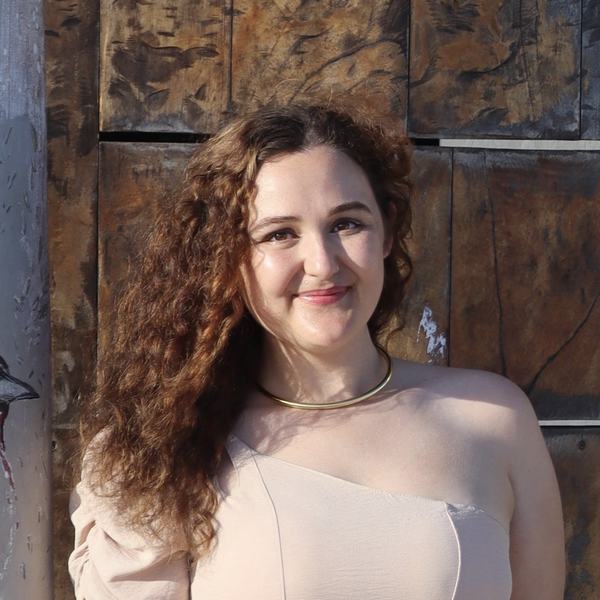
Lauren P.
“Instead of seeing deer or squirrels crossing the road, I see sea lions and giant tortoises. Even though it’s become part of my daily life, it’s still hard not to be amazed.”
1. What inspired you to apply for this Peace Corps position?
I served as an Education Volunteer in Ecuador for the two years preceding my application, had a background in wildlife, and had always dreamed of visiting the Galápagos. Over the course of my service, I built both personal and professional connections to the country, and fell in love with its environment, its cultures, and its people. This position felt like a natural extension of that experience, allowing me to continue working in a country I had come to love, while allowing me to utilize my background in conservation.
It seemed like an amazing opportunity, and the fact that it was available at the end of my service felt like kismet. It all came together in a way that made applying feel like the obvious next step.
2. What projects are you working on with your community?
There are always tons of projects running concurrently within my partner organization; most of my day-to-day work involves reviewing collected data. My largest ongoing project is reviewing camera trap images that have been collected from Wolf Volcano, the highest point on the islands, and the only habitat of the critically endangered Galápagos pink land iguana.
I also have an upcoming 12-day work trip to Santiago Island, where I’ll collaborate with a team to monitor Galápagos petrels—a critically endangered endemic seabird that lays its eggs in underground nests.
3. How have you leveraged your previous professional experience in your service?
I had experience with geographic information systems (GIS) and reviewing and analyzing data prior to service, and it has proved invaluable during my time here. It allowed me to take on more technical responsibilities earlier on. I was able to support data collection and analysis, help organize information, and contribute to a wide variety of projects. Having that background also made it easier to understand the work being done, how I could effectively contribute, and support the organization’s efforts.
Living in Ecuador prior to this role also allowed me to adapt more quickly. I was familiar with the language, the work culture, and day-to-day realities of working with an Ecuadorian organization, which made integration easier. My time in Peace Corps also gave me confidence in navigating challenges and adapting to new environments, which was essential throughout my service.
4. What is a highlight of your time in service so far?
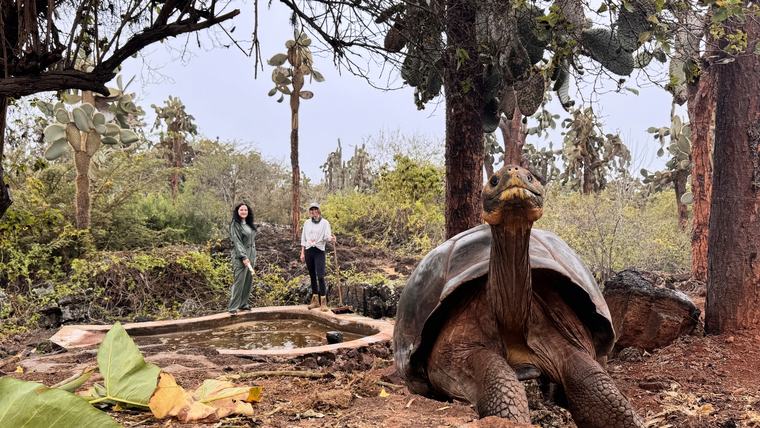
One of the biggest highlights of my time in service so far has been the opportunity to get up close with so many unique and world-famous animal species. I see Darwin’s finches and mockingbirds every day on my walk to work; these animals that I grew up only seeing in textbooks are now as normal to me as pigeons. Instead of seeing deer or squirrels crossing the road, I see sea lions and giant tortoises. Even though it’s become part of my daily life, it’s still hard not to be amazed.
I also got to work with the descendants of the Floreana giant tortoises at the Fausto Llerena breeding center, and the subspecies was finally reintroduced to Floreana Island after almost 200 years. It’s such an incredible honor to have contributed in some way to such a historic event, and it’s something that I’ll cherish for the rest of my life.
5. How have you navigated the challenges of service?
I worked on developing strong relationships, which I’ve found are crucial to navigating challenges. Having a support system at site is vital for Volunteers. Taking the time to establish trust and open communication with my counterparts also made it easier to address issues as they arose.
When I felt stuck, I learned to step back and reevaluate both the situation and my role in it. Often, there was a simple solution that I wasn’t seeing because I was too focused on a specific approach.
I also made a point to reach out to my program manager for guidance when needed. The Peace Corps Ecuador staff are there to support Volunteers, and my program manager was always happy to listen and to offer advice.
6. How has your service shaped what you will do in the future?
I have seen how many organizations must work together to further conservation efforts, and now have a better appreciation for how complex it truly is. I’ve been given a firsthand glimpse of how strong, well-designed policies can effectively guide conservation work, and, at the same time, how inefficient or unclear policies can stall progress, even when there is strong commitment from the people involved.
As a result of my service, I’ve decided to study environmental policy so that I can contribute to conservation efforts on a larger scale. I want to better understand how policies are designed and implemented, and how they can be used to create more effective, sustainable outcomes. Ultimately, I hope to have a role in shaping the policies that guide conservation work.
7. Tell us about someone who’s impacted you during service.
I’ve been hugely impacted by some of the incredible female scientists I’ve met during my time in the Galápagos. I’ve had the pleasure of getting to know women like Jess and Carolina, counterparts in my partner organization who have been consistent sources of inspiration throughout my service.
As I worked in a male-dominated space, I became more aware of the subtle ways women can be underestimated or steered away from hands-on and field-based work. Even Jess and Carolina, whose academic backgrounds are more extensive than many of their male colleagues, often face the same challenges.
What I particularly admire about them is how they approach these issues. They are both highly accomplished and continue to assert themselves in spaces where their abilities are not always recognized. I believe their determination is helping to shift expectations and open doors for other women in the field, and I admire their commitment each and every day.
8. What is the most interesting thing you’ve learned about your host country?
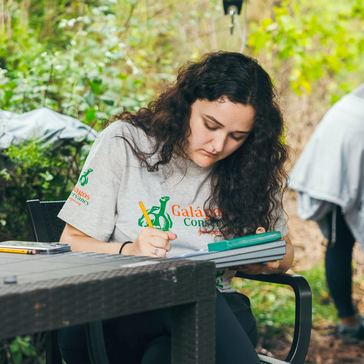
One of the biggest things I’ve learned is the importance of working alongside local community members. The Galapagueños I’ve worked with are passionate about their community and about conservation and have an incredible wealth of knowledge developed over years, or even decades, working with these species.
Their lived experience and long-term commitment to the islands have taught me that meaningful, sustainable work can only happen through collaboration and mutual respect. I’ve learned to listen first, to ask questions, and to recognize that local expertise is just as important, if not more so, than any formal training. Being part of a community that cares so deeply about protecting its environment has reinforced for me how essential it is to support and uplift local community members in the field of conservation.
9. How have you shared the culture here with family and friends back home?
The Galápagos is an attractive place to visit, and I’ve been fortunate to have several friends come and visit me during my service, and experience elements of the culture firsthand.
Beyond that, I’ve shared my experience through conversations with family and friends, talking about my work, the community, and what life is like here in the Galápagos. Sharing my stories and experiences has been a great way to introduce my friends and family to the culture, and to the realities of everyday life here.
I’ve also shared photos and updates throughout my service, which always piques people’s interest. I’ve had a number of people reach out to me to ask questions about my work, my life here, and about the Galápagos as a whole.
10. What would you say to someone thinking about joining the Peace Corps?
I was very confident throughout the application process and the medical and legal clearances. After all, I had known for years that I wanted to serve. And then, the night before I was set to leave, the reality of what I was about to do really hit me. I was terrified. But I pushed through, because I didn’t want fear to stand in the way of such an incredible opportunity. And I couldn’t be happier that I did.
So the advice I’d give is pretty simple: do it! It’s normal to be nervous, but pushing through that fear can lead to opportunities and experiences that you never imagined. My service has been incredible. It’s helped me grow as a person, opened new doors, and led to friendships I’ll carry with me for the rest of my life.
Learn more about serving as a Peace Corps Response Volunteer.



