 An official website of the United States government




Featured Volunteer Profile
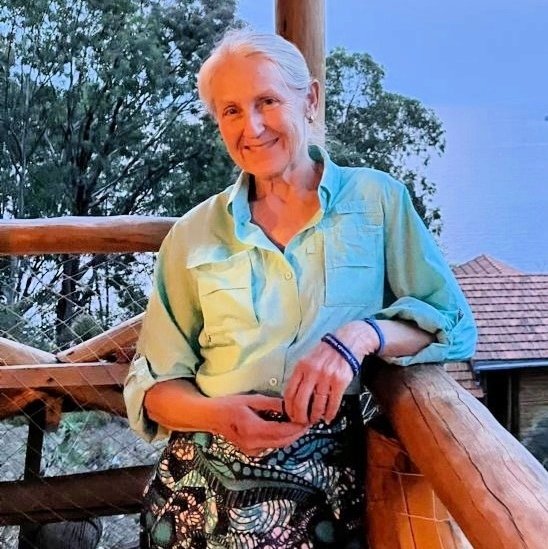
Kathy K.
“One of the best compliments I receive is, 'Uri umuyrwanda,' which means ‘You are a Rwandan.’”
1. What got you interested in Peace Corps?
I’ve volunteered before (at a wildlife refuge for five years), but I’m not someone who spent holidays serving meals at a soup kitchen or used vacation time to build houses for humanity. I was never one of those people who “always wanted to do Peace Corps.” It just wasn’t on my radar – not after college, not when I got married, not when my husband and I raised two sons, and not even when I retired. Peace Corps was something I’d heard about in college in the 1970s. I wasn’t looking for a job. As a retired labor and delivery nurse, I was happy feeding orphaned raccoons and rescuing sick pelicans. My husband had worked in global health engagement during his military career and, a few years ago, I was surfing the internet looking at potential retirement jobs for him, when I saw a post from Peace Corps for a Maternal Child Health Volunteer in Rwanda. I only had to read it once to know I wanted that job.
2. What projects are you working on?
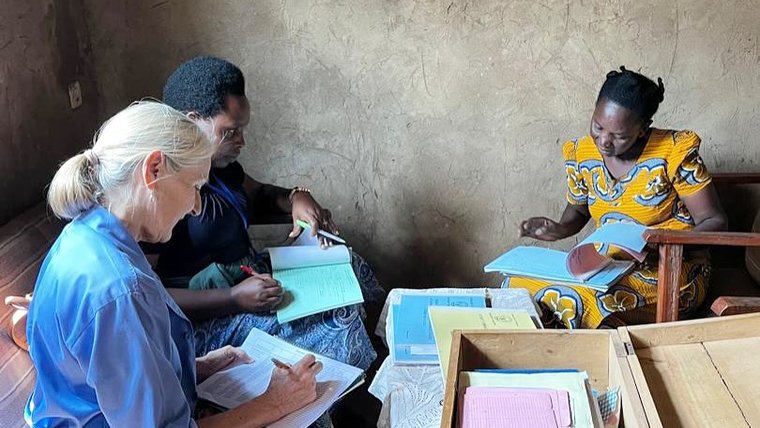
Over the past couple years, I have engaged in many activities related to nutrition and hygiene with my counterparts, who include the community environmental health officer (CEHO) and the nutritionist at the health center. For example, I spend a lot of time with the nutritionist doing growth monitoring—measuring height, weight, and middle upper arm circumference (MUAC) of children under two years of age and pregnant/lactating mothers to assess nutritional status. Those measurements allow a diagnosis of acute, moderate, or chronic malnourishment to be made and a determination of which supplemental food product(s) should be given. We distribute a porridge made of fortified flour (SHISHAKibondo), a corn-soy blend (CSB), milk, and a ready-to-eat therapeutic formula (RUTF) to over 500 malnourished mothers/children on a weekly or monthly basis.
With my CEHO, I am regularly involved in activities in the community such as monitoring and collecting reports from the Community Health Workers (CHWs), supervising the CHWs in various campaigns such as measles and polio vaccinations and Maternal Child Health Week, doing home visits of CHWs to assess their knowledge/skills and measures of their hygiene, and working on Excel spreadsheets and graphs to monitor trends in selected indicators.
To try and improve the sanitation at the health center, we have trained the cleaning staff, built handwashing stations, inventoried cleaning supplies, and displayed information regarding hygiene and sanitation at different levels of detail within the health center.
Currently, my counterparts and I are on a team to supervise the CHWs in a health mobilization campaign to educate about mental health and encourage purchase of community-based health insurance. Outside of the health center, I am working with the headmaster and librarian at a local school to provide recreational reading materials to the students during their summer break.
3. What strategies have you used to integrate in your community?
When I first arrived at site, going out in the community wasn’t easy. I didn’t know anyone, and I didn’t know the culture well enough to interpret the subtleties of expressions and behaviors. Open staring, children asking for money or following me, and crowding on the bus made me uncomfortable. Over time, I’ve come to know that a greeting—especially in Kinyarwanda—and a smile will disarm anyone! Rwandans are friendly people; they expect and thrive on greetings and introductions. It’s a very simple solution with a huge reward! Now, I enjoy walking in my community and greeting random strangers and having short conversations in Kinyarwanda or allowing students to practice their English as we walk along. I love that small children will rush towards me and give me a big hug. I appreciate the light in the eyes of an older woman when I wish her a good day. And, when I walk through the village and hear, “Umuzungu!” (the Kiswahilli word for a Caucasian person) yelled my way, I know it will likely be accompanied by a big wave and a friendly smile.
Integrating in the community involves getting out there—participating in Umuganda (a monthly Saturday devoted to community service), shopping at the market, attending the Kwibuka commemorations (day of remembrance for genocide victims), going to weddings and baptisms, and, for me, wearing igitenge – the traditional fabric of Rwanda. One of the best compliments I hear is, “Uri umuyrwanda,” which means “You are a Rwandan.”
4. What is a highlight of your time in service so far?
One of the highlights of my service was working with a group of teenage mothers. The group began with 12 participants and, after collaborating with a dedicated local NGO, increased to 56. With the NGO and my counterparts, we applied for—and received—a $10K grant called “Empowering Teen Mothers to Support Themselves.” The implementation plan included five training events around the topics of resilience, nutrition, small business/marketing, basic animal husbandry/goats, and advanced animal husbandry/goats. Upon completion of all the training, each teen mother was to receive a goat. The first training about resilience was given by my counterpart, the CEHO, and she rocked it. I could see hope in the eyes of the teen moms! It was so exciting to see the energy in this first kick-off training!
And then the USAID-funded grant was discontinued. Full stop. That halt required ending all grant activities—there were no more trainings and the goats were never distributed. It was a difficult situation to explain to the participants and my community.
However, despite the end of the grant activities, for me a highlight came in an unexpected way. In time, the NGO used their own organizational funds to continue engaging with these 56 teen mothers. I was so happy these young women were going to get more of what they needed because of the connection I’d made. The NGO invited me to a kitchen garden training they were presenting, and I wondered what kind of reception I would receive from the teen moms. When I arrived, the teen moms all began applauding and cheering; it was so heartwarming. And most importantly, I could see that they were, indeed, resilient!
5. What have you enjoyed most about the community where you are serving?
My community is a mixture of a market-centered core and 30 rural villages. I’m able to connect with shopkeepers, farmers, teachers, and health providers, among others. I am witness to families of means and children with no means. I engage with everyone from small children to men and women walking with canes. There are people of many religions and probably some without. I like having these opportunities to experience a variety of people, living situations, and perspectives. I especially enjoy the friendships I’ve made among this population. My community has made me feel welcome, safe, and appreciated in so many ways.
6. What are some of the most important things you have learned from your community?
I think one of the most important things to be learned from my community is their ability to put things in perspective. They do not complain of being tired, or of being hungry, or of not having things. When faced with a disappointment, they quickly shrug it off and move forward. They use their history as a baseline and know that the challenges they are facing are ones they can handle because they have survived worse. They don’t talk about it. They just face life with courage and acceptance and grace. These are lessons I will take with me when I return.
7. How do you spend time when you are not working on projects?
When I am not working on projects, I spend a lot of time communicating with my family and my friends. I miss my husband and sons, and I miss talking with my friends. Feeling free to have conversations as long and as often as I want with them is one of my coping mechanisms for being here alone and sometimes feeling isolated. I’ve also always been a big reader, so my Kindle is loaded, and I can spend a Saturday evening deep in a story. Sometimes that story is on Netflix!
8. What are you looking for in your remaining time as a Volunteer?
My service is coming to a close in a couple of months. During this time, I’m looking forward to being replaced at site and being able to share some of my knowledge with the incoming Volunteer. I will continue with the regular work I do at the health center, complete any projects, and put together my last quarterly report. I will complete the medical and administrative tasks required to complete service and sort through my belongings to decide what to take home with me. I will relish the anticipation of seeing my family again soon. And, mostly, I will look forward to sharing with those here in Rwanda how much they have enriched my life with their kindness, their patience, their knowledge, and their willingness to let me into their lives.
9. Once you finish service what will you do differently when you are in the U.S.?
When I return to the U.S., most of my life will be the same as before my service. I’ll have my coffee in the morning—but I’ll wish it was Rwandan coffee. I’ll volunteer again at the wildlife refuge—and understand what it really means to be a low resource organization. I will appreciate the clean water that flows from the tap and be more willing to adhere to “if it’s yellow let it mellow” and other ways to reduce consumption. It’s said that you can’t teach an old dog new tricks, but no one says you can’t teach the old tricks in new ways.
Learn more about serving as a Peace Corps Volunteer in Rwanda.



