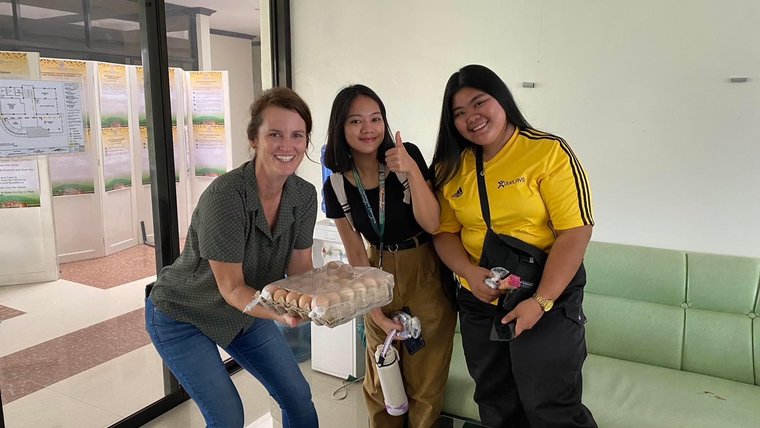
An official website of the United States government




Featured Volunteer Profile
Julie N.
“If you pay attention, use your patience muscle, remain flexible, and laugh out loud at least three times per day, the world is your oyster.”
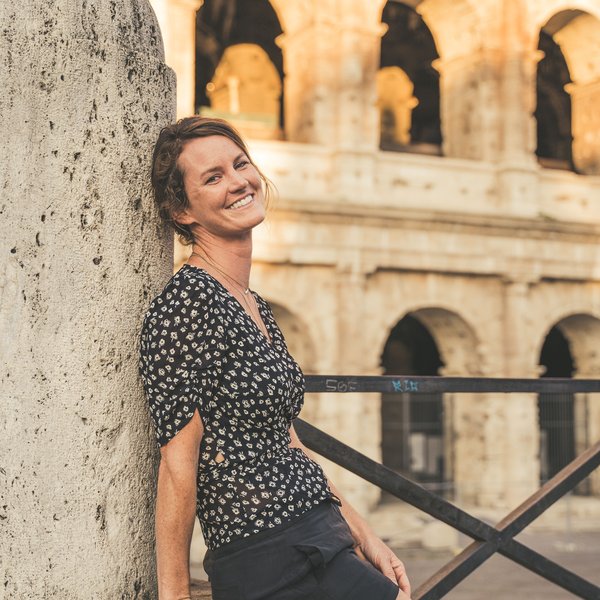
1. What got you interested in the Peace Corps, specifically the Response program?
Initially, I just felt stuck in my previous job and was emerging from my post-pandemic cocoon, eager to get back into the sustainable development sector and work abroad again. I had worked on a USDA grant program in my hometown in Puerto Rico during the pandemic to assist farmers with the island’s food insecurity challenges. After wrapping up the project I wondered if I could take my grant writing skills somewhere else and collaborate with local people to go after these types of funds. I wasn’t able to dedicate another full 27 months, but the Response Program seemed like a great fit: detail-oriented work with measurable outcomes, networking with NGOs and other institutions, and also a great way to connect with in-country professionals to swap work skills, life experiences, and similar interests.
2. What projects are you working on with your community?
The best part of my work here in the Philippines is the flexibility to cast a wide net and see what shakes out. The possibilities are endless and the potential for proof of concept and pilot projects makes it a fun and engaging atmosphere where my team and I strive to solve challenges that all of us face in our own backyards, so to speak. By working together and using our shared life experiences to tackle some of these issues, we really complement each other and are able to find unique solutions, drive innovation, and create action plans for real change.
I’ve helped draft a five-year agritourism plan for the region to include the university as well as adjacent communities, or barangays, which include the 9,000-acre dormant volcano and national park, Mt. Arayat. The plan encompasses a sustainability plan focused on natural resource management, sustainable tourism, elevation of the knowledge and the lived experiences of the indigenous Aeta people, economic vitality for agricultural prospects, and increasing food security strategies. The next phase is to introduce the LGU (local government unit) to the Sister Cities International Program, the UN’s Global Village, and the framework outlined from the Global Sustainable Tourism Council to help strengthen the objectives of the agritourism plan and to help connect university staff and city officials internationally.
Additionally, I also really, really love pickleball and have worked closely with Selkirk Equipment to help foster the University’s first league on campus. The U.S.-owned company donated a box of brand-new paddles and balls and it’s all the rage on campus right now. The sports director is already talking about making it a chartered sport, which is super cool.
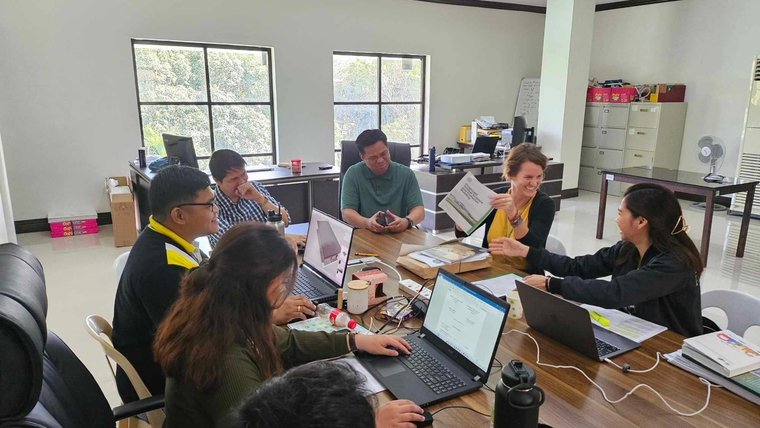
3. How have you leveraged your previous professional experience and skills in your service?
I know that people are always your best asset in whatever work you do, so it’s not surprising that “people first, work second” is a commonality between my previous experiences and how I’ve leveraged those relationships to “go slow to go fast.”
Having worked in many countries and many capacities, adaptability is key for a successful project. Reading a room to determine the mood and anticipating how you’ll respond to questions that may not seem customary in an office setting keeps you on your toes, builds relationships, and gives you a glimpse into how things operate locally. If you pay attention, use your patience muscle, remain flexible, and laugh out loud at least three times per day, the world is your oyster.
4. What is the highlight of your time in service so far?
I was invited to participate in a presentation and panel discussion with a diverse group of university scholars to address a broad range of topics including conservation, responsible tourism, Indigenous knowledge, and land use in the Philippines. The symposium was attended by 500 students and went for nearly three hours. The students had remarkable questions and were eager to learn how their college experiences could align with the goals of the Philippine Development Plan. They want to get involved and solve problems.
We’ve since created a student steering committee to begin working on challenges related to sustainability, waste management, and volunteerism on campus. We invited two-year Peace Corps Volunteers for a panel discussion for university students to connect with Peace Corps Volunteers. It was a great success, as both Volunteers and students came away with ideas to encourage volunteerism in their communities. It was also a great opportunity for Filipino students to connect with recent U.S. graduates to ask questions about the college experience in the United States and learn more about studying abroad there.
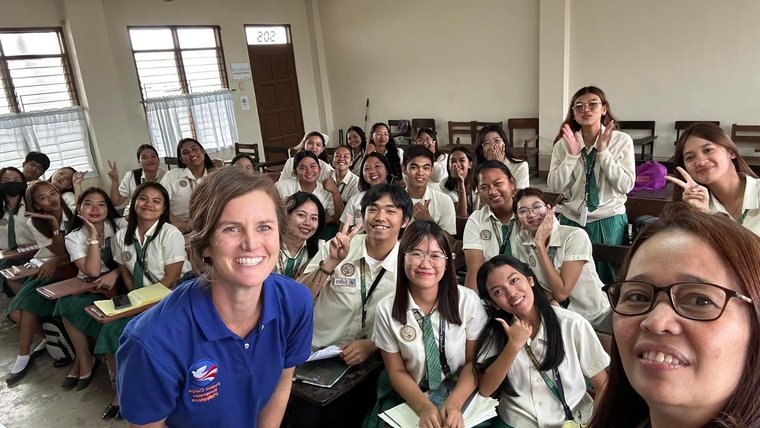
5. What strategies have you used to meet the challenges of a Response Volunteer experience?
There’s an ongoing joke in my office about a hamster and the internet: if the internet goes out at random times without notice, the hamster falls off the wheel. In this digital age, where everything relies on connectivity and productivity, the lack of reliable internet puts additional strain on the responsibilities required of both my officemates and me.
How do we meet this challenge, you ask? Card games. Playing music. Going for merienda (coffee/snack time). Reading books. Drafting plans in Word. Adaptability. And when the hamster is running for its life and we have internet without interruptions, you can hear a pin drop as we’re frantically catching up, drafting, and typing our fingers to the bone.
It’s not perfect and definitely accounts for the multi-faceted challenges in the office. A level of patience, cooperation, initiative, and flexibility is what’s needed. The rewards are endless. So, sit back and enjoy the round of Uno. There will always be work at some point. Sometimes it’s good to just be present.
6. How will the skills you are developing help you in the future?
The training and support I receive from Peace Corps is unmatched and invaluable. I’ve learned language skills, cultural norms, what not to do, and best practices to integrate into the office and community. I’d like to work with the International Trade Association as a cultural liaison or a global trainer to empower business leaders with the cultural finesse to navigate the country where they’d like to do business. Ultimately, I’d like to stay in the international circuit and work abroad.