 An official website of the United States government




Featured Volunteer Profile
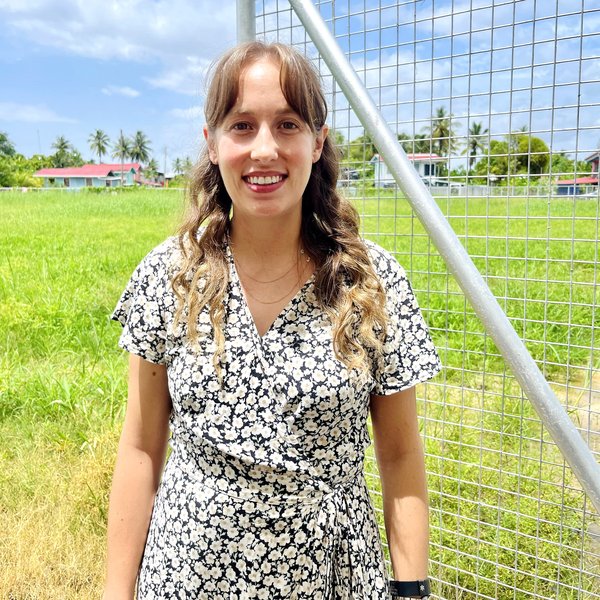
Georgia M.
“Guyana has a saying 'just now,' meaning it could happen in five minutes or five months. As someone who’s used to planning all my time, embracing 'just now' has taught me to focus on the moment.”
1. What got you interested in the Peace Corps?
I learned about the Peace Corps at a very young age and immediately knew it was for me. The idea of immersing myself in another culture and creating international friendships sounded like a dream. I also valued the fact that the Peace Corps only goes where their assistance is requested and creates partnerships that benefit all. While I planned to apply after I retired, life began sending me signs that the time to volunteer was now. I applied for the “serve where needed most” position, and when I found out I was going to Guyana, I knew it was meant to be.
2. What projects are you working on?
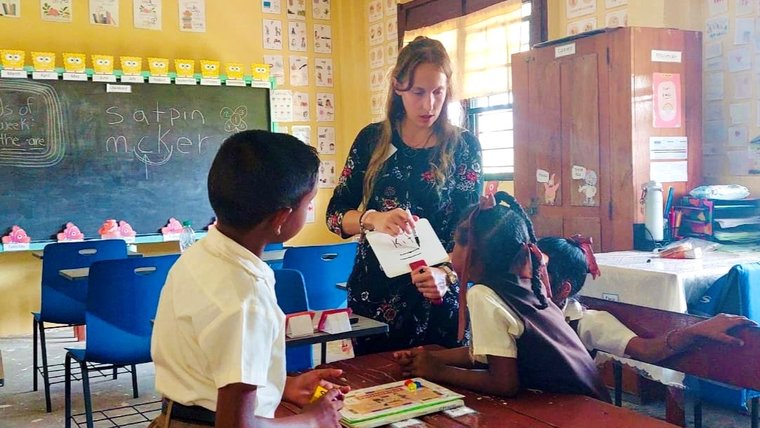
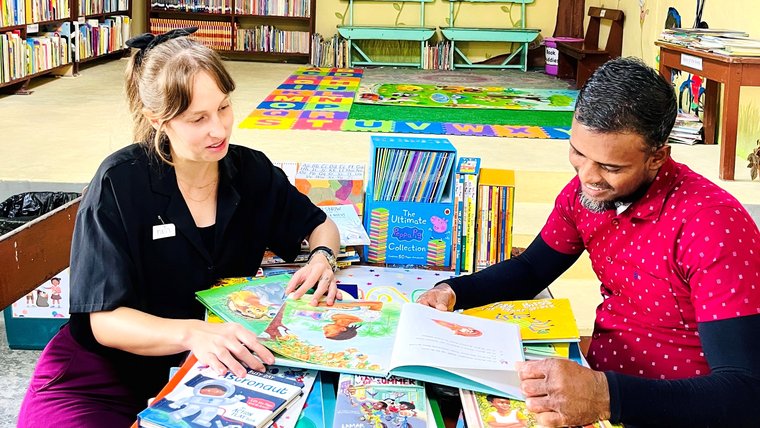
As a Primary Literacy Promoter, my focus is the “read to achieve” project. Working with headteachers, teachers, and parents, I help children learn to read. I conduct pull-out sessions, where I work closely with small groups of students who need extra support with literacy skills. In addition, I’ve worked with my school and community to convert their storage room into a library. Everyone chipped in, from teachers who donated supplies and ideas, to the chairman of our parent teacher association (PTA), who painted murals with me over winter break. A local store donated a rug, and another school let us visit their library for inspiration. Now that the school has a library, we can create events to engage more readers. For example, we host reading competitions during the school year and are planning a festival of books to celebrate our recently received donations. My role is continually growing, as I move into more co-teaching opportunities in the classrooms. Every day brings something new, and I look forward to seeing where the rest of my time here takes me.
3. What strategies have you used to integrate into your community?
My host family has gone above and beyond to help me feel welcome in the community. My first day here, they walked me around the neighborhood so I could feel comfortable in my surroundings. I met a teacher who I would work with, future students who were playing outside, and I even got to tour my school. They answered all my questions and helped me map out places to go on the island. They’ve also taken me to various gatherings, events, and around the island on their boat. They’ve not only made sure I feel part of the community, but a part of their family as well.
For my part, when I first moved here, I made sure to walk the main road in my community and visit all the shops, taking time to introduce myself to the owners and people I passed, while getting to know where to purchase necessities. It’s a small community, so many of the people I met I now see regularly either at school, on my runs, or around town.
4. What is a highlight of your time in service so far?
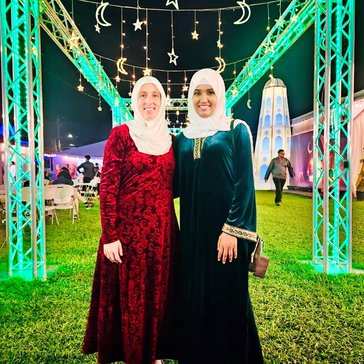
I love the beautiful blend of cultures and religions in Guyana. I’ve visited the Ramadan Village with my resource family, thrown colored powder with my students for Phagwah, and watched the air fill with kites on Easter Monday. The people of Guyana always have something to celebrate, and every celebration has an abundance of food. Eating seven-curry (seven different meatless curries) from a giant lotus leaf and being sent home with a bag full of desserts (sweet meats), is a regular occurrence. I also love the enthusiasm students show for me, even after months of working together. They’re always excited to see me. It reminds me that my role isn’t solely about teaching, it’s about being a part of their lives and embracing the connections I get to build here.
5. What have you enjoyed most about the community where you are serving?
Being in a small community means everyone knows everyone, and here they really watch out for each other. It brings a sense of security and comfort, no matter where you go. Plus, whenever I leave my house, I’m bound to see at least a couple of my students along the way. Their smiles always brighten my day. The abundance of fresh, locally grown fruits and vegetables has also exceeded expectations. We joke how in America there is a special aisle for organic fruits, but here everything is organic and locally grown. Some come straight from my yard. Since coming to Guyana, I’ve been introduced to more than 50 new fruits. I honestly didn’t think that was possible.
Another great thing about where I live and volunteer is that it’s on one of Guyana’s many islands. So, for example, on bank days I get to take a boat when I go to the mainland. I love the water, and before coming here I always joked that I was seeking a friend with a boat. Little did I know how lucky I would be.
6. What are some of the most important things you’ve learned from your community?
I’ve learned to be more flexible. Guyana has a saying “just now,” meaning it could happen in five minutes or five months. As someone who’s used to planning all my time, embracing “just now” has taught me to focus on the moment. Time waiting on the boat allows me to build new connections or catch up on my reading. Not knowing when an event will actually start means I get to be present and take in what’s happening around me. I’m also impressed by how easily Guyanese people make things happen. When something needs to get done, neighbors, friends, and community members pitch in, all while gyaffin (chit-chatting) and enjoying a fresh breeze.
7. How do you spend time when not working on a project?
I love to run, so I’m lucky to be in a community that has plenty of space to do so. Since it’s a small community, I always pass people and students I know. They always wave or say “hi.” I also love taking in the tropical flowers, goats, cows, and the occasional donkey or horse. At home, I enjoy reading, journaling, drawing and yoga. There are actually quite a few locals interested in yoga, so we’ve been working to get a class set up at my school. My community is very welcoming, so there are lots of events to keep me busy, no matter the celebration or holiday; the community always makes me feel included.
8. What are you looking forward to in your remaining time as a Volunteer?
My host family has promised to take me to a nearby island known for its beach. Unfortunately, the tides have not cooperated. But I know someday they will and, as the Guyanese say, it will happen “just now.” My host sister and I are close in age and have a lot of similarities, so I always look forward to spending time with her. It’s fun to see how two people growing up in very different places can be so alike. Finally, I hope to visit other parts of Guyana. I explored some of the rainforest when my parents came to visit, but I still want to see Region 9 and go to the rodeo. I love how diverse Guyana is with the coastal areas, grassy savannahs, and the rainforest. Every region I visit has such a unique feel. Plus, I am a squirrel fanatic, so I’m always on the lookout for my first Guyanese squirrel.
9. What will you do differently when you return to the U.S.?
As an introvert who grew up in America, an individualist culture, living in Guyana, a collectivist culture, has shown me how beneficial knowing your neighbors can be. I’ve learned I have more capacity for connections than I thought, but also what my limits are. Because, while I love saying “yes” to every new opportunity, in order to be the best version of myself for my students and the community, it’s important to say “no” sometimes. I hope to keep that balance of making community connections while allowing myself the time I need to recharge when I return to America.
Learn more about serving as a Peace Corps Volunteer in Guyana.



