 An official website of the United States government


Featured Volunteer Profile
Emily P.
“Going the extra mile to make someone feel welcomed, comfortable, or loved, will never ever be time wasted. Here, especially when it comes to serving guests, it’s expected.”
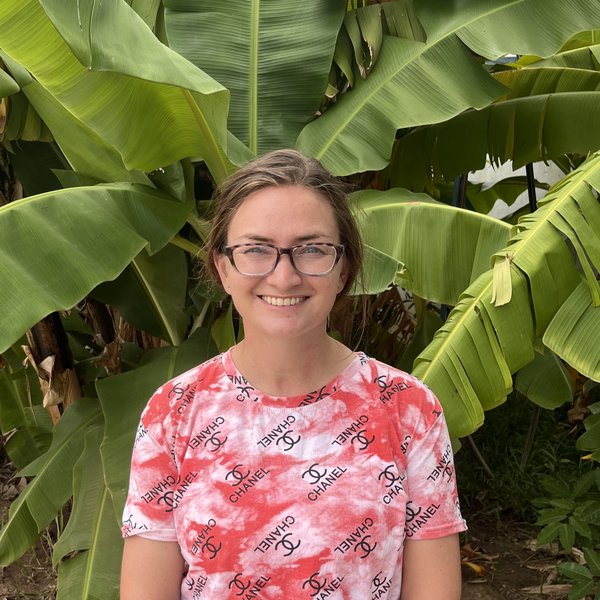
1. What got you interested in the Peace Corps?
My first memory of the Peace Corps is from elementary school, when a test asked students to name the organization that sent Volunteers overseas. A lot of my family had rarely, if ever, left the U.S. before, and I had never imagined what it would look like to live or work in a different country. But then in high school and in college, I felt this need to go somewhere different, somewhere I felt like I could learn more about myself and the world around me.
My parents got me involved in volunteering when I was young, and I have always loved learning about different social justice issues. The Peace Corps felt like a unique way to gain new perspectives on some of those issues. These past 7 months in The Gambia have been some of the most challenging in my life, in terms of integrating into a new culture and adapting to a new diet. Yet in some ways, it’s also felt like the easiest time in my life in that I get to focus on doing what I love, while spending time with some of the most incredible and loving people I have ever met.
2. What projects are you working on?
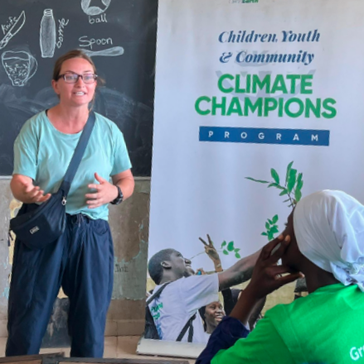
As a Nutrition and Food Security Facilitator, my primary project is collaborating with the local women’s association to improve their community garden. We are currently doing weekly collections in the village and have also applied for a grant from a local organization in order to replace the fence and water system. I’m working with my counterparts (Hawa, a member of our women’s association, and Jewru, a local business owner and agriculture expert) to get organization management trainings in place from local experts for the women’s leadership team. The goal of these trainings is to further empower leaders in the women’s association, while helping them create sustainable systems to take care of the community garden and future projects for years to come. I am also preparing a papaya nursery, so that Hawa and I can train local women on how to transplant, sell, and hopefully, propagate papayas to make additional money for their families.
Additional projects I am working on include conducting a weekly English class for adults in three local villages, fundraising to repair our school’s computer lab, and facilitating computer skills workshops for teachers. Finally, 5 months ago I started teaching agriculture at the local middle school for grades 7 and 8.
3. What strategies have you used to integrate into your community?
In Gambian culture, families sit around one or two large food bowls with each person sitting next to each other and eating their own “slice” of the food bowl. Eating out of one bowl, you have to be cognizant that you’re not taking from another person’s section, that you share the toppings in the middle of the bowl with everyone, and that you do not pull the best toppings until the eldest person at the food bowl has begun. The belief is that in sharing a food bowl together (whether you are family, friends, or strangers), you are understanding of and respect one another.
Eating with my family from our big family food bowl has definitely been a helpful way to integrate. My host family and many others in my village assumed that Americans wouldn’t eat Gambian food—it’s been really special to be able to share meals together, eating my family’s food and also sharing some American traditions as well.
Another helpful way of integrating has been going to a new compound every week or so to spend a few hours in the afternoon. It’s a bit out of my comfort zone in that sometimes I don’t know anyone in the compound, and sometimes no one in the compound speaks English. But it’s a great way to connect with new people I haven’t met yet, practice my Pulaar language skills, and actively take interest in the lives and families of my village.
4. What is a highlight of your time in service so far?
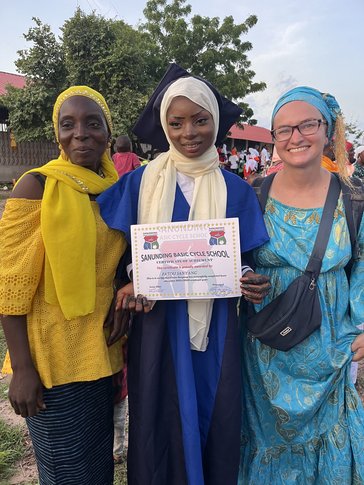
One of my favorite parts of service so far was going to my language tutor’s swearing in ceremony for an apprenticeship program through The Gambia’s National Youth Service Scheme. My language tutor lives in my village and is the same age as me but she never had a chance to graduate high school. After facing a few challenges in her adult life, she’s excited to participate in the free apprenticeship program, where she gets to learn about hairdressing and running her own business.
I helped her apply and prepare for the interview portion. My tutor and a friend of hers from a nearby village were selected for the program. She took a 7-hour bus ride to complete an intensive 20-day orientation on character building, mentorship, and discipline before the apprenticeship training began. It was her first time seeing the capital city! Another Peace Corps Volunteer and I happened to be in the capital at that time, so we were able to take pictures and videos of the ceremony to later share with their families. Seeing the pride, excitement, and incredible friendships that both my language tutor and her friend made during orientation alone was truly beautiful. I am honored to know my language tutor and to support her as she begins the rest of her program!
5. What have you enjoyed most about the community where you are serving?
The people. My village is very small. It’s about the size of a small suburban U.S. neighborhood with only about 30 compounds. However, unlike any neighborhood I’ve ever lived in, everyone knows each other, which compound they’re from, and almost every member of their extended family. (Mind you, some compounds have 20+ people living in them—that’s a lot of people and relationships to remember.)
Anytime there is a wedding, baby shower (called “naming ceremonies” here), or funeral, people from all over the village pitch in to help cook, clean, bring presents, and support with anything that the family may need. Our village has challenges like anywhere else, but the level of connectedness and compassion that the entire community has for each other is unlike anything I’ve ever experienced outside of my own family. My father is from a very small town in America’s southeast, and it’s really cool to see that most of my favorite aspects about small village life here resemble stories that my dad has shared about his hometown.
6. What are some of the most important things you’ve learned from your community?
Going the extra mile to make someone feel welcomed, comfortable, or loved, will never ever be time wasted. Here, especially when it comes to serving guests, it’s expected. From the day I arrived in my village, every member of my host family—from my 80-year-old host father all the way down to my youngest host brother—went above and beyond to make me feel at ease. I’ll never forget my 6-year-old host brother telling me that I was “really, really good” at things like fetching water (a job that he sees every woman in his family do everyday, and a job that I struggled with) just because he wanted to encourage me.
A lot of the communication and actions that happen here are unspoken, so I’m still learning. My family and community make me a better person every day by demonstrating how to anticipate each other’s needs and take care of one another. We are all a part of a larger system of life, and without one another, that system cannot work. It’s been rewarding to start to notice and act on opportunities to help others before anyone asks. It could be something as small as sitting and talking with my host sister when she’s had a frustrating day. Actions like this are acts of kindness everywhere in the world. But here, rather than it being an unexpected kindness, it’s very much the norm.
7. How do you spend time when you are not working on a project?
When I’m not working on a project, my favorite thing is to sit with my family or my counterparts’ family and try to help with whatever they’re doing. If it’s before the rainy season (farming season), that activity is likely hand shelling peanuts for a few hours. If it’s the day before a lumo (weekly supermarket), it is tying up mint leaves or onion leaves to sell. If it’s just a regular day, it could be playing cards or jumping rope with the kids. All of those activities lead to fun conversations with laughs and smiles and connection.
My favorite person of all to spend free time with is my host grandma. Whether she’s teaching me new Pulaar words, taking fun pictures with me in her new glasses, or shelling peanuts in silence lost in her own thoughts, I always feel at ease and happy when I’m around her. Not to mention, she also has a pet cat that will snuggle!
8. What are you looking forward to in your remaining time as a Volunteer?
In my remaining time as a Volunteer, I’m hoping to strengthen connections between my village and our local school. We have great teachers at our school, and amazing people in our community, but sometimes those two worlds function very separately. Teachers and parents in our village are slowly working to change that so that their children’s education has a stronger support system.
Additionally, many women in my village have expressed interest in learning business skills, learning how to make and sell soap, as well as growing different types of fruit trees to sell. Some families in our village find themselves in food insecure positions from time to time, which can make life very challenging for them and their children. I would like to collaborate with our women’s association to get some new income-generating activities for local women to feel more financially secure on a day-to-day basis. With additional income-generating activities and business skills, I’m hoping we can inspire new ideas and profitable careers.
9. Once you finish service, what will you do differently when you return to the U.S.?
The first thing that comes to mind is having a new appreciation for anyone living in the U.S. who speaks English as their second (if not third or fourth) language. Living here in a community where I must speak a different language most of the day has been challenging to say the least. Since English was my first language growing up, and I always lived in primarily English-speaking communities, translating my thoughts into a different language was never something I had to even consider.
Additionally, almost all Gambian children grow up learning a local language, such as Pulaar or Mandinka, with school being the first place they are ever taught English. By grade 7, the national curriculum expects Gambian children to read, write, and speak relatively fluent English for all of their classes. This is particularly difficult in rural villages, as some students don’t have any other family members who can read or write English. I am inspired by the language abilities of the kids in our villages each and every day. They often speak two or three local languages while also learning English!
The other thing I’d like to do differently in the U.S., is to bring some of the simplicity and peace that I’ve found living in the village here. In the U.S. with so many amenities and conveniences at the touch of our fingertips, it’s easy to create problems in your own head or over-complicate things. I’ve appreciated my time here in just learning the value of deep connections, seeing how freely people forgive each other, and knowing when it is time to stop the work and just rest.



