 An official website of the United States government


Featured Volunteer Profile
Dave M.
“The best strategy for integrating into your community is the simplest one: be present ... No one expects you to always have the answers, but you can offer a helping hand. The easiest way to know when support is needed is if you are present.”
1. What got you interested in the Peace Corps?
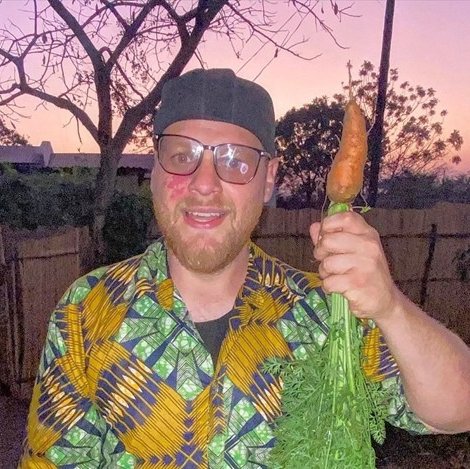
When I met my wife, Kelliesha, in 2014, she told me, “At some point, I’m going to Africa to serve in the Peace Corps.” At the time, it was a wild concept to me. I hadn’t left the east coast let alone the continent. She always knew she wanted to be a teacher when she grew up. I was working as a cook at the time and thought a job in the service industry could mean more than just a good meal at brunch. My research into Peace Corps’ programs got me thinking about people’s connections to food and the environment. We decided that we would apply and serve together.
It was a bit tricky to find a country that could accommodate a couple serving in different programmatic sectors with our qualifications, but we persisted and found a perfect match in Malawi—the warm heart of Africa. We were accepted for our positions and were scheduled to enter on duty June of 2020, but then the pandemic hit. After applying for two years, we were put on an “indefinite delay.” We remained committed to our Peace Corps dream, so when we heard that Malawi was accepting its first batch of Volunteers after a three-year hiatus, we were ready. We prepared and organized our lives to be gone for 2 years.
Six weeks before our departure, we were delayed an additional 3 months due to health risks in country. But at this point, we were masters of the waiting game. Patience makes great Volunteers! On August 14, 2023, Kelliesha and I arrived in Malawi and were sworn in as Peace Corps Volunteers. We were thrilled!
2. What projects did you work on?
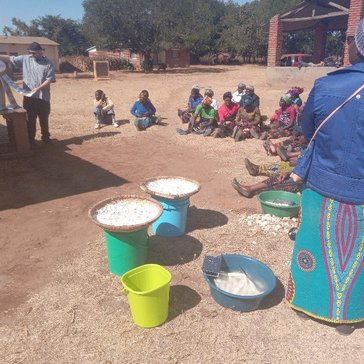
As an Environmental Education and Food Security Volunteer, I facilitated wildlife clubs at two secondary schools, where I taught about environmental conservation, conservation agriculture, animals, and crops of Malawi as well as the rest of the world. I also conducted formal and informal cooking demonstrations—mostly with women and young boys—to change the perception of gender roles in the village. By empowering the women through food service as an income-generating activity and building the capacity of young boys with this domestic task, I encouraged them to collaboratively change the cultural norms for gendered delegation of the domestic workload.
I also served as a Peace Corps Volunteer Leader. There was a recognized need for a liaison between Peace Corps staff and Volunteers. Peace Corps/Malawi created an extraordinary Volunteer Leader position to address these needs with four defined functions: collaborate with Peace Corps in-country staff to apply Volunteer insight to strategic objectives; enhance operational efficiency; support Volunteers in training and improve their overall experience; and engage communities in projects aligned with defined post programmatic priorities. In short, I help to make sure the Volunteers get the support from the staff that they need.
3. What strategies did you use to integrate into your community?
The best strategy for integrating into your community is the simplest one: be present. Allow yourself to sit in uncomfortable silences. Be with members of your community when they are working their way through problems. No one expects you to always have the answers, but you can offer a helping hand and the easiest way to know when support is needed is if you are present.
4. What was a highlight of your time in service?
After teaching my third wildlife club lesson, the class president asked if I wanted to write a song with him. I have no problem joking around and singing songs, so I said “Sure, as long as we make the song about protecting the environment.”
He came to my house the next day, and together we searched for free beats online. We sat there for roughly two hours writing verses and a hook for a rap song and had a great time! The song reinforced what the wildlife club learned, specifically the importance of preserving the environment and not cutting down trees. We even recorded it in a village-made recording studio with a microphone and old computer. We later performed it at a talent show in the village.
5. What did you enjoy most about the community where you served?
My community has a boarding house for students attending secondary school. My wife and I formed strong bonds with all the boys in the boarding house, and it made us both proud that the boys know we are there to support their personal growth. Plus, it made us feel truly integrated when teenage boys weren’t too cool to say hello to their teachers at the market.
6. What were some of the most important things you learned from your community?
One of the most important things I learned from my community is that a person is not defined by their work. I remember introducing myself by saying in my bad Chichewa, “Dzina langa ndi Dave. Ndine uchefi” (“My name is Dave. I am a chef.”) My profession was always the second thing I said about myself when explaining my identity.
People in my community identify not as carpenters, farmers, or shopkeepers, but as Amayi a Michael (Michaels’ mother) or Amuna a Lupika (Lupika’s husband). The locals proudly identify themselves based on their family relationships. The way Malawians always keep the focus on the person instead of your work identity was very eye-opening for me; it made me recognize the importance of my relationships.
7. How did you spend time when not working on a project?
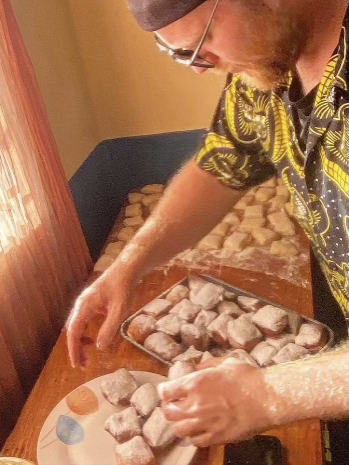
When I was not working at site or at the office, I would be cooking. Whether it’s cooking the Malawian staple dish nsima and ndiwo (a corn flour patty with various stewed vegetables and meats as sides), baking cakes with our neighbors, having dinner with nearby Volunteers or staff, or trying to figure out a way to make pierogis and soft pretzels in the village, I was always close to the stove.
8. What will you do differently now that you have completed service?
I have a changed mindset in how I conduct professional activities. I now make sure to consider how actions will affect the entire community. I believe service has shown me that even if someone thinks they are just a small part of the community, their actions can have a rippling, larger impact. Seeing the big picture for actions that I take in whichever community I find myself in will be something I keep with me.
Learn more about serving as a Peace Corps Volunteer in Malawi.



