 An official website of the United States government


Featured Volunteer Profile
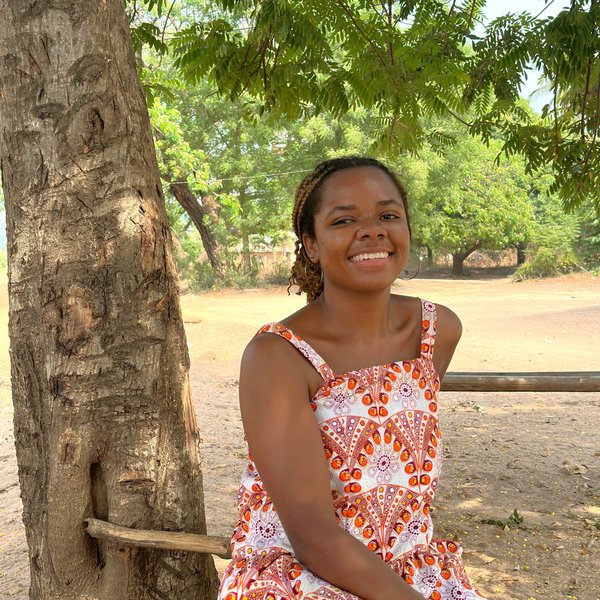
Courtney M.
“My time in Togo is filled with stories of people supporting me in endless ways. I’ve learned that asking for help is a strength, and much more effective than struggling to do things alone.”
1. What got you interested in the Peace Corps?
I’ve always been interested in travel and cultural exchange. The world is such a huge, diverse place, and it feels limiting to only ever experience an American way of life. I think sharing culture and experiencing another’s life is such an important part of developing empathy and understanding.
When researching international opportunities, Peace Corps’ two-year model really spoke to me. More than just visiting a place for a few weeks, Peace Corps would allow me to fully live and immerse myself in a new culture. The rare opportunity to live in a rural, west African village excited me and I knew Peace Corps was my next step.
2. What projects are you working on?
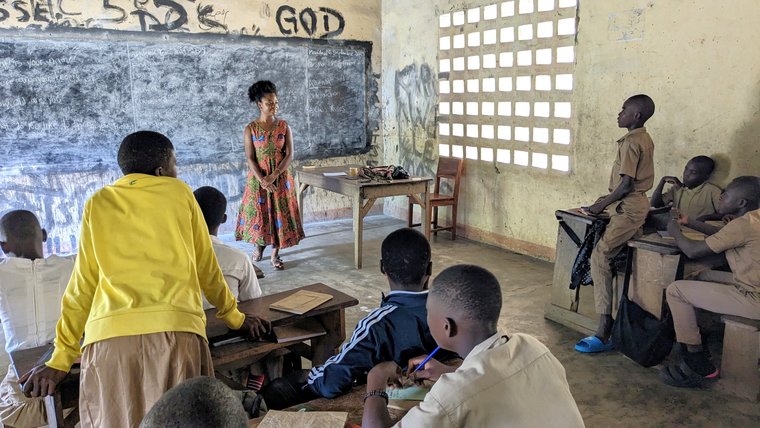
I teach English at the middle school in my community. I teach two classes, 7th and 8th grades, for eight hours a week. Additionally, I run an English club alongside my work partner, a fellow English teacher at the school. The English club was initially created to provide a fun and creative space for students to practice English outside the classroom. The club has evolved to really showcase the students’ leadership and critical thinking skills, as well as to teach life skills. Life skills are explored by guiding students to write and perform skits. Students have produced skits on the importance of education, the societal roles of boys and girls, and goal setting.
3. What strategies have you used to integrate into your community?
Leaning into curiosity and openness has really enriched integration into my community. In my early weeks at site, before the school year started, I made a rule that I had to walk around my community for at least 30 minutes every day. This had amazing results, as people would call me over for a drink, take me on walks to see their farm, or invite me to various community events. People genuinely appreciated how curious and open I was to learn more about their lives, and I made many strong relationships that I relied on throughout my service.
Practicing the local language has also helped me integrate into my community. My village speaks Ikposso, a minority language in my region of Togo. Whenever I greet people or buy items in the local language, everyone gets so excited! Using local language has been a way to show I care about my community and am actively working to be a part of it.
4. What is a highlight of your time in service so far?
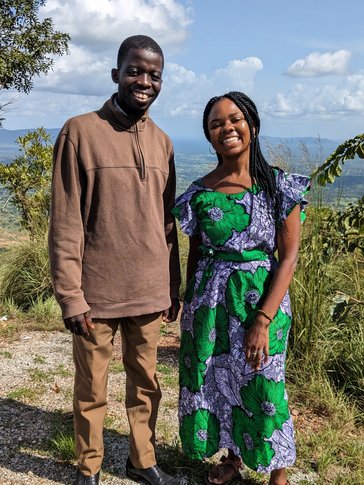
A highlight was attending a wedding with my work partner. While talking after school, I asked him about his weekend plans. He told me he was going to a wedding and after I told him I hadn’t yet been to a wedding in Togo, he informed me he would pick me up the next morning at 5 a.m.! Sure enough, he showed up to my house bright and early the next day. We drove for about an hour up a beautiful mountain road, and the views alone could be considered a highlight of my service.
Although I knew no one at the wedding, I felt so at home, dancing, eating, and even getting a picture with the newlyweds! That wedding showed me how welcoming the people of Togo are and how beautiful the country is.
5. What have you enjoyed most about the community where you are serving?
I’ve most enjoyed seeing my students grow. When I first started teaching, the students were shy and quiet, not sure what to expect from a foreign English teacher. However, over the course of the two years, I’ve come to learn their personalities and see growth in their confidence. I love seeing the quieter students raise their hands to answer a question, a little unsure but willing to give it a try. When students finally understand a grammar point we’ve been struggling with, or create a complex sentence, I feel so proud of the work we’ve done. My favorite is when they make jokes in English, which always gives me a laugh.
I’m especially proud of my English club students. When we first introduced the idea of writing a play, students were confused and hesitant to participate. When the time came to perform, the students were boldly speaking their lines and even correcting their friends’ mistakes. By the next year, the students shocked me by coming to the first day of club with a fully written-out idea for our play, and all I had to do was help translate some new words. My students are my favorite part of my community, and I’ve been so lucky to work alongside them.
6. What are some of the most important things you’ve learned from your community?
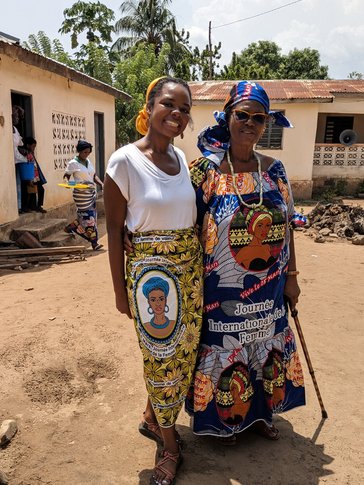
One of the most important things I’ve learned is how to ask for help. I could not have survived without leaning on so many people in my community. My work partner helped immensely with understanding the school system, but he also helped me find a turkey when I wanted to host Thanksgiving. My language tutor helped me understand the basics of the local language, but he also found a carpenter to build furniture for me when I first moved to site. My time in Togo is filled with stories of people supporting me in endless ways. I’ve learned that asking for help is a strength, and much more effective than struggling to do things alone.
7. How do you spend time when you are not working on a project?
When not working on a project, I enjoy taking walks around my village, reading new books, and spending time with other Volunteers. I love walking through my village, as I live at the base of a mountain and there are so many gorgeous and peaceful areas to explore. There is a waterfall a few miles away, and during the rainy season, it’s incredible to see water cascading down the mountain. Walking also gives me the opportunity to visit people in the community I don’t often see.
I also enjoy spending time with other Volunteers. On weekends, I travel to my market town to buy groceries for the week and often meet up with nearby Volunteers for lunch. We catch up on our weeks and appreciate the rare English conversation time.
8. What are you looking forward to in your remaining time as a Volunteer?
In my remaining time in Togo, I hope to explore more of the country. As the school year comes to a close, I’ll have more free time to travel. There are waterfalls I want to hike to, cultural festivals I’d like to attend, and more Volunteer sites I’d like to visit. Although Togo is a small country, it’s also extremely diverse with more than 40 spoken languages. By traveling around the country, I can learn more about the different cultures and experience all Togo has to offer.
9. Once you finish service, what will you do differently when you return to the U.S.?
When I return to the U.S., I hope to prioritize community. Living in such a small village, I really admire the ways people support one another. They help raise each other’s children, offer financial support if there’s a loss in the family, and always, always greet you as you pass. I know almost everyone in my village and greet them every day on my way to school or while I’m fetching water. This level of community makes life feel safer and there is less pressure to be completely self sufficient. I hope to retain that level of friendliness and community when I return home, by getting to know my neighbors or at the very least, saying a kind hello.
Learn more about serving as a Peace Corps Volunteer in Togo.



