 An official website of the United States government




Featured Participant Profile
Allen S.
“The feeling that I am helping public school teachers in Colombia gain useful skills not only in English but also in general teaching practices is incredibly fulfilling.”
1. What got you interested in the Peace Corps, specifically the Virtual Service Pilot?
I applied for in-person Peace Corps Volunteer positions in the past, but I suspect my qualifications weren’t the right fit for those roles at that time. I enjoy learning about cultures and passing along some of the more positive things about the culture in the U.S., as well as helping to empower people through education. If being involved in an online capacity is the gateway to supporting a group of people do that, then that’s great, too.
I much prefer interacting with people face-to-face, especially when teaching, but sometimes having classes online is the only way to connect people. With my current schedule as well as the students’ schedules in Bogotá, online classes were really the only viable option.
2. What projects are you working on?
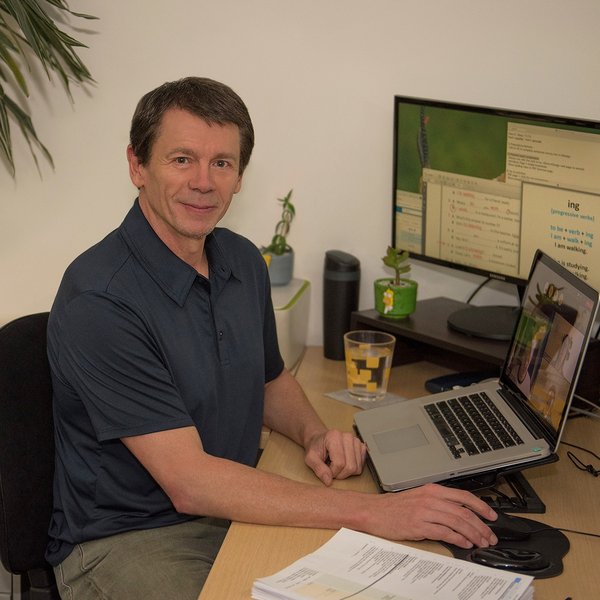
As an English teacher, I want people to become empowered by gaining crucial communication skills. This virtual service opportunity allowed me to support teachers from the public schools in Colombia. To start, my counterpart, a local English teacher, and I sent out the invite to participate in the online English sessions. We were expecting a few responses as we knew that teachers in Bogotá are busy, but to our surprise, over 200 teachers registered within a day! We narrowed the list down to two classes of 12 teachers to make it more manageable. We also added two workshops to promote attendance. Each week, I facilitate two classes that are an hour-and-a-half long each, for a total of four weekly classes. Each class requires a minimum of one hour to prepare for various proficiency levels and interests.
I have also had the opportunity to support the city’s English spelling bee finals. My small role was as a pronunciation announcer. I also recently planned and facilitated a half-day video workshop for a group of high school students who had excelled in their school’s audiovisual course. The students learned about narrative arcs, wrote storylines, and shot and presented their own videos—all in English.
3. What is a highlight of your VSP experience so far?
The participating teachers and my counterpart, Milena, are always so appreciative. No one wants the classes to end! That kind of human connection is so great to experience. It’s also a testament to the value of these kinds of VSP efforts in developing countries like Colombia.
4. What strategies have you used to meet the challenges of a short-term, remote experience?
It’s easy to think the “American way” is the “correct” way. Of course, that’s not true, but I didn’t realize that until I started traveling years ago. No one way is necessarily better or worse than any other.
I observed and listened. How are teachers trained in Colombia? What is the typical education background of teachers and what classroom management training do they receive? How are students expected to behave here? Only when I started to feel like I understood their perspectives and expectations better, did I devise a methodology plan, and through that, start to share my own perspectives.
I split the 24 participating teachers into two groups based on English ability for more specialized support. I try to foster an environment where everyone feels my full attention and engaged. It is important to help the Colombian teachers feel more confident in applying what they learn to what they already know. The best learning often takes place outside of your comfort zone, so I encourage them to be comfortable making mistakes.
5. What benefits are you gaining from your participation?
The feeling that I am helping public school teachers in Colombia gain useful skills not only in English but also in general teaching practices is incredibly fulfilling. Of course, I’m also learning about how the teachers approach the learning and instruction process and that helps me continue growing as a teacher, too. A bigger value has been connecting with smart and warm people from a different culture who share a desire to help others through teaching. I can see being friends with many of them and know my life would be enriched by that friendship.
6. How has your previous professional experience influenced your VSP experience?
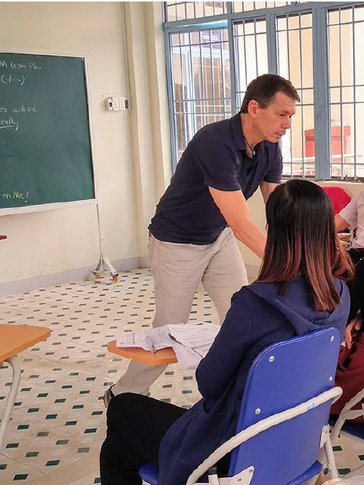
Having taught in Peru, México, Thailand, and Vietnam, I’ve learned a little bit about cultural differences and how they can impact the learning process. I tap into that when I'm teaching even when I’m teaching groups in the U.S., because most English as a second language (ESL) students come from different countries. I find out how they are interacting with the classroom and the materials before adjusting my teaching approach to connect and inspire them to engage. That’s a big reason why I enjoy traveling—to learn more about and from different cultures to help me grow as an educator and human.
7. What will you bring away from your experience as a VSP Participant?
I’ve gained a better understanding of Colombia’s educational framework, the family structure, the classroom environment, typical methodologies used, the children, and different ways to navigate some of the country’s unique administrative challenges. I’m learning a tremendous amount about the education system in Colombia and the people dedicating themselves to help it progress.



