 An official website of the United States government


Featured Volunteer Profile
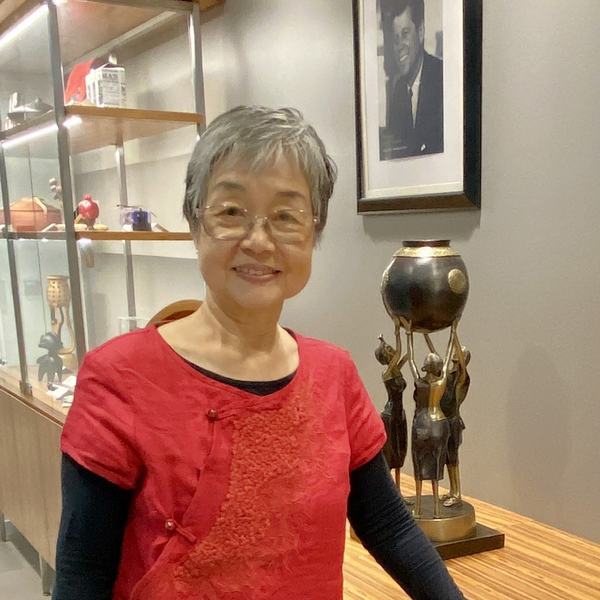
Jian Z.
“I believe that my service at 70 set an example to my son and my grandchildren. I hope I have planted a seed in their young minds about helping others and exploring the world.”
1. What were your primary responsibilities during service?
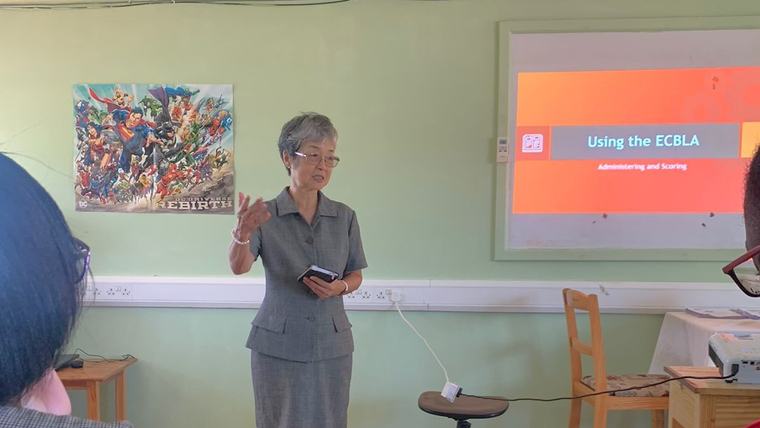
St. Vincent and the Grenadines’ (SVG) Ministry of Education recognized that primary school students were underperforming in comparison to other regions, a problem partly caused by a two-year school closure due to a volcanic eruption and the COVID pandemic. To address these needs, I ran weekly teacher training workshops on literacy instruction and using assessment as an instructional tool to improve teaching. I also modeled reading classes, using media and online books.
As a lifelong educator, I believe the best way to engage students in doing something they find interesting and meaningful. The very essence of my teacher training was promoting learner-centered approaches.
I used many online resources when I was teaching college-level literacy. However, I found most of the elementary level reading resources by my observing my own grandchildren’s elementary school reading classes prior to service.
2. What projects did you collaborate on with your community?
A. I created school library teaching sessions for students in collaboration with literacy teachers at the two schools I worked with.
The library reading classes usually started with a popular children’s book from YouTube and followed by the teacher’s guided comprehension check and students’ independent reading responses or group discussion. Before I arrived, school libraries were already set up with limited donation from “Hands Over the Sea,” U.S.-based charity.
I proposed that each class run one reading class per week, the teacher being responsible for linking one book with a topic that they were teaching, and prepare comprehension exercises. Before I left the island, most classrooms in the two schools had set up their own small libraries. In this way, students could be assigned independent reading sessions, while the teachers worked with special groups or individuals during class time.
B. I revised and conducted training on literacy assessment tools for the whole country with the help of literacy officers in the Department of Education.
Previously assessments were mainly used for statistical purposes. My workshops showed teachers how to use assessment as a teaching tool. I revised the existing assessment, proposed the designated testing and scoring time, and created a performance sheet for teachers to fill out for each student they tested. That way, they knew immediately how their students performed, instead of waiting several months for results from the government.
C. I promoted interactive group activities in classroom teaching to accommodate students of different reading levels in a classroom. An effective way to address this challenge is to develop group activities where students can work with each other or receive instruction at their level. Many experienced teachers in SVG were already conducting interactive group activities, such as separating students according to reading level and assigning different tasks to different groups, etc. Group activities help students feel more involved than simply listening to the teacher explaining the text.
I compiled an eBook on innovative class activities contributed by the teachers, which was distributed among all teachers in the two schools and shared with the Department of Education.
3. How did Peace Corps service influence you professionally?
I learned a lot more than I contributed.
Life on the island taught me how to be creative in a resource-constrained environment. I came with a lot of ideas to help local schools, only to find they were unrealistic and impractical. I introduced the idea of providing students with a book bag and daily reading assignment sheets for parents to use, thinking that would involve parents more, but learned that many parents were illiterate or semi-literate and schools had no money to print daily reading sheets, not to mention the book bags. I recommended assigning online reading materials as homework but realized that most students don’t have computers or smartphones at home. Some students had no money to buy textbooks, so they were only able to use books loaned by the teacher during class time. I gradually learned how to adjust the way I worked.
Now that I am back to a society with plenty, I can no longer tolerate wasting paper or throwing away reusable anything. I appreciate everything more and feel humble all the time. The resilience and work-with-nothing attitude of the local teachers reminded me of my own impoverished childhood in China. I feel that I have more compassion and patience now.
4. How do you use skills honed during service in currently?
I have become an enthusiastic volunteer in my local community.
5. How have you shared the value of Peace Corps service and communities abroad with people in the U.S.?
I told my host schools about my immigrant status. They were not surprised, as many teachers there have relatives who immigrated to the U.S. I even taught some students how to say “hello” in Chinese and loved their chiming back to greet me every morning.
I wrote about the experience for a book about parenting in the United States as a first-generation immigrant.
I have also shared my Peace Corps experience with friends and wrote short articles for retirees’ newsletters, encouraging retired colleagues to participate in volunteer service.
I believe that my service at 70 set an example to my son and my grandchildren. My son’s family was initially not happy with my decision to serve abroad because I could no longer help care for my grandchildren. I felt it was okay because both kids were entering elementary school and able to take a school bus instead of relying on me to drive them to daycare or kindergarten. Now my grandchildren know that I left them to help kids in a foreign country. I hope I have planted a seed in their young minds about helping others and exploring the world.
6. How have you remained involved with the Peace Corps community following service?
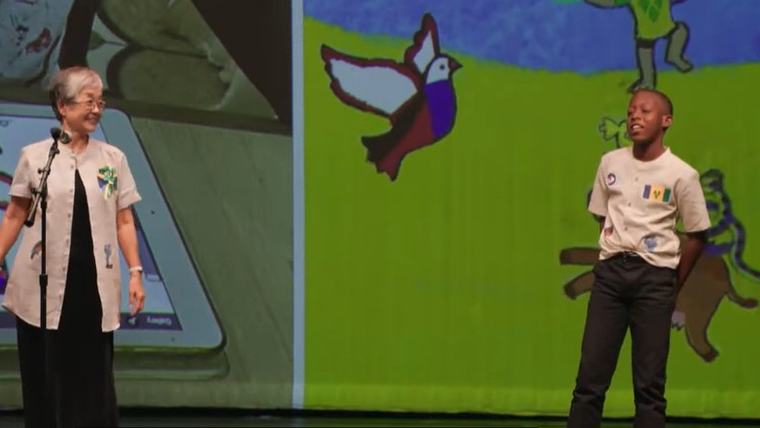
I remain in contact with the two local teachers I closely worked with in SVG. My landlady and her son Fabian came to the States for a visit, during which Fabian and I shared our special story of connection at the Kennedy Center.
My counterpart plans to visit me this summer. She has already been to the U.S., but not to New York. I would love to take her to see Statue of Liberty, Times Square, and Chinatown, among other sites. I want to treat her to sushi, which she has never tasted. In SVG, there were no Japanese restaurants, and the Chinese ones were not authentic at all.
I also reached out to the local National Peace Corps Association affiliate group to get more involved with Returned Peace Corps Volunteers (RPCVs) like myself.
7. What do you miss most about your host country?
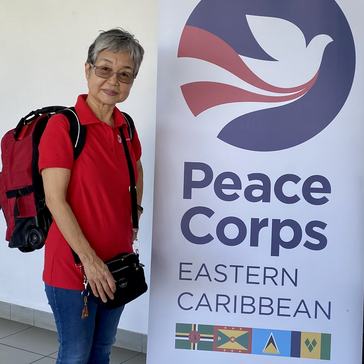
The smiling faces of the students and their greetings every morning to me: “Good morning, Miss Jian!” I also miss the direct involvement in teaching.
Once upon a time, I thought that the Peace Corps was only for young American college students to start on their path to adulthood, but I have found out that more and more older adults, including retirees, are participating in service in recent years. As far as I know, around 7% of Volunteers nationwide were aged 50 or older in 2023. In fact, I was motivated greatly by a success story of an 80-year-old volunteer serving in the community development sector in Africa before my decision to apply. The Peace Corps actively encourages applications from individuals of all ages, recognizing the unique skills and experiences that older Volunteers bring to their service.
8. What’s your favorite phrase in your host country?
“Small yourself” was the first SVG phrase I learned, as I sat on a very crowded local van, the only public transportation on the island. It means "Move over so I can squeeze in!” It’s a vivid expression. Once I was so jammed among sweaty locals, I answered back,” I am already very small!” Fellow passengers looked at the two of us, and we all laughed.
9. What would you say to someone thinking about joining the Peace Corps?
Peace Corps service offers the opportunity to renew your sense of youthfulness.



