An official website of the United States government



The 6 stalls you might find in a Timorese market
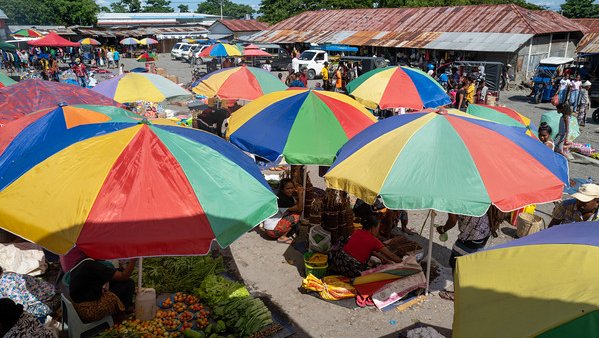
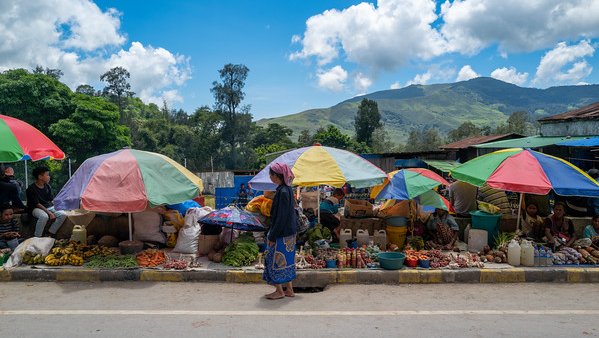
In my small town in central Timor-Leste, the market is held once a week on Sundays. People come to sell produce, home goods, clothing, and various other things. Although it’s small, it is always full of people and interesting things to see.
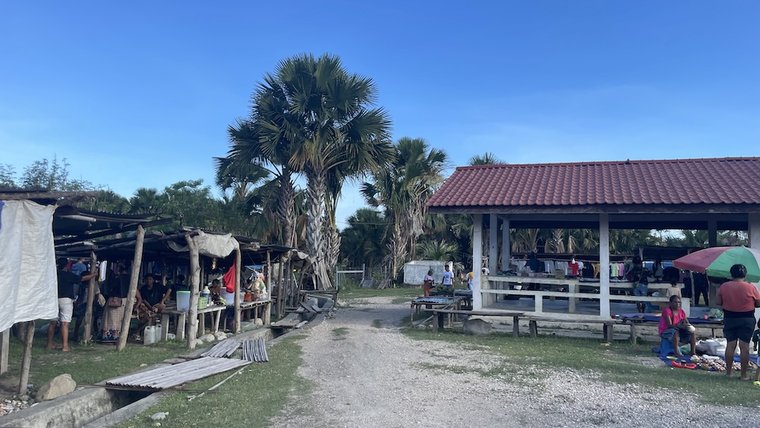
It’s a short walk to the market from my house, down a muddy path and through towering palm trees, passing lots of cows and goats along the way. The entrance to the market is always crowded with motorcycles and tuk-tuks, people coming and going. If it’s a busy market day (usually this depends on rain), it’s quite a colorful scene: big rainbow umbrellas, elderly women in patterned sarongs, and produce from bright red tomatoes to purple eggplant. Many of the vendors set up their stalls under umbrellas, but some have tin roofs over their stalls, and a handful set up shop under the pavilion in the center of the market. The market in my town also has a section in the back just for used clothing vendors.
To give you a better picture of what it’s like, here are 6 types of vendors I often see while wandering through a market in Timor Leste.
1. The friendly auntie selling leafy greens
I see a table covered with more cabbages, bundles of greens, and heads of lettuce than you can count—all bright green and super-fresh. I am walking by when the tia (auntie) selling the greens says, “Have a look, friend! Fresh lettuce. Two for a dollar.” She gives me a big smile. I don’t really need lettuce, but it is so fresh… I end up buying some, charmed by the tia’s friendliness.
2. Wandering snack sellers
A handful of men wander around the market selling snacks. Some carry many plastic bags full of bread rolls, some carry poles on their backs with bundles of oranges tied to them, others sell little baggies full of roasted peanuts. Their vocabulary consists of one word, which is whatever they’re selling. They call out, repeating their sales pitches again and again. “Paun, paun, paun, paun, paun,” cries the bread seller as he walks past. “Sabraka, sabraka, sabraka,” shouts the orange seller.
3. Used clothing stalls
Taking a detour from grocery shopping, I enter the clothing section of the market. Under the tin roofs of these stalls are used clothes of all kinds—rows and rows of clothing on hangers, plus piles of even more clothing on tarps on the ground—more than at any thrift store I’ve been to in the States. Here, one might find button downs, baby onesies, jeans, sundresses, odd graphic T-shirts, and even bed linens. Women sort through the colorful piles of clothes looking for a good find. I join them in digging through the pile of clothing, hoping for a new piece to add to my sparse Peace Corps closet.
4. The beans seller and her protégés
This stand has a tarp laid out with huge sacks of dried beans, dried corn, and coffee beans for sale by the cupful. I recognize some of the beans—kidney beans, mung beans—but I’m not totally certain about others, since they are all unlabeled. As I consider the beans, I hear children’s voices whispering “malae, malae,” (“foreigner, foreigner”) and look up to see two small kids half-hidden behind their mother, the beans seller. I greet them, but they are too shy to respond.
5. The noodles and coffee stall
I am walking around when I smell the noodles and coffee stall: the savory mie goreng instant noodles which are so popular here have become an unmistakable scent to me. On a little table under an umbrella there is a place to buy hot coffee and instant noodles to eat at your leisure while shopping at the market. There is a big thermos of hot water to make noodles and coffee, with toppings for the noodles that include boiled eggs, lime wedges, and hot chilis. They are also selling various dosi, fried bread, and sweets to go with the coffee.
6. Buckets ‘r’ us
At this stall I see plastic buckets of all shapes, colors, and sizes laid out on big blue tarps. There are various pails in small, medium, and large sizes; big basins with handles for washing clothes, vegetables or what have you; baskets with lids for serving rice; Tupperware containers decorated with little cartoon pictures; trash cans; storage bins--you name it. A bucket for every occasion!
Of course, there’s so much more to see at a Timorese market. You’ll just have to come out and see for yourself!
My weekly grocery shopping trip looks a little different than it did back home in the States, as is the case with all Peace Corps Volunteers! How does this compare to grocery shopping where you live?