An official website of the United States government


A tool for breaking stereotypes and building true connections
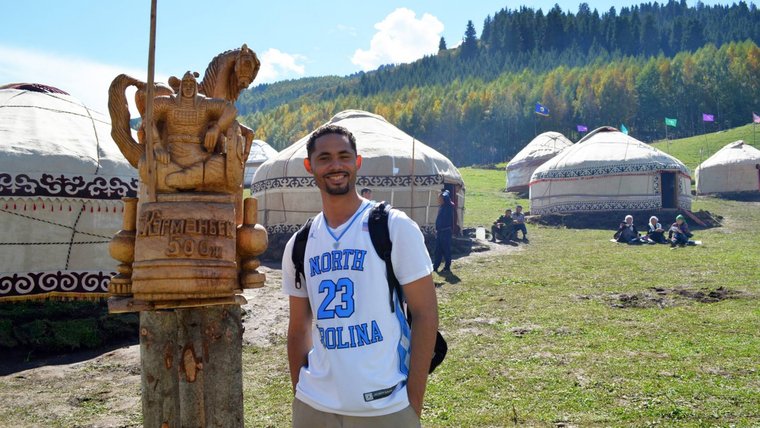
When I arrived in Kyrgyzstan everything felt unfamiliar. The sights, sounds, and language were all new. I had never traveled before, and it was the first country I’d ever visited outside the U.S. Suddenly I was surrounded by Cyrillic letters and a culture vastly different from my own.
Learning the Kyrgyz language was a way to connect with my new community. But it was more than that. It felt like a responsibility. As a Black, mixed-race Volunteer, I wasn’t representing only myself; I was representing my family and my community back home. Often, I was the first Black person people in Kyrgyzstan had ever seen—and likely the only one they ever would. Struggling or failing at the language felt like letting down more than just myself. And that sense of responsibility made the challenges ahead even more intimidating.
Those first few months in-country were tough. I struggled with Kyrgyz and was easily the weakest language learner among the 38 Volunteers who arrived with me. When I announced I was switching to Russian, there were plenty of jokes and light comments that reminded me what I was up against. (Since Russian grammar can be more complex for native English speakers, Volunteers learning Russian might progress slower than those studying Kyrgyz.)
Then came a series of setbacks. Only seven days after swearing in, I was involved in a car accident. I was shaken.
Then, after the accident, I experienced several incidents of racial hostility. While these events certainly didn’t represent all Kyrgyz people, they reinforced my feeling of being an outsider. I felt scared and started questioning whether I could make it through service.
Everything changed when I was reassigned to a new site. There I was offered a role at Central Asia’s first community station, called Radio Most. I created communication materials, developed a central website, and assisted in launching a mobile app that allowed citizen journalists in remote areas to upload local news on issues like water supply shortages, domestic violence, and even human trafficking. I also mentored citizen reporters.
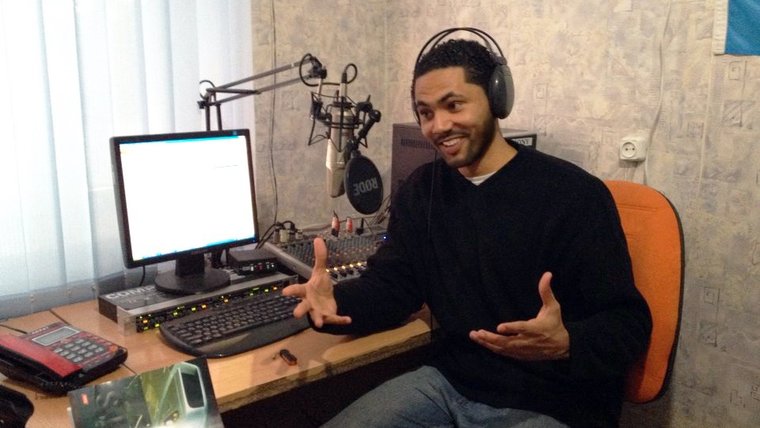
The powerful work we were doing gave me a sense of purpose. I went all in on the language, practicing sentences over and over, memorizing vocabulary, and drilling phrases in my head until they stuck. I felt like I had to work twice as hard to break through that outsider label, and language was the bridge I needed.
Having an anchor at Radio Most—and eventually gaining the ability to communicate more fluently—helped me move past those early setbacks. It showed me that a few negative encounters didn’t have to define my entire Peace Corps experience.
When mid-service language testing came, I was nervous. I had put in months of work but wasn’t sure if it was enough. During the test, I caught a look of surprise from the examiner. I ended up being awarded “intermediate high,” a level I never expected to reach at that point in my service. In fact, no other Volunteer who’d switched to Russian had reached that level so early. That recognition was a huge win for me; it was the moment I realized I wasn’t an outsider anymore—I was becoming part of the community.
With my strong language skills, I was able to do more than I ever imagined at the radio station. I was using language to make a real impact, fostering connections and understanding. Our work amplified the voices of marginalized groups, giving them a platform to speak.
After completing my Volunteer service, I worked as a communications coordinator for Peace Corps Kyrgyzstan. In that role I focused on showcasing the benefits of the Peace Corps to government ministries, local stakeholders, and the public.
By the time I left Kyrgyzstan, I was a completely different person. I had built friendships, gained confidence, and found a sense of belonging. I still keep in touch with friends there, and those connections mean the world to me.
Learning Russian taught me that the toughest challenges can lead to the most profound changes. Language, for me, became a tool for breaking stereotypes and building true connections. I went from feeling like a fearful outsider to someone who belonged across cultures, and that’s a power I’ll carry with me forever.
Drake's story was selected as a winning entry in "Tales of Transformation," a Peace Corps Week 2025 storytelling contest that showcases the changes individuals and communities can experience when the power of human connection is shared worldwide.