An official website of the United States government




A retired educator serves virtually with the Peace Corps
A longtime educator and nurse
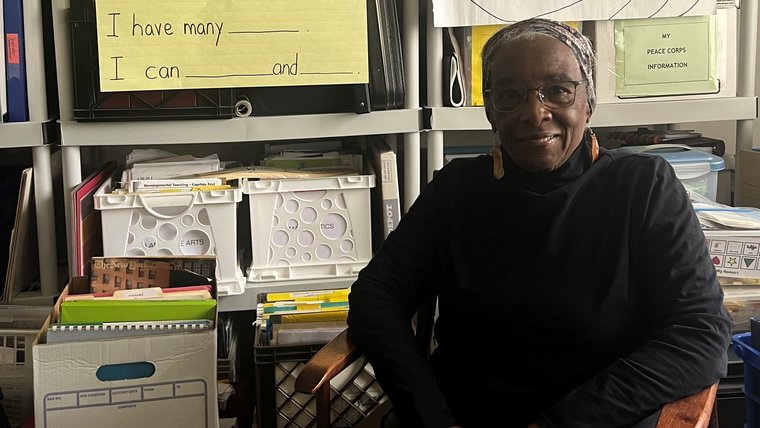
Judith Harper’s Maryland home feels like a cozy library. The walls are lined with a colorful display of books and binders that any new educator would envy. The impressive compendium is the result of a 50-year-long career in education and, thanks Harper’s participation in Peace Corps’ Virtual Service, its contents are being disseminated to teachers around the world.
“Teachers are hoarders,” chuckled Harper. “My children laugh, because I have a spare bedroom that I use as a study since it's full of teaching materials.”
She picks up a dog-eared copy of "What Is It About Me You Can’t Teach?" and says, “This book addresses the excuses people make for not teaching certain learners. Every kid's got something good going on. We [the educators] just need to find it.”
Harper’s dedication to serving others started at a young age. She fondly remembers lining up her dolls for make-believe class and watching her mom prepare for a nursing shift. After earning her own nursing license, a bachelor’s degree in special education with a concentration in speech pathology, and an EdS. in elementary school administration, Harper alternated between her two career passions for more than 40 years before revisiting her Peace Corps dream.
Serving as an older Volunteer in Namibia
By that time, her four children were starting careers and families of their own, making Harper feel more comfortable leaving to live abroad for an extended period. In 2004, the age of 58, she served as an Education Volunteer in Namibia, where she co-trained education teachers on curriculum development and teaching English as a second language. The local community asked Harper to also teach reproductive health and HIV/AIDS prevention – an unexpected secondary project that allowed the former nurse practitioner to merge her professional experiences.
“I encourage older people who have talents and skills to consider the Peace Corps, because it would be a waste of their gifts to not be giving, and it was such a beautiful experience.”
Her oldest child, Lyjune, shared: “I did not [initially] want her to go – parents do not leave their children! But I am so proud of the work that she has done. Teaching is her gift and passion, and all [her children] are proud of her.”
Harper enjoyed living and teaching in Africa so much that she extended her service in Namibia for an additional two years. When she finally returned home in 2008, she worked as a substitute special needs teacher for another ten years before officially retiring in 2022.
A busy retirement engaged with Virtual Service
While others might spend retirement traveling or relaxing, Harper searched for a new way to contribute to the world. And then, as if by fate, she learned about Peace Corps’ Virtual Service Pilot (VSP), which provides a unique opportunity for U.S. citizens to connect with communities abroad to complete short-term projects.
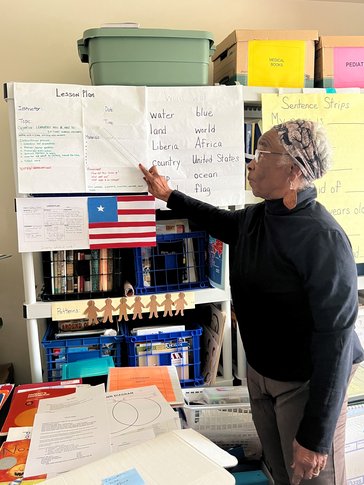
Through VSP, Harper began donating her time and expertise to support remote primary schools in South Africa’s Limpopo province. Each week, Harper prepared lesson plans, keeping the national curriculum and her counterpart’s requests in mind. Then, Harper co-taught the hour-long weekly English class to 45 students. The experienced educator requested that her in-country counterpart rotate the students from the back of the room to the front to promote participation from everyone.
“It’s been a pleasure working with [Harper]. We benefited immensely [from her online support],” shared her former counterpart.
Harper knew the importance of having a dedicated counterpart present and engaged in each lesson from her time in Namibia. She doesn’t ever want teachers to take a backseat with the misconception that the “American knows best.” Following Peace Corps’ people-to-people approach to development, Harper spent one-on-one time with her counterparts to emphasize their role and build their own capacity.
“I told [the teachers] that the learners don't always understand my accent. They sometimes have questions and might be afraid to ask me. I like to [reinforce] to the teachers that they're needed, that they're essential to the learners’ success,” explained Harper.
Harper then co-developed and co-facilitated teacher training sessions with a learning center in South Africa, and mentored teaching assistants who support a literacy program in South Africa’s Northern Cape province.
Continued impact in her 70s
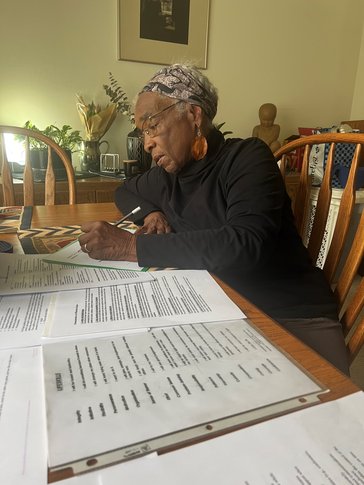
In February 2024, Harper started her fourth virtual engagement, which has her collaborating with the principal and curriculum specialist at a school in Liberia. Over the course of 12 weeks, Harper will be sourcing content from her library to support the development of early childhood education teaching manuals. She will also prepare and co-facilitate workshops designed to strengthen the local teachers’ presentation skills and visual aid use.
“I can do more this way. If I can help the teachers strengthen their lessons, and the children can go on to successful careers, then I'm impacting a whole country. I'm preparing people for opportunities that they might not otherwise have.”
At 78, 20 years after her first Peace Corps Volunteer experience, Harper proves that retirement can be an equally productive and inspiring chapter in your life.