An official website of the United States government


A pillow for Purnima
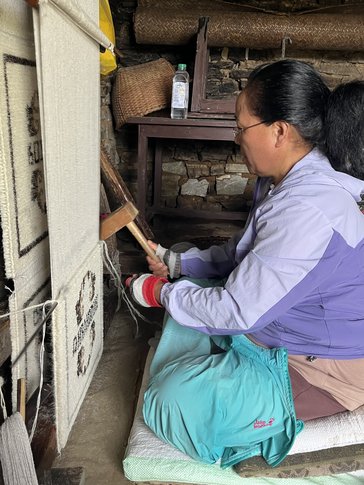
A Volunteer arrives
When I arrived as a Tourism Response Volunteer in Nepal, my community identified handicraft promotion as a priority project. I learned that Purnima is one of the few women in our community in the Himalayan foothills who still weaves a specific style of carpet, galaicha, and I wanted to highlight her talents and this textile tradition that is fading away. I met and interviewed her for a magazine article I was writing about traditional weaving in her village. A kind hotel owner in the village helped translate.
A relationship begins
I later returned to visit Purnima to get more information about her weaving. Somehow, despite her few words of English and my slowly growing Nepali, we understood each other. Perhaps because I am also a craftsperson and was genuinely curious about her work; perhaps because she wanted to learn English, and I am a teacher; perhaps because two people are sometimes quick to recognize a part of themselves in another person.
In subsequent visits, Purnima worked slowly so I could take photos and patiently listened to my simple questions in bad Nepali. We both laughed at my mistakes, but somehow, we understood each other.
Sharing time, tea, and a love of weaving
I asked the names of her tools and took video of her amma (mother) separating and carding wool that Purnima would weave into rugs. We ate corn on the cob and threw the corn into their garden; she and her amma howled when I threw mine too hard and it landed behind the neighboring hotel. We nibbled on cucumbers, dipping them in chili powder, and amma brought us milk tea. I’d tell Purnima if I was going away and when I’d return. She would count the days on her hands. I commissioned her to weave me a small galaicha with a mountain peak at the center. When she finished, I paid her what it was worth. “Ma tappailai maya garchu (I love you),” she told me.
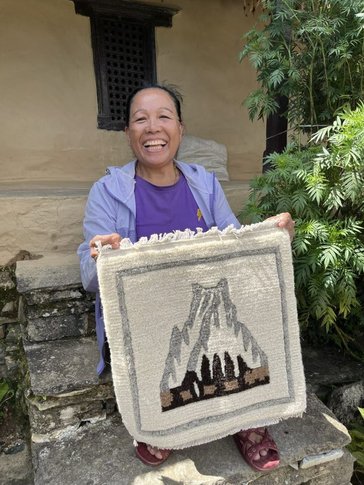
Purnima’s accident
One day I went to visit, but Purnima wasn’t there. She was always there, sitting on the floor of her little weaving shed, tying knots. I returned another day, and her mother said she was in the big city a few hours away, in the hospital. Through talking to others in the village, I learned that she’d fallen down the back steps of her house. A few weeks later, I received a text message from Purnima: “Namaste,” with a thumbs up. I asked if she was feeling better, “ali ali (a little),” she wrote.
A reunion
The following week, she texted saying she was back home. When I visited, I could see that she was still in great pain. Hunched over, she shuffled to the back of her home to show me the several stone steps she’d fallen down, landing hard on another jagged stone at the bottom. She’d broken ribs and bruised her back, tailbone, neck, and arms. It’s a miracle she didn’t sustain worse injuries.
Purnima is a professional weaver, although she probably wouldn’t call herself that. Her livelihood involves sitting on the floor in front of her loom, using her upper body strength in physically demanding ways. Not being able to work was very hard, she told me, her head cast down. We sat on the stone and mud front porch of her home and talked, drinking salt tea amma had brought us. Looking at the thin cushion she sat on, it didn’t seem to provide much comfort. The cushions were recycled rice bags that she had filled with wool not good enough to spin into yarn. I finished my tea, said I’d see her soon, and ran to my house.
A healing gift
The Peace Corps issued me two blankets, a set of sheets, and a pillow. My pillow was big and a bit firm. I’m a small person and never used mine because it was so big it hurt my neck when I slept on it. Early in my service, I bought a smaller pillow and didn’t use the big one except as an occasional bolster when reading in bed at night. I grabbed my pillow and climbed the steps back to Purnima’s. I placed the pillow behind her back. She held my hand as she leaned back. She didn’t let go as she relaxed into the giant pillow, closed her eyes, and produced a wide grin. Sometimes you don’t need language—not a verbal one anyway—to show kindness and gratitude, and to build a friendship.