 An official website of the United States government


Featured Volunteer Profile
Sean H.
“Despite the language and cultural barriers, I’ve always felt welcomed and cared for here. The high value placed on family in Indonesia is very healthy, in my experience, and has been a key factor in my ability to adapt here.”

1. What got you interested in the Peace Corps?
The Peace Corps is something that I had in the back of my mind since I was young. I began looking into the possibility during my final year of university; at the time I had become deeply interested in anthropology and medicine, and the Peace Corps seemed like the perfect opportunity to test whether the work of an anthropologist is suitable for me—building close, long-term relationships with the people in another culture, learning their language and attending to the mental biases that shape my experience of their lifestyle. The Peace Corps is also a chance for me to do deeply meaningful work outside of academic study, and to consider other possibilities for my future as my perspective of the world grows and changes. As a Volunteer, I am fulfilling my desire to intimately experience a different culture at the level of daily realities, while offering my own experience and efforts to the people supporting me here.
2. What projects are you working on?
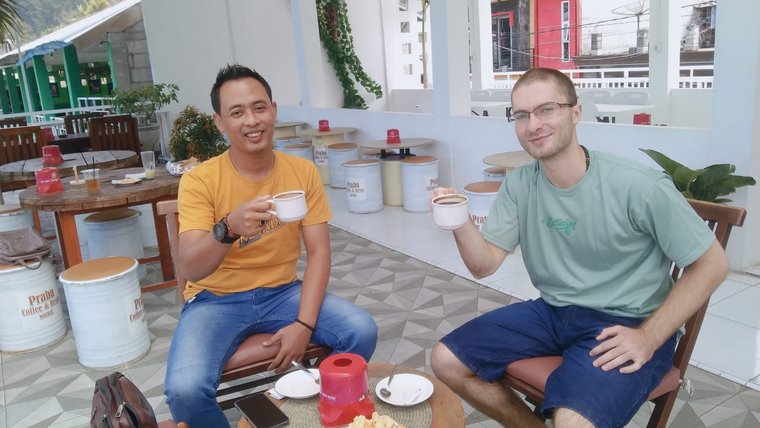
Initially my primary project was adapting to the culture at my school, strengthening initial relationships with counterpart teachers and determining how to work effectively together. Sometimes that looked like lesson planning in the office, and sometimes it meant laughing over late-night coffee and fried snacks. My school has made it a priority to improve the international program at their school; we are planning to improve the curriculum, as well as scheduling educational trips to places such as the U.S. Consulate General in Surabaya. Outside of class time I’ve been helping students prepare for English debates and speeches. With my counterparts I have also discussed beginning a book club to encourage students to read for enjoyment and support the Indonesian government’s attempts to increase literacy.
3. What strategies have you used to integrate into your community?
Indonesians are generally very social people; lots of time is spent chatting with neighbors, relatives, and co-workers. Although I am typically a quiet person, I have been making a consistent effort to get outside my comfort zone and engage in social opportunities as often as I can. I try to show interest in meeting people, ask questions, and try to understand their lives. Making myself known by participating in community events makes building new relationships easy. This interaction is also absolutely necessary for language learning, and immersing myself fully into the language learning process has been a primary tactic as well. My social battery has never been tested to this extent but accepting another invitation instead of retreating to my bedroom has always proven to be the right choice (unless I really need to be alone to rest). Nothing feels so satisfying here as building new relationships, which opens doors to further opportunities and helps me feel accepted and comfortable with the people in my community.
4. What is a highlight of your time in service so far?
Moments of laughter with community and family members. I often find it hard to maintain a sense of humor due to the stress and uncertainty so the times I feel comfortable and relaxed enough to laugh—I mean really laugh, without a care—are truly satisfying. I have had beautiful experiences with both of my host families, during pre-service training and at my permanent site, where we can enjoy ourselves and laugh over meals or on bike rides. I’m grateful to say the same about my new counterparts at school; just last night at a warkop we shared an experience that will surely stick with me, despite the simplicity of it; we spent time talking about nonsense, teasing each other, telling stories, mixing their broken English with my broken Indonesian, scattering bits of Javanese and Arabic throughout. I felt like I was back in America with my high school buddies.
5. What have you enjoyed most about the community where you are serving?
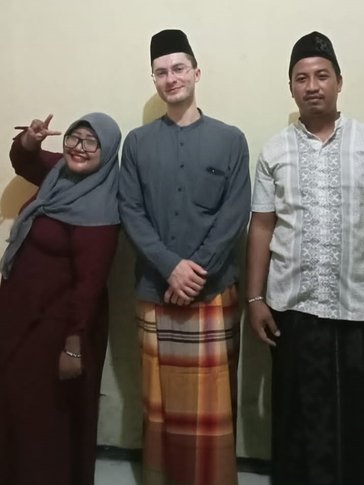
Family ties are strong here. More often than not, immediate and extended relatives live nearby and see each other on a daily or weekly basis. In both of my host families, my host mother lives directly next door to her parents. Young children are cared for by all their older relatives. Islamic tradition teaches children to live together with their parents when they are old, returning the care that their parents provided for them. This sense of family seems to extend easily onto co-workers and neighbors and is often expressed through the language of food. I have no doubt that I will never once feel hungry over the next two years (except during Ramadan as I want to join my community in fasting). There is always someone ready to show kindness and generosity and concern by offering food, and a common friendly greeting is “Sudah makan?” (“Have you eaten?”). Despite the language and cultural barriers, I’ve always felt welcomed and cared for here. The high value placed on family in Indonesia is very healthy, in my experience, and has been a key factor in my ability to adapt here.
6. What are some of the most important things you’ve learned from your community?
The commitment to family, which encompasses neighbors and friends, has had a big impact on me throughout my first few months in Indonesia. Generosity is natural and reflexive for the people I’ve been living with. Sharing food, talking and laughing, making time to spend together, paying for one another without a thought of being paid back. The sense of togetherness and community is more tangible here. The generosity shown to me thus far and the willingness to accept me and make me feel welcome, are two qualities I deeply value and am sincerely grateful for. They are two qualities that I will strive to internalize and take with me wherever I go next.
Another notable aspect of the culture in East Java is the strictness of hierarchy and rules of respect. These rules pervade language and behavior, the clearest example being the Javanese language itself: each verb has at least three levels of formality, the most formal reserved for elders and the least formal for friends or younger people. This social hierarchy is further reflected in greetings, seating arrangements, the order of who may eat or drink first, and more.
Modern American culture has lost a lot of these strict social formalities, and so their presence in Indonesian culture has made it both difficult and extremely interesting to adapt here. At this point, I feel an affinity for this form of social organization, the way it guides behavior and etiquette on a cultural level with which everyone is familiar and through which everyone is decisively related. Of course, there are clear pitfalls as well, but the presence of positive and negative effects in each culture is what makes comparison across cultures useful and intriguing in the first place.
7. How do you spend time when you are not working on a project?
When I arrived at my permanent site the semester had just ended, so we had two weeks of break with no schedule—slightly daunting when you’re in a new community with no idea what to do with yourself. I immediately bought a bike and took lots of rides, first with my host father and then alone, meeting the neighbors, memorizing the streets, making my face known around the community. My host parents had some time off work so we drove into the city and ate at their favorite restaurants; we even went to a movie theater to celebrate Christmas, at my request. I took a couple trips to nearby lakes and mountains with co-workers at school as well. Now that school is in session, I’m usually there from 7 a.m. to 3:30 p.m., and in the evening I shower, eat, wash/iron my clothes and sometimes finish up lesson plans before bed. Now that I’ve settled in a bit I spend some more time alone on the weekend, watching shows on my laptop or reading. There’s always a decent amount of time spent hanging out with family and neighbors as well.
8. What are you looking forward to in your remaining time as a Volunteer?
Over the next two years I’m excited to make a positive impact in students’ lives. As a native English speaker, I have the advantage of the students’ excitement, even amazement, and so there is the opportunity to really inspire and encourage them. So far, moments with students have been the most rewarding, and I hope I can become even more skilled at supporting them on their journeys. I also look forward to deepening my understanding of the Indonesian language, culture and history, both through interactions in my community and by traveling to see more of this incredibly diverse country. I expect my experiences here to directly shape the next stage of my life; I’m excited to see what it may be.
9. Once you finish your service, what will you do differently when you return to the U.S.?
I will add more spices to my food and put more sugar in my coffee. I’ll aim to be more generous with food, making sure others around me have eaten before I do. I’ll eat more often with my hands. I will always greet guests with snacks and drinks. I will sleep and relax in the house wearing a sarong. I’ll sit on the floor more often. I’ll try to spend more free time with my family. As of now, I feel more inclined to stay close to my parents and siblings in the next step of my life, whatever that may be. I hope I will find a path that allows me to keep speaking Bahasa Indonesia or studying language in general. I think that after two years I will feel more comfortable working with a loose, flexible sense of time, which is antithetical to the rigid academic schedule I was accustomed to before Indonesia. Hopefully I won’t be addicted to smoking fat kretek cigarettes by the time I’m ready to return home.



