 An official website of the United States government


Featured Volunteer Profile
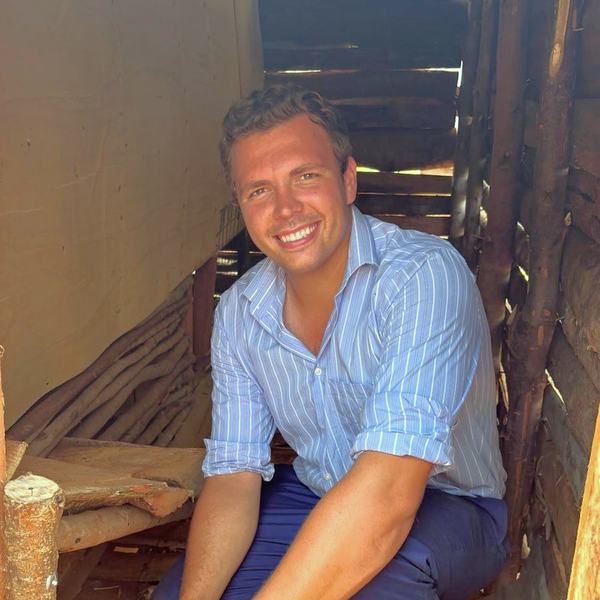
Ben J.
“One of the biggest highlights of my service was the completion of my library grant … The students’ and community members’ desire to read was unbelievable. Having a place to explore and learn through reading has birthed a new academic love at my school.”
1. What inspired you to apply for this Peace Corps position?
There were many reasons why I applied to Peace Corps. An underlying passion for a purpose greater than myself found only in the service to others, combined with an intense desire for adventure and work abroad, led me to realize the type of life I wanted to lead. Peace Corps was the beginning of the answer, the opportunity to partner with a community internationally and work and help others in a completely new and foreign environment. It was the perfect opportunity for me to create a new career path for myself.
2. Tell us about a moment that sticks with you from the first week at your site.
My first week of site was chalk full of new experiences. It’s difficult to pinpoint one that stood out. It may’ve been the extreme hospitality of my village. Dishes upon dishes, more food than anyone could handle. That, and getting my local name, were the moments that stood out to me. They named me Wafula, which means “the one who comes with rain,” and you guessed it — I arrived at site when it was raining. The name is a blessing and one that now I go by primarily.
3. What projects are you working on?
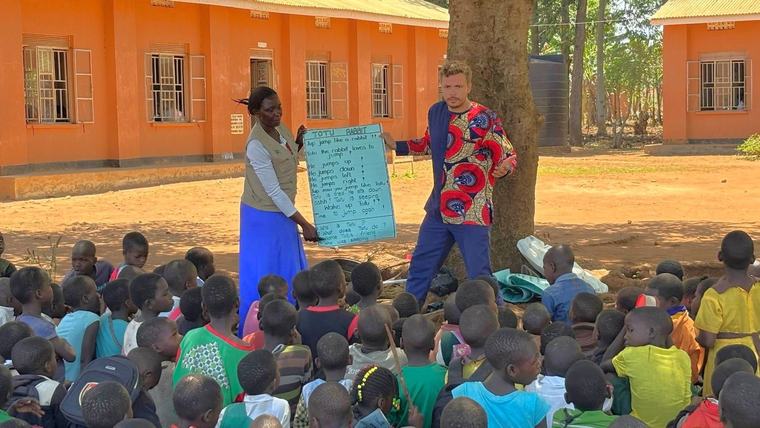
As a Volunteer in the education sector, my primary duties are to improve lower primary literacy rates at my school. However, upon reaching my site I realized that to truly help the school and improve literacy rates there were a plethora of challenges to be addressed; student feeding, absenteeism, inadequate school funding, and more. So, besides teaching lower primary classes, I’ve tried to create holistic approach to my school and its development. I created a robust ongoing club system including a chess club, agricultural club, and debate club to engage the children beyond the classroom. To address food security for the children and the teachers, I helped coordinate the first school garden and feeding program for the students. Furthermore, I created an active rabbitry and apiary to help support the school and for use as student-led labs. Lastly, the biggest project was obtaining and funding a Peace Corps Partnership grant to build a new school library, which I have completed and am now working on integrating it into the school curriculum.
4. What strategies have you used to integrate into your community?
When moving or going anywhere new in the world, I always approach people and places with a humble yet relentless curiosity. Simply put, the main “strategy” I used was to be open-minded to my community and their experiences. I made a point to explore and engage with the community and participate in local events and activities. Before I knew it, I felt, and was, a member of the community. To go from being in a foreigner in a place and culture to becoming a part of it, is truly a surreal and a beautiful thing. An experience that has changed my whole outlook on culture and community.
5. What’s a typical day like for you?
Throughout service my days have varied. Currently, a typical day starts with me waking up around 7:30 a.m. and brewing some coffee. After some chess practice and reading I head to school and teach a phonics or reading lesson to lower primary students. Then I act as the school librarian, cataloging books, leading class reading sessions, and making sure students are following library procedures. Towards the end of the day, I either co-lead chess club, debate club, or film club and then head home. I will do some cleaning and then read as the sun sets. For dinner, I eat with my neighbors then work out at my home and go to bed.
6. What is a highlight of your time in service so far?
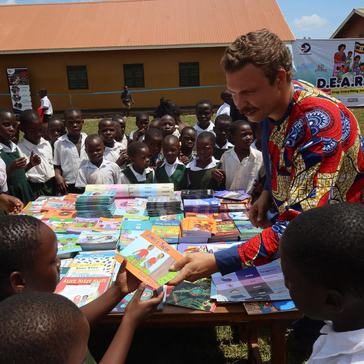
One of the biggest highlights of my service was the completion of my library grant. It’s the first library in the subcounty of my district. What really makes it meaningful is the way the children are so hungry to read and absorb knowledge. The students’ and community members’ desire to read was unbelievable. Having a place to explore and learn through reading has birthed a new academic love at my school. The teachers, the students, and the community are using and benefiting from this source of information and learning already so much and are working together to continuously improve and add to it without my support. That is not only sustainable, but what our projects as Peace Corps Volunteers should ultimately be.
7. What have you enjoyed most about the community where you are serving?
What I have enjoyed the most about the community so far is the sense of intense belonging it creates. The culture, language, and daily life all depend on community members. When you become part of that, you become part of something that’s beyond yourself. There is a sense of togetherness that I haven’t been able to find outside of family in the States. It has completely altered my view on society and one’s role in it. Simply put, it’s the sense of community that have enjoyed the most.
8. What are some of the most important things you’ve learned from your community?
A sense of community has so many aspects of it that compound on themselves to create a sense of strength. One of the most important things I have learned through my community is the value of helping and being there for each other. In the village, money and support flow through community members. In a place where money is hard to come by, the community support each other during times of need. Whether it’s a funeral where everyone, and I mean everyone shows up, or an introduction ceremony (wedding). They support each other. Community members at my site will even take in abandoned or needy children and support them even when they are not related.
9. How do you spend time when not working on a project?
When I am not working on a project I practice chess, read, explore, exercise, travel, and hang out with friends. It’s been a blessing to be able to rekindle my love for reading, learn and grow at playing chess, and explore Uganda. It allowed me to reconnect with nature and leave behind the complexity of western living.
10. Tell us about the strongest relationship you’ve developed while in country.
The strongest relationship I have developed in country is with my neighbors. They have truly become like a second family to me. We eat, play, and explore together. They are my best friends and the people I spend the most time around. We support each other by keeping each other company and handling daily chores such as gardening, cleaning, and taking care of the many animals on our compound. One of my favorite things to do is teach the children new games. From monopoly to freeze tag, we have a continuous stream of endless laughter and fun.
11. What are you looking forward to in your remaining time as a Volunteer?
I look forward to the first harvest from the school apiary and the ongoing use of the school library. The beekeeping was a recent initiative I collaborated on with a fellow Volunteer and his organization. We brought two beehives to the school with all the proper gear and conducted a two-day seminar for the students and the teachers on the importance of bees and apiary management. With one of the beehives already colonized, my students, teachers and I look forward to harvesting honey in the months to come!
12. Tell us your favorite phrase in the local language.
The language I study is Lusamia, and my favorite phrase is “obulamu butyo.” It translates roughly to “that’s life” or “that’s how life is.” Locally we use it to convey that there is so much outside our control, and that life operates in many ways we cannot fully understand. I have found its meaning beautiful and its use profound in the community.
13. What will you do differently when you return to the U.S.?
If I return to the U.S., my experience here has showed me a different way to appreciate and involve myself in my community. Furthermore, I think I will spend more time exploring things around me. There is so much happening outside of our own bubble. When I was living in the U.S. there was so much going on around me that I didn’t engage in because I thought I was too busy. I now know the importance of pushing one’s boundaries and exploring different avenues in the community, society, and in oneself.
14. What would you say to someone thinking about joining the Peace Corps?
Everyone’s Peace Corps journey is different yet similar. As with any aspect of life, don’t set rigid expectations. Be open to both experience and different beliefs. Absolutes are the death of discovery. The Peace Corps experience is beautiful and difficult. If you have an open mind and desire to partner with others and explore internationally, then the decision is easy. Join!
Learn more about serving as a Peace Corps Volunteer in Uganda.



