 An official website of the United States government




Featured Volunteer Profile
Molly G.
“Thanks to the guidance of my community, I learned the benefit of open conversation and exchange of ideas, beliefs, and interpretations in order to better understand one another and be able to work together toward common goals.”
1. What got you interested in the Peace Corps?
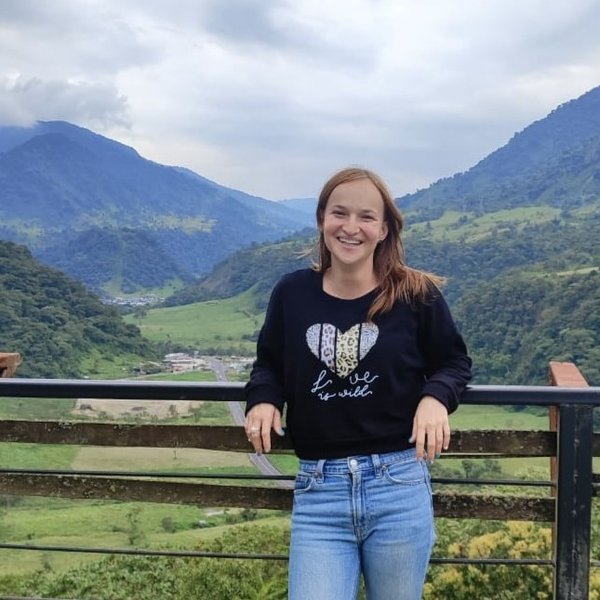
Since learning about the Peace Corps in my first years of high school, I have known it is something I wanted to do. In my motivation statement for my Peace Corps application, I wrote, “I will ask intentional questions—of myself and of others—in order to learn how to be a more engaged, thoughtful, and creative citizen of the world.” I have always been driven by curiosity to get to know the world around me. I approached Peace Corps as an opportunity to immerse myself in a new culture to ask questions, not with the intention of receiving any specific or definitive answers, but merely to learn and better understand the vast complexities of the problems that face people living in communities around the world. I have always believed that forming connections between people with vastly different life experiences is a way to break cultural and political barriers. Only through mutual understanding and respect can we hope to tackle the issues facing our local and global communities.
I see it as an enormous privilege to have had the chance to get to know my rainforest community in Ecuador, and I will forever carry with me the relationships with the people I met there.
2. What projects did you work on?
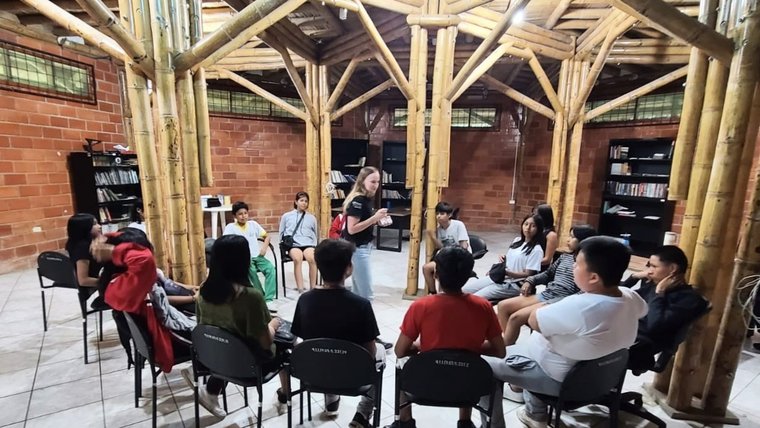
I worked on several projects during my two and a half years, all focused on supporting young people and families. My central project was the “Grassroots Library Project,” for which I earned a grant to help reopen a public library in a park that had been closed due to the COVID-19 pandemic. Working alongside community members and organizations, I facilitated the reopening of the library during my first year of service, and it has since become self-sustaining and run by the local municipality. During my service, I also worked with my incredible counterparts to develop and implement programing for children, adolescents, and families in the community. These included afterschool clubs and activities for young people, youth leaderships seminars, life skills workshops to prevent alcoholism and drug use among adolescents, and public events to encourage healthy use of free time, such as sports, music, or dance.
3. What strategies did you use to integrate into your community?
When I arrived at my site, I promised myself to say “yes” to every opportunity. I said yes to eating lunch with any coworker, trying any new food, or participating in any new activity. At work, I shadowed various coworkers to learn about their work and assist in whatever way I could. I worked to develop the language skills necessary to effectively communicate with people. I mostly remained silent and listened as much as I could in the beginning. As I became more familiar with the language and people, I was able to foster relationships and begin collaborating on projects. Ultimately, I developed close friendships with the people in my community that I will carry with me long after the conclusion of my service.
4. What was a highlight of your time in service?
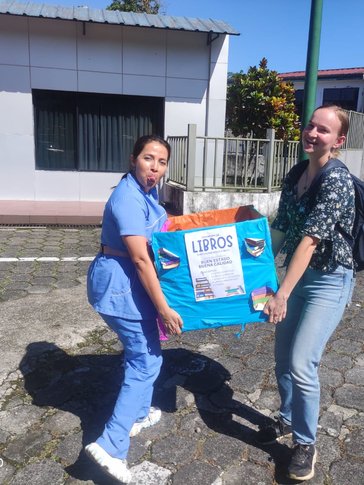
On August 25, 2023, the community gathered in the newly restored library and surrounding park to celebrate the library’s reopening, including municipal authorities, Peace Corps representatives, classes of local high school students, and community members and families. On that day, I felt very proud to have been part of the larger collective effort to make the library opening possible. The library continues operating under the local municipality, and it has achieved its goal of becoming a communal space to hold meetings, clubs, lectures, seminars and other activities, with a principle focus on youth and family development.
5. What did you enjoy most about the community where you served?
I most enjoyed spending time with people in my community. As they say in pre-service training, being a Peace Corps volunteer is a 24/7 commitment, and I wanted to take advantage of every moment to spend in my community and get to know the place and people. I may never have the same kind of opportunity to deeply immerse myself in a place so far from my home, and I treasured the time spent with my adopted Ecuadorian family and friends. I arrived in Ecuador in August of 2022, and when the two years of allotted Peace Corps service had concluded, I opted to extend my time until the beginning of the next year, drawn by my love for the place, the work that I did, and the people I came to know.
6. What were some of the most important things you learned from your community?
From my community, I learned the importance of openness and communication in forming genuine connections with others. When I arrived, I did not know how to speak Spanish as fluently as I do now, nor was I familiar with local social and professional customs, and yet my host family, coworkers, and neighbors welcomed me and helped me to navigate the new linguistic and cultural landscape. I learned that intercultural communication is difficult and requires people to actively work to understand and appreciate another’s words and perspectives. Thanks to the guidance of my community, I learned the benefit of open conversation and exchange of ideas, beliefs, and interpretations in order to better understand one another and be able to work together toward common goals.
7. How did you spend time when you weren't working on a project?
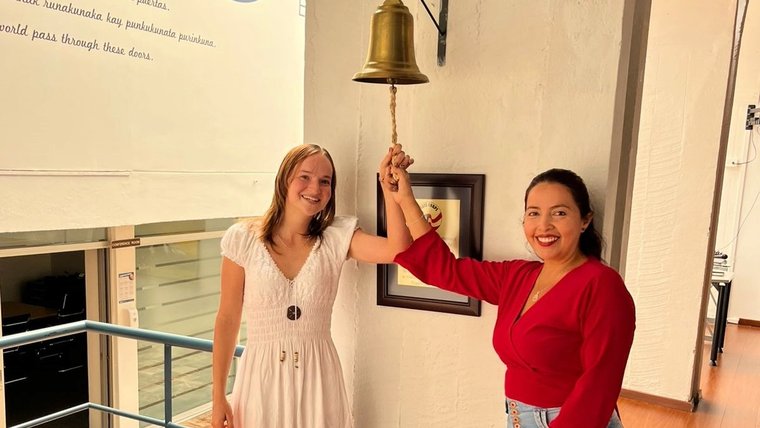
Every day was filled with dozens of small challenges and surprises. I valued the time I spent both in and out of work as an opportunity for learning and connection. I spent weekdays bouncing from the municipal office to local high schools, community centers, and libraries to work with young people and families. I spent weekends visiting with people, learning to cook new recipes, and swimming in beautiful rivers to escape the Amazonian heat. Although I faced various challenges through the course of my service, I departed feeling above all grateful for my experience.
8. How did service influence your life in the U.S.?
I will be forever impacted by my experience in the Peace Corps. Inspired by my work with youth and families, I made the decision to apply to law school, with the specific goal of going into social impact law. I am most interested in the way that law and policy directly affect youth and families because working with children and young people is a dear passion of mine. With a law degree, I hope to use the law as a tool to positively impact people’s lives, by directing funding towards schools, establishing community programs, creating public spaces, and addressing community problems.



