 An official website of the United States government


Featured Volunteer Profile
Daisy R.
“I love the fact that I’m familiar with all the faces around me daily and that I know most community members by name.”

1. What got you interested in the Peace Corps?
Peace Corps was always talked about in my international studies classes when hands-on development work was discussed. After learning about hundreds of different international bodies that worked in international aid and development, the uniqueness of the Peace Corps was solidified in my mind. Peace Corps’ focus on integration and cultural exchange on top of volunteer work in a diverse array of sectors drew me to apply to where I was most needed and commit to volunteering abroad for two years. The benefits of immersing into another culture and embracing the process of learning and integrating into a community of another country are innumerable. I had many Returned Peace Corps Volunteers as professors during college which only solidified my decision to apply my senior year and accept my current position as a Youth Leadership Development Facilitator in Panama.
2. What projects are you working on?
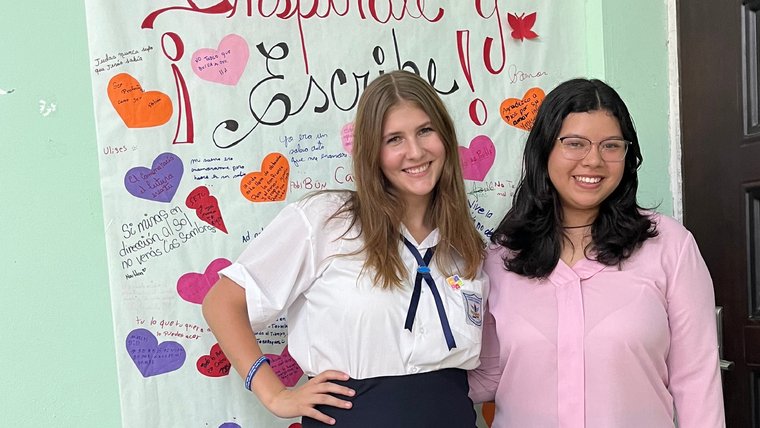
In Panama, Youth Leadership Development Volunteers typically work within the secondary schools and in local IT centers. I have the privilege of having awesome counterparts in both settings who have helped me implement several projects thus far in my service with many plans in the works for more! At the school, I typically work with the orientation professors who teach life skills and employability skills to the students. Together, the professors and I plan activities that relate to goal-setting, assessing personal strengths, and practicing positive traits, such as gratitude. In the local IT center, I help teach a weekly digital literacy class with youths from my community. My counterpart and I have also recently started a community youth group focused on increasing community engagement and leadership among youth.
2. What strategies have you used to integrate into your community?
As the first Volunteer ever in my community, integration looked very different for me than for other Volunteers who are replacing a previous Volunteer. When I arrived in my community, many community members had a very basic understanding of Peace Corps but most of my first six months to a year were spent introducing myself, Peace Corps as an organization, and my specific program, Youth Leadership Development. The strategy I used more than anything else was to show up, ask questions, and listen actively to community members. I was constantly walking around my community or school, seeking out people to talk to in order to understand as much as possible about the past, present, and envisioned future of my new home through the eyes of those who have generational ties to my community. I learned that although many people are shy at first, and conversations sometimes awkward, the more you show that you are committed to forging an authentic connection with community members, the more they open up and are willing to share with you. Now, I feel completely at home and supported within my community, where I was a complete stranger just under a year ago.
3. What is a highlight of your time in service so far?
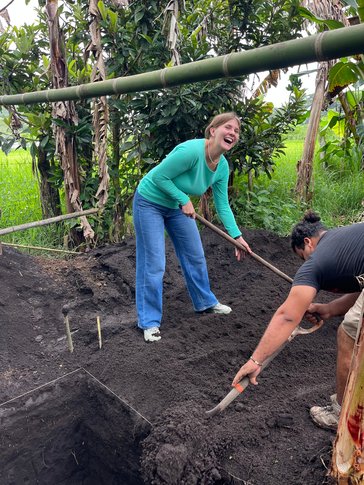
A big highlight of my service so far was the summer camp that my community counterparts and I organized during the summer break from school, which is from December to March, for youth in our community. The day camp was two weeks long and consisted of trash clean-ups, digital literacy lessons, sports activities, and even an archaeology activity on the last day. Seeing kids from my community show up every day at 9 a.m. during their summer break just to interact with each other and learn was so powerful for me. This was one of the first successful events that my counterparts and I organized and was a big motivator to develop other community projects and a new community youth group. The young people in my community are incredibly motivated and enthusiastic; working with them will forever be the highlight of my service.
4. What have you enjoyed most about the community where you are serving?
I like to tell people that my community is perfect for me. In so many ways I consider myself lucky to have the privilege of living here for two years. My community is quite small, with less than a thousand people, but there is still a clear center of town with a court to play soccer and basketball and a public IT center equipped with computers and internet. I love the fact that I’m familiar with all the faces around me daily and that I know most community members by name. Like almost all Peace Corps Volunteers, the people in my community have made my service what it is and have positively impacted my life forever. Almost daily I hear someone tell me that when I leave, everyone is going to miss me or ask when I am coming back, even though I still have more than a year left in my service. I know that for the rest of my life I will have dozens of homes and people who will welcome me with open arms, and for that I could not be more grateful.
5. What are some of the most important things you’ve learned from your community?
One of the biggest lessons that I’ve learned from my community is to not be afraid to lean on others and admit when you need help or are struggling. There have been times during service that I have faced hard events or circumstances, but I have found that my friends and neighbors have always opened their doors and arms to me in these moments, making me feel incredibly loved and supported. I have tried to return the favor to those around me, stressing to my students and community members that I am always around to listen and support them through anything that they are going through. Small acts of kindness are a fact of life here, with my landlady always sending food over to my house if there’s any extra or my neighbor bringing me plantains because his family won’t be able to eat them all before they go bad. The ebb and flow of giving and receiving is a constant. No one keeps score because they know that what they give to others will come back to them in one way or another.
6. How do you spend time when you are not working on a project?
I am a huge advocate of self-care and mental well-being coming first; it is something I stress to my students and counterparts constantly as well as practicing it myself. I am currently about 7 weeks into training for my first half marathon in Panama City this November. I am know widely known by my community and neighboring towns for being the girl that’s always running; not because I run all that often but rather because almost no one else runs for pleasure or exercise in my rural community. I also spend much of my time with friends, neighbors, and counterparts conversing or walking around the community. I am incredibly grateful to have a support network with friends of all ages that never turn down a nice hang-out session. Cooking and household chores have also proven to be very calming and routine-building for me; sometimes a mindless task is what you need to get through the fatigue of speaking another language all the time.
7. What are you looking forward to in your remaining time as a Volunteer?
In my remaining time as a Volunteer I am looking forward to my mother’s visit to my community for my birthday. Seeing my two worlds combine when my mom arrives to my community is going to be incredible. Plus I am looking forward to community members seeing that the level of Spanish that I have is actually much better than most Americans (including my mom)!
I’m very excited to see how some of my projects progress, such as the community youth group, which is still in its first few months of existence. I feel like I’m in a very good spot in terms of integration and am looking forward to deepening my connections with my friends, neighbors, students, and other community members. I also am very excited for the national festivities and celebrations in November that were largely cancelled due to heavy rains last year. I am very hopeful that mother nature doesn’t interrupt the independence day celebrations again!
8. Once you finish service, what will you do differently when you return to the U.S.?
When I return to the U.S. I hope to prioritize community in the same way that it is valued here in Panama. I want to know and form bonds with my neighbors and support more local businesses. I want to be more curious about those around me and practice more gratitude on a daily basis. One of the major lessons that I will take back with me is to appreciate convenience, but also to sometimes find beauty in taking the less efficient or longer way. I also can’t wait to show my family and friends that there is more to Panama than just the canal!
Learn more about serving as a Peace Corps Volunteer in Panama.



