 An official website of the United States government


Featured Volunteer Profile
Bonnie Raechal B.
“My community has shown me the value of being involved in unfinished work. I want to engage in this ongoing effort because unfinished work connects the generations of the past with those of the present and those yet to come.”
1. What got you interested in the Peace Corps?
My interest in the Peace Corps began in high school, when I was taking a class on the history of sub-Saharan Africa, and a Returned Peace Corps Volunteer (RPCV) from Tanzania came to speak. Her story sparked something in me, and I remember thinking, “That’s going to be part of my narrative someday, too.” Years later, during my junior year of college, I studied abroad in Panama with the School for International Training (SIT), and that’s when I knew for sure I wanted to serve. Our program director had been a Peace Corps Volunteer in Panama, and I saw her as a role model. When I asked her about her service, she said, “It was the hardest thing I’ve ever done,” then added, “and I’d do it again in a heartbeat.”
That same semester, I met another RPCV working alongside her husband, a Panamanian biologist, at an amphibian conservation center where they were saving endangered frogs through a breeding program. Like me, she was originally from Wisconsin, and in her I saw the kind of person I aspired to become. Without realizing it, she showed me a path I hoped to follow. My Peace Corps journey would be my own, but I hoped it would help me grow into someone with the same grounded strength, quiet confidence, and clear sense of purpose I saw in her—and in every RPCV I had met. Serving in the Peace Corps felt like the natural next step, and returning to Panama offered a meaningful way to build on what I had already begun to learn abroad.
2. What projects are you working on?
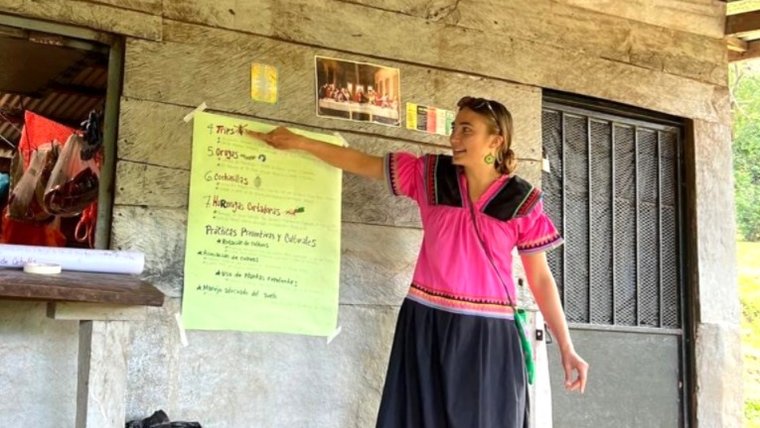
I’m currently serving in the Ngäbe-Buglé Comarca, one of Panama’s seven Indigenous regions, where I support two women’s artesanía groups and a local producers’ group to build business skills and strengthen organizational capacity. The artesanía groups make beautiful bags from plant fibers and recycled materials, as well as traditional dresses (naguas), shirts, and blouses. I lead workshops on budgeting, recordkeeping, group savings, and managing shared funds—practical skills to help ensure long-term sustainability. We’re also working together to draft constitutions and internal rules so they can apply for personería jurídica, a legal status that opens access to funding and markets.
A central part of this work is supporting women and girls as they build confidence, take on leadership roles, and gain financial independence. I also teach basic English to help group members communicate with potential customers and expand their reach. With the local producers’ group—who grow corn, beans, squash, bananas, plantains, and yucca—we’re navigating land use permissions and planning a community market to create jobs and bring fresh, affordable produce to neighboring villages. I’m currently preparing a Peace Corps grant application to help secure materials and bring this project to life.
Outside of these group efforts, I started a small “leave a book, take a book” library and run a read-aloud book club to nurture children’s literacy and a love of learning. Since there was no third-grade teacher available, I have also recently stepped in at the school to support the class full-time—teaching Spanish, math, social science, natural science, and English.
3. What strategies have you used to integrate into your community?
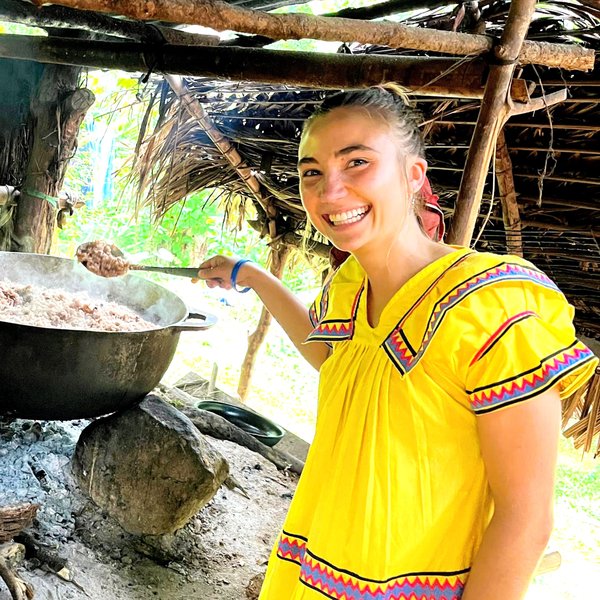
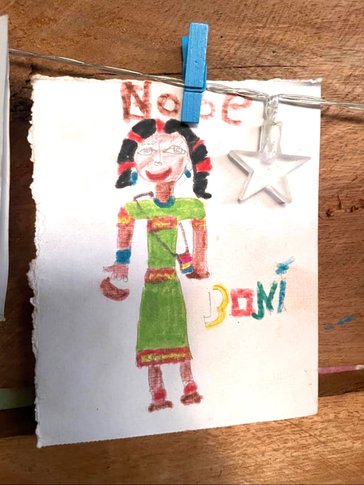
On my first day in the Ngäbe-Buglé Comarca, I was baptized into the culture and given a Ngäbere name: Ökwächi, meaning “little eye.” Ökwächi was one of the community’s first ancestors, known for her skill in artesanía; they named me after her, hoping I would emulate her traits and help strengthen the women’s artesanía groups. Knowing this, I began learning to weave chakras—the traditional handwoven bags—and roll plant fibers into string that same week. As I practiced and improved, people noticed, and when they saw that I wasn’t just interested but starting to master the craft, they embraced me as Ngäbe, meaning “people,” and officially claimed me as one of their own.
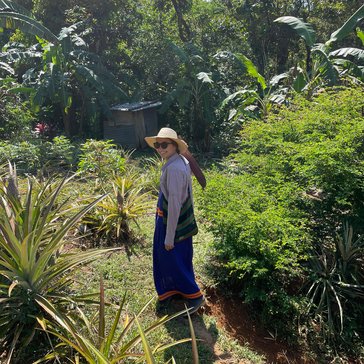
Alongside learning artesanía, I adopted other community traditions: women wear traditional dresses called naguas and carry chakras, and it was important to them that I do the same. I started with one nagua and one chakra, and now I own at least ten naguas and seven chakras, four of which I made myself. The children also played a big role in my integration, welcoming me from the start with hugs and friendship. Their warmth helped ease skepticism among some adults, who, seeing me spend time every day playing with their kids, came to recognize how much I wanted to be part of the community.
Food became another meaningful way to connect. People often spoke with great affection about the Volunteer before me who could eat multiple lunches and dinners without getting full, and I quickly realized food would be central to my integration. For the first three months, I made it a habit to pasear—visiting three to five houses a day until I had visited every home. At each visit, as is their custom, I was offered something to eat: whether a full meal, a sack of avocados, a bag of yucca, a handful of oranges, or a bunch of bananas. Refusing wasn’t an option—even when I was full or worried it might upset my stomach—so I began carrying a Tupperware and a cup to accept food without feeling pressured to eat it all at once.
Now that I have my own place, I love returning the favor by sharing with neighbors when they visit. Beyond that, I attend every community event and meeting, and when people go to their farms, I politely invite myself along. Being a good community member means sharing, demonstrating genuine interest in the culture, and consistently showing up— and that has been my strategy for integration.
4. What is a highlight of your time in service so far?
A highlight of my service so far was celebrating Panamanian Mother’s Day last December. In my community, it’s a big event where women are honored with heaping portions of food cooked and served by the men. Although I’m not a mother, the women in my circle told me I’d be celebrated as one anyway—which led me to jokingly claim I was a mother… to Macarona, the orange cat I adopted during my Peace Corps service. That day, I truly felt like part of my host family, which, counting the extended family next door, includes about 25 people. I sat at the table with the other mothers, surrounded by warmth, laughter, and love. I knew I wasn’t Ngäbe by birth, but they had embraced me as if I were—and in many ways, I felt I was. The smiles and joy from that day still stay with me. At the end of the event, the women and I exchanged secret Santa gifts—names we’d drawn months earlier to allow time to save or make something special. The woman who had drawn my name gave me a beautiful new nagua and wrapped me in the biggest hug. Whenever I think back on that moment, look at photos from that day on my camera roll, or wear that nagua, I can still feel her arms around me.
5. What have you enjoyed most about the community where you are serving?
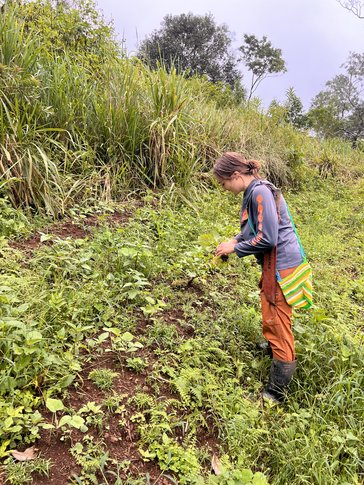
I was so excited when I found out I’d be living in an Indigenous community. There are certainly unique challenges, but there is also so much unique beauty. Where I live, there’s no public transport. After getting dropped off in what looks like the middle of nowhere, it’s about a 35-minute hike to my house. That might sound inconvenient (and sometimes it is), but the walk is breathtaking, with stunning views of mountain passes and, in the distance, the ocean. There’s no traffic—just nature all around. We don’t have running water or electricity in my community, so I bathe, wash dishes, and do laundry in the stream. As a child, part of me always dreamed of having an experience like this, so it feels a bit surreal to be living it. Laundry days can be tough, but my three host siblings under age 10 often come with me to splash around, which makes my heart happy. The absence of electricity also means the night sky is absolutely stunning. Beyond the natural world, I’ve loved getting to know the people and the culture—visiting is a huge part of life here, and we’re always sharing stories, jokes, and laughter. At night, starting around 9 p.m. after the children go to sleep, we gather to work on our chakras and drink unsweetened cacao, the comarca’s traditional beverage, often culminating in a midnight meal. I usually join three to four evenings a week, and the time we share—filled with crafting, laughter, and connection—has become one of my favorite parts of life here.
6. What are some of the most important things you’ve learned from your community?
Living alongside my community, I’ve learned that true value doesn’t come from how much you bring, but from how fully you show up. Presence, patience, and consistency often matter far more than expertise. Generosity here is abundant—even when resources are limited—and people share what they have without hesitation, modeling a selflessness that deeply moves me.
At the same time, I’ve become increasingly aware of how much I’ve been given in life, and how many doors have opened simply because of where I was born. This recognition of privilege is uncomfortable but necessary, as equity cannot be achieved without those born into privilege choosing to give some of it up.
These lessons have shaped how I approach my Peace Corps service. Over time, I’ve come to see it not as a sprint, but as a relay—doing what I can, while I can, and then passing the baton to the next volunteer or, more importantly, to the community members themselves. Initially, I was determined to complete projects within my two-year term, but I’ve learned that some work takes much longer—sometimes generations—to fully realize. This has taught me to think in the language of cathedrals: laying foundations, carving stones, and trusting others to continue the work long after I’m gone.
My community has shown me the value of being involved in unfinished work. I want to engage in this ongoing effort because unfinished work connects the generations of the past with those of the present and those yet to come. Though I may never see the fruits of what we start here, that doesn’t make the work any less meaningful.
7. How do you spend time when you are not working on a project?
Living in the Comarca, the concept of personal space doesn’t really exist—everything is shared, and there’s always someone stopping by to visit. Coming from life in the U.S., this was a big adjustment for me, but over time, it’s started to feel normal, sometimes even comfortable. When I’m not working on a project, I spend a lot of time simply being present in the community—hanging out with the kids, weaving chakras with neighbors, or helping someone on their farm. I also have a small demo plot where I experiment with crops like carrots, beets, potatoes, peanuts, herbs, and other plants not typically grown in the community, but that could help diversify local diets. Tending to my plot gives me a sense of calm and purpose—it’s a quiet space where I can try new things, learn through trial and error, and model possibilities.
Another thing I’ve gotten into is baking, which I’ve mastered without an oven! I use what Peace Corps calls the “double-paila” method: placing a clean tuna can or flat rock inside a large pot, setting a smaller baking pan on top, and covering it with a lid to trap the heat. It’s simple, surprisingly effective, and has allowed me to make banana bread, squash bread, birthday cakes, regular bread, and even pizza. I teach others how to bake this way and follow up with a cost analysis, so they can decide whether they’d like to sell what they make—by the slice or whole.
In the rare quiet moments I have to myself, you’ll usually find me in my hammock writing in my journal, snuggled up with my cat, or on my yoga mat—breathing, reflecting, and recharging.
8. What are you looking forward to in your remaining time as a Volunteer?
After studying abroad in Panama and spending the past year here as a Volunteer, I’ve seen much of the country—but with Panama’s incredible biodiversity, there’s still so much more to explore. I’d love to revisit a few favorite spots and hopefully discover some new ones before I leave.
What I’m most looking forward to, though, is continuing to build relationships in my community—especially with the youth. A few months ago, I stepped into the role of full-time third-grade teacher, a shift that’s been unexpected and exhausting, but also deeply rewarding. It’s made me think more seriously about a future in education, particularly in non-traditional spaces.
One dream I’ve been sitting with is the idea of co-creating a school alongside some friends that emphasizes the whys and hows, not just the whats, and places a strong focus on outdoor, experiential learning. Teaching here has given me space to explore that—through creative lessons, games, and, hopefully soon, a youth conservation group.
I’m also incredibly energized by the producers’ group we’ve formed in the community. We’re working toward building a local market, and I would love to see it come to life before I go. I hope it becomes something enduring—a sustainable resource the community can continue to build on for years to come.
9. Once you finish service, what will you do differently when you return to the U.S.?
In a community where many girls become mothers as young as 15, simply being an unmarried, childless 24-year-old—a rarity here—has shown me how powerful my presence can be. Carrying myself with confidence, I’ve realized I embody a different path—one that opens doors to new possibilities. This awareness has deepened my commitment to advocate for women, helping empower them to imagine opportunities beyond the expected and build futures on their own terms.
Additionally, living in the Comarca Ngäbe-Buglé, often as the only person of my race and struggling to learn an indigenous language, has expanded my understanding of isolation—and the essential human need to connect. When I return to the U.S., I’ll carry with me a heightened awareness of my privilege and a profound responsibility to use it to uplift others—offering friendship, solidarity, and support wherever I can.
This journey has reshaped how I see the world—and my place in it—in deeply meaningful ways. I know I’ll spend years unpacking these lessons, with writing as my way of making sense of it all. Someday, I hope to write a book that shares the stories of the community members I’ve come to love, alongside personal reflections from my time here—so keep an eye out for that!
Learn more about serving in Panama.



