 An official website of the United States government




Featured Volunteer Profile
Austin W.
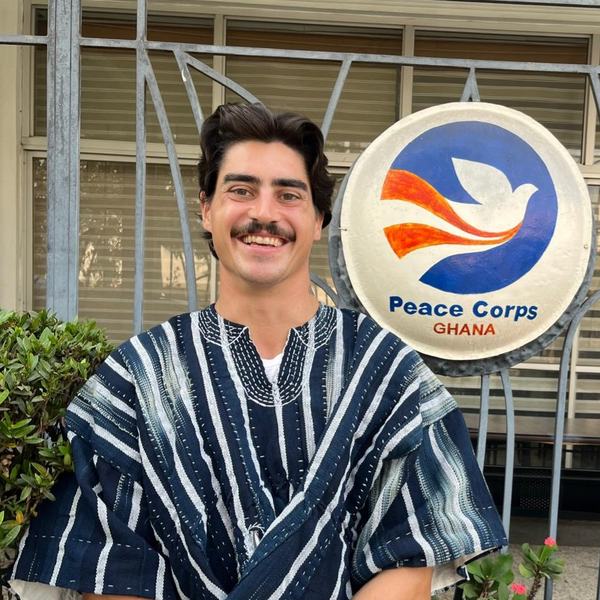
“I really felt people’s love when visiting their homes for project-related tasks or just to say hello. I would always be bombarded with food. Everyone wanted to make sure I ate very well and stayed nice and plump.”
1. What inspired you to apply for this Peace Corps position?
My father served in Guatemala back in the '80s. When I was a kid, he would talk about the adventures he had living in a tiny village outside of Guatemala City. His house, a repurposed chicken coop, and his shower—four sheets tied to coconut trees to provide privacy—filled my mind with curiosity and adventure. I always thought how cool it was that he traveled from his small town in rural Minnesota and all the way to Central America to help with agriculture and how much impact someone can have. Growing up I met many of the other Peace Corps Volunteers that he served alongside. It was a testament to the strong bonds Peace Corps Volunteers have with each other, and I wanted to create my own. In addition to my dad being a big inspiration I also wanted to explore the world and experience a culture vastly different than my own.
2. What projects are you working on?
In my first two years I worked on many different projects, but my main job was to do farm demonstrations and introduce new farming techniques to local farmers. I did this in a few ways, such as teaching a group how to grow oyster mushrooms as an additional source of income and nutrients. I also supported a local junior high school to compete in a national school farming competition; we grew over 200 kg of tomatoes on a farm behind our school. A big project was raising funds to build bio-digester latrines for 23 households in my community, helping to reduce open defecation.
Recently, I extended for a third year in Ghana and I’m now acting as Peace Corps Volunteer Leader. I work alongside staff improving processes, assisting Volunteers out in the field, and finding NGOs that we can partner with to support our mission.
3. What strategies have you used to integrate into your community?
When I first arrived at my site, I went to local farms. Although it was hard to persuade the farmers to let me come, once I was there I was able to connect with them and support them. I would lend a hand weeding with a cutlass, planting cassava sticks, or piling up mounds for yams. If an opportunity arose, I would suggest methods to improve yields or get rid of a pest that was harming their crop.
At the end of the day I would go to a friend’s store and hang out in the evenings. Most of the time, there would be a game of Spar (pronounced “Spa” by the locals) going on. I would join them and typically lose. They have been playing the game for so long they know all the best moves and if I made one mistake I could easily lose. If no one was playing games, I would hang out with my friend Fausti and help run her store until dinner time.
4. What’s a typical day like for you?
As a Peace Corps Volunteer Leader, my days are much more structured than they were at my first site. I usually wake up at 5:30 a.m., have breakfast and get ready for the day. After getting ready, I hop on my bike and take a 20-minute ride to the Peace Corps office in Accra. At the office, I shower and prepare for any meetings I have that day, whether it’s with staff at the office, Volunteers at their sites, or NGOs that we collaborate with. If I don’t have meetings I will reach out to Volunteers or work on projects that staff have given me. At lunchtime I walk down the street to pick up local food like jollof, waakye, or gobe. I finish my day around 4 p.m. and then bike to the gym down the road from my apartment to do some lifting. Then I head home, shower and end my day by either watching a show or playing a boardgame online with other Volunteers in Ghana.
5. What is a highlight of your time in service so far?
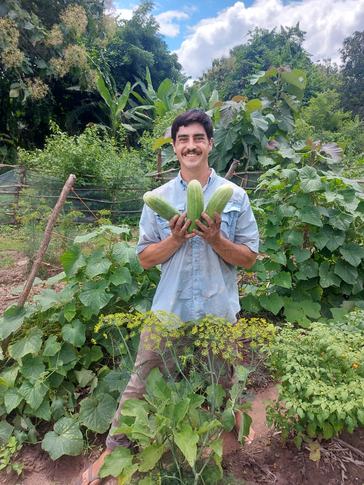
My happiest moments were working on a school garden I started with junior high school students. Together we built a fence and planted five rows of cucumbers. Working with the students was very rewarding and fun! They wanted to grow cucumbers more than I did and loved to help with watering and weeding. We would joke the whole time so it didn’t feel like working at all. When it was finally time to harvest many boys came to help pick dozens of cucumbers. They were very proud of all the cucumbers we managed to grow and we enjoyed our bounty by munching on fresh cucumbers. The sun was setting as we divided up the harvest to bring back to our various friends and families.
6. What have you enjoyed most about the community where you are serving?
What I enjoyed most about my first community was the people. Ghanaian people in general are generous, kind, and humorous. Interacting with them day-to-day never failed to entertain me or blow me away at the kindness they shared towards me. It helped me during the hard times and motivated me to work hard. Going to my friend’s store to play checkers or cards, or making jokes on the farm about our different tastes in music, was always fun. I enjoyed every minute of being in my community. I really felt people’s love when visiting their homes for project-related tasks or just to say hello. I would always be bombarded with food. Everyone wanted to make sure I ate very well and stayed nice and plump.
7. What are some of the most important things you’ve learned from your community?
The biggest skill I learned from my first community was patience. Life in rural Ghana is filled with unexpected twists and turns—from a huge storm that can delay a meeting to a funeral that puts the whole community on hold. As I experienced these twists and turns I learned how to maneuver my way through them, while finding ways to fill the available time—making me adaptable to almost any situation. The overall pace of life in Ghana moves a lot slower than back in the U.S. It took me a while to get used to, but by the end of two years I came to enjoy it.
8. How do you spend time when not working on a project?
At my first site most of my free time was spent reading. Here at the Peace Corps office in Ghana we have a decent library with books that were donated by staff and previous Volunteers. I also brought my Kindle from the U.S. to supplement any books I couldn’t find physically. If not reading I would go for a run or play games with the kids near my house, with an occasional nap thrown in.
Now that I’m a Peace Corps Volunteer Leader I spend a lot of my free time going to the gym down the road from my apartment, practicing baseball with a local team, or reading. A lot of Volunteers come to the office in Accra where I’m now living so on weekends I often go out to dinner or hang out with whoever is in town.
9. Tell us about the strongest relationship you’ve developed while in country.
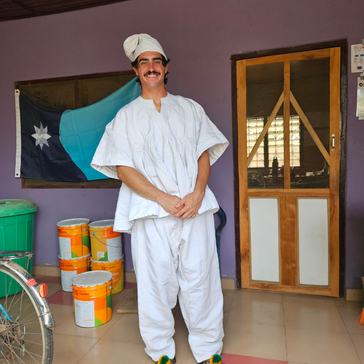
I became very good friends with a woman named Fausti in my first community. She owned the local store and had three kids; Hedford, Annalee, and Tanisha. When I had nothing going on I hung out at her store. That quickly turned into me helping her at the store and running it when there was a rush or she had an errand to run. On Wednesdays after she got back from the market with supplies, I would help stock the store, and in return she cooked dinner for me. For fun we went to the market together or simply talked. She was my source for all the village gossip and we could talk all day long. Now that I live in Accra I still call her every week and I plan on visiting as much as I can.
10. What are you looking forward to in your remaining time as a Volunteer?
As the Peace Corps Volunteer Leader, I am looking forward to gaining more skills while working with the Peace Corps Ghana staff and supporting my fellow Volunteers with their projects. I hope to take the skills I have learned back with me to the U.S.
I am also excited to start the baseball season with the local Ghanaian team that I joined. Ghana started their first national baseball league and asked me to join after I played in a scrimmage with other Volunteers. Practicing with them has been so much fun and I look forward to it every Saturday.
As part of my job as the Peace Corps Volunteer Leader I have to volunteer for a local organization, so I am using my skills as a machinist at a vocational school. They are happy that I reached out to lend a hand, and I enjoy getting my hands dirty. During my time at my site I loved teaching my school clubs and I am happy to continue that type of work at the vocational school.
11. Tell us your favorite phrase in the local language.
During my pre-service training I learned Twi, the most common local language in Ghana. In my first community, however, I picked up a local language called Mo over a period of two years. My favorite phrase was “tung ra,” which means “be quiet.” It made the people in my community very happy whenever I used a little bit of Mo. When I met with students, “tung ra” worked very well. It helped get my students' attention and cut through all the noise. They found my slight mispronunciation to be hilarious. Depending on the context “tung ra” can also mean “shut up.” Sometimes after a day on the farm my hands got blisters from the hand tools and my friends would make fun of me for having soft skin. I would jokingly say “tung ra” and we would all laugh.
12. What would you say to someone thinking about joining the Peace Corps?
The Peace Corps is difficult, but that shouldn’t discourage you from joining. The growth, relationships, knowledge, and skills that you gain from this experience will be unforgettable and will put you on a path to succeed later in life. For people who already have skills from previous work experience and want to join the Peace Corps, what better thing to do than to share that knowledge with people who can benefit from it the most. If you want to go on an adventure, meet amazing people, and make an impact on yourself and others that will last a lifetime, then join the Peace Corps. You won’t regret it.
Learn more about serving as a Peace Corps Volunteer in Ghana.



