 An official website of the United States government




Returned Volunteer Profile
Jim D.
“Your experience will forever change your life in ways that you may not appreciate at this very moment. My experience shaped who I have become and my community and organizational leadership style.”

1. What were your primary responsibilities during service?
I was an Upland Community Development Volunteer living with an indigenous mountain people in a remote village of ten families. I focused on health, agricultural, education, and ancestral land rights activities.
It took close to 3 hours to hike into my site from the lowlands, the path of which meandered through primary canopy rain forest. The Hanunoo Mangyan were one of seven subtribes of Mangyans (the indigenous group) on the island of Mindoro in the Philippines. The Hanunoo Mangyan were swidden farmers and forest hunters and gatherers.
I became fluent in the Hanunoo language and during my tenure also learned the Tagalog and Bikolano languages—and some basic Hilagaynon.
2. What projects did you collaborate on with your community?
I had four projects:
- introduced intercropping methods to the indigenous “slash and burn” (swidden) fields located on mountainsides surrounding my site to prevent soil erosion and reestablish nitrogen levels in the soil with fast growing, soft wood trees;
- established a small village clinic and trained a young community member based on the principles of “The Barefoot Doctor’s Manual”;
- supported the local Pundasyon Hanunoo Mangyan Foundation, Inc., in its quest to secure ancestral land rights and the prevent illegal logging on indigenous lands
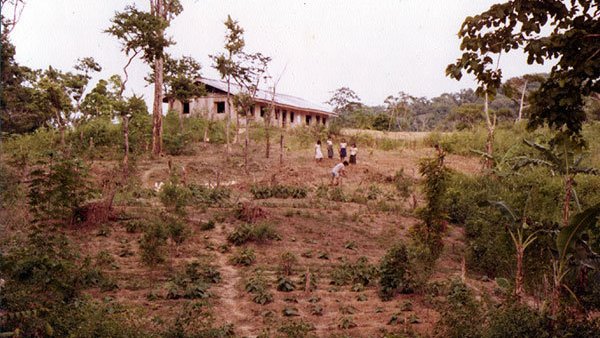
- built a school with indigenous materials from the forest (harvested our own lumber, built our own desks, etc., while only relying on metal roof sheeting from the lowlands).
In addition, I coordinated with the Philippine Department of Education and Culture, Plan International, Ford Foundation, and De La Salle University to stand up the country’s first indigenous-based curriculum taught by qualified indigenous teachers from other indigenous communities in the Philippines; the school supported the villages of Umabang (my site and where the school was built), Bailan, and Amindang. All three villages were located with 1.5 hours walk from one another. To this day, the school is still operating.
3. How did Peace Corps service influence your professional path and development?
I was very health-focused prior to Peace Corps, having worked as an emergency department technician and lab phlebotomist. However, my experience as a community development specialist and a newfound deep interest in people and cultures pulled me in the direction of health administration. I started graduate school about 18 months after service and supported myself and young family as a hospital pharmacy technician. After graduation, I began my professional career. I entered the hospital and health system profession and spent 35+ years as a hospital or health system senior executive and CEO in the international, rural, suburban, and urban markets in Micronesia, Washington state, California, Oregon, Washington, D.C., and finally Hawai’i.
4. How did you use skills honed during service in your career?
My Peace Corps experience exposed me to leadership and communication skills, working with diverse cultures and people, and the importance of community engagement and developing others. Healthcare leadership felt very natural for me post-Peace Corps.
I am presently mostly retired, although I maintain a part-time hospital/health system and health sciences academic advisory consultancy in organizational/leadership resiliency and renewal.
5. How have you helped those at home understand the value of Peace Corps service and communities abroad?
My life and professional stories are replete with Peace Corps references. My offices always had pictures of my Peace Corps days and Hanunoo artifacts and handicrafts are on display in my home. I am quick to make presentations on my experiences or speak with prospective Volunteers.
6. How have you remained involved with the Peace Corps community following service?
Over the years, I have joined Returned Volunteer (RPCV) state affiliate groups, most recently serving on the board of the Returned Peace Corps Volunteers of Hawai’i. I also briefly served on the National Peace Corps Association board from 2023-2024. I remain in contact with several RPCVs who worked and served with the Hanunoo Mangyan on the island of Mindoro, two of whom reside in the Philippines, one in Guam, and several scattered throughout the U.S. I recently re-established communication with the Department of Education in the Philippines and with the principal of the school that was established during my tenure 40+ years ago.
7. What tips do you have for Volunteers just returning from their service?
Your experience will forever change your life in ways that you may not appreciate at this very moment. My experience shaped who I have become and my community and organizational leadership style. Share your stories with others. Seek out other RPCVs, as they will intimately appreciate your experience. And always remember that your Peace Corps memories will be with you forever.



