An official website of the United States government




Virtual service enables online cultural exchange
One of the cornerstones of Peace Corps service is learning to appreciate a different way of life while collaborating with others. In-person Volunteers are immersed in a host country’s traditions, but what about Virtual Service Pilot Participants (VSPPs) who serve remotely?
Three VSP Participants share how virtual engagement cultivated a deeper understanding of different cultures.
1. Traditional attire
Nicora G. viewed the Virtual Service Pilot as an opportunity to reconnect with the East Asian country that she called home during her previous Peace Corps service (2004-2006). For 24 weeks, Nicora collaborated with the secretary general at United Nations Association of Mongolia (UNA), Khishigjargal E., to produce an advanced NGO guidebook.
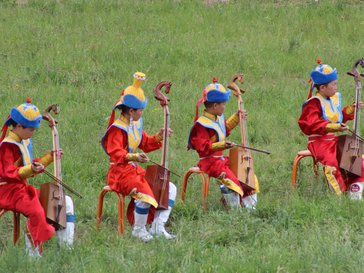
The short-term engagement happened to occur during Mongolia’s Naadaam holiday—a 5-day festival that celebrates the country’s nomadic culture. Khishigjargal took videos of herself attending the colorful celebration in Ulaanbaatar, where parade participants and spectators alike dressed in traditional attire.
“It was fun to see how the Naadam festival is celebrated in the capital, since I only experienced it in more rural settings. I was very intrigued to see the costume parade and to see the beautiful improvements to Sukhbaatar Square," shared Nicora.
2. Cuisine
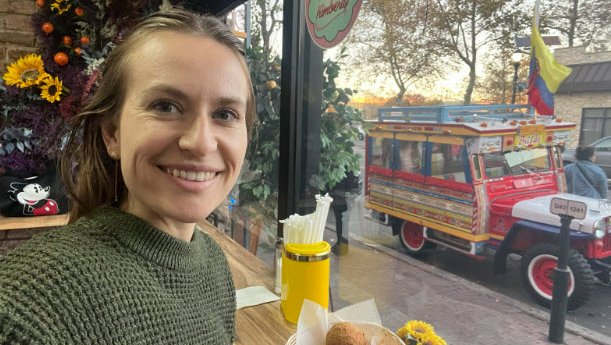
Annelise M. hadn’t previously served as a Peace Corps Volunteer, but she was excited to apply her extensive experience teaching English as a second language (TEFL) to support Colombian K-12 teachers online.
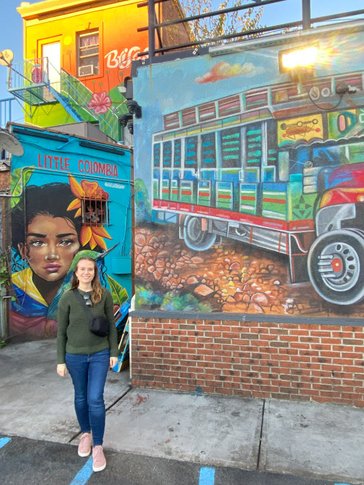
Annelise co-planned and co-facilitated a four-week course for the teachers to practice communication skills followed by two webinars that introduced new teaching approaches. Her last task was to develop materials that the teachers can use to support their lessons next year. Annelise incorporated engaging elements of culture into sessions when possible and asked the teachers to share their own culture with her, especially since she has yet to visit the country.
“One weekend, I went to little Colombia, a community of Colombian restaurants and stores near me. I got bandeja paisa, which is a traditional dish that’s basically a plate with a bunch of different food on it. I also got bunyuellos to take home. I told the [teachers], and they seemed excited even though I got a vegetarian version,” chuckled Annelise.
Annelise currently works as a K-12 educator in an area of New Jersey where the majority of the students, including a few from Colombia, are multilingual.
3. Holidays
Katie M. previously served as a Peace Corps Education Volunteer in Ukraine (2016-2018). One of the highlights of her service was learning how holidays like Easter are celebrated differently in Ukraine, including baking paska (Easter bread) and intricately decorating pysanky eggs (Easter eggs). As the war between Ukraine and Russia continues, Katie felt compelled to serve with the Peace Corps again—this time virtually.

During Katie’s 18-week-long virtual engagement, she collaborated with two Ukrainian educators to develop a syllabus for a vocational training center’s virtual English club. Together, they co-hosted the 1-hour weekly club that covered topics from national cuisines to education and culture. Remembering that Halloween was a crowd favorite from her in-person service, Katie focused one session to discuss its origins and modern traditions.
“Sharing holiday traditions is a powerful way to connect with others. During my virtual service, for one of our English club topics we discussed shared holidays, such as Easter, Christmas, and New Years, as well as country-specific holidays like Ukraine’s Ivana Kupala and America’s Halloween. The homework assignment was to choose a Halloween costume. Many teachers came to the English club prepared with pictures of their chosen costumes, but one teacher showed dressed up as a classic witch with a hat and homemade wand!”
Want to experience a new or familiar culture virtually? Browse our current virtual service opportunities.