An official website of the United States government


The Sombrero: A Bridge to Community
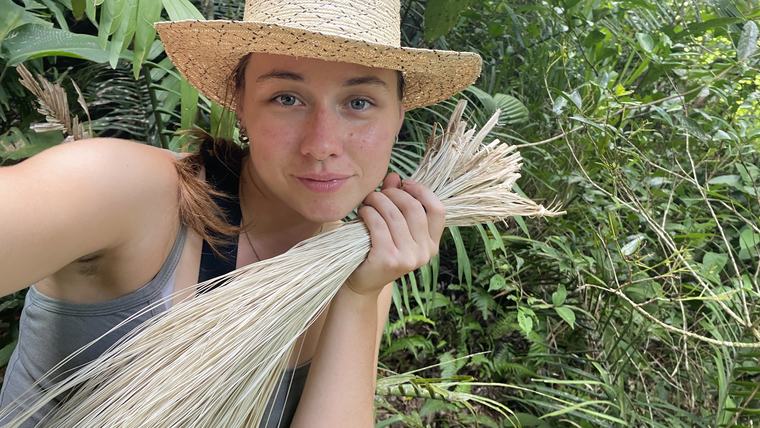
Myra T., an Environment Volunteer in Panama, shares how learning to weave a sombrero helps her connect with members of her Panamanian community.
Upon exiting my semi-unpacked bedroom, hardly an hour after moving to rural Panamá to start my Peace Corps service, I made my way to the front porch of my host family’s house. Red clay created a natural wall to guard against the elements, and a green trellis of “maracuyá” (passion fruit) vines formed a leafy extension to the tin roof.
My host mom was seated in one of the two hammocks strung up within this shaded wing of the house, a red plastic chair holding a neat bundle of what looked like fine white straw facing her. Usually, a hammock is a place of rest, but for her, it is a place of work.
The house is relatively large, nestled in the side of a hill. The yard is thick with lush palms, mango and banana trees, and shrubby plants that bear small, sweet “ají” peppers. Thick grey cement walls enclose four bedrooms, a living room with a couch and television, and a kitchen split into two parts—each with a stove, refrigerator, and separate spaces for my host mom and her daughter to cook and store food. A roofed area behind the house shelters a variety of animals, the washing machine, and a “fogón,” an outdoor wood-fueled stove usually used for cooking beans, smoking meat, or boiling the white sombrero-making “chonta” fibers.
A labor-intensive process
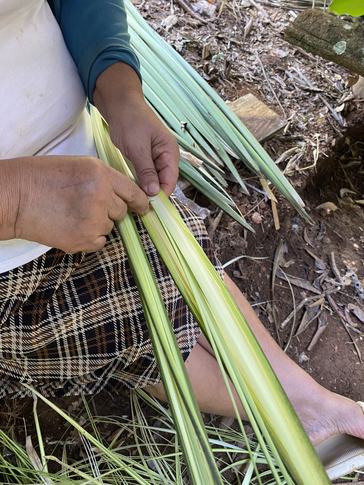
Gazing intently through small, rectangular eyeglasses, my host mom’s fingers moved, expertly weaving 12 separate chonta strands into a long, flat braid. The opposite end of the braid started to take the shape of what would eventually be a sombrero. The chonta fibers are available year-round, first harvested from a spiny palm, sorted and bundled for quality, boiled for several hours, and then dried in the sun before use. My host mom completes this intensive process whenever she runs low on weaving materials and is involved in sombrero-making every step of the way.
Sensing my approach, she lifted her gaze from her work and smiled warmly in greeting. As someone who at home in the U.S. enjoys fiber arts such as knitting, embroidery, and bracelet-making, I couldn’t help but ask what she was doing.
An introduction to weaving
“It's easy,” she told me, “Look, I’ll show you.” I moved closer as she proceeded to braid, more slowly this time. “Over two, under two, over three.”
She made the process look so simple, nimbly weaving while keeping each row perfectly taut and even. Beckoning me to try, she guided my fumbling fingers through the process. It didn’t feel as simple as it looked, and I proceeded hesitantly, not wanting to make an error and disrupt her progress.
My first sombrero
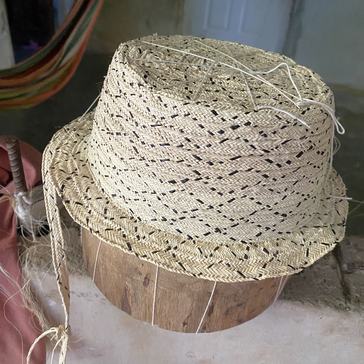
Several days later I went to the porch, where my host mom was working. She handed me a small, flat braided coil. It was made of the same white, straw-like material, with the addition of one black strand zigzagging through it, forming an outline that resembled a robustly petalled flower. She showed me how to hold it and continue the braid. Hours passed, and the strands slowly lengthened, becoming increasingly even and smooth as my fingers and brain acclimated to this new craft. When I had accumulated several arm's lengths of braid, my host mom showed me how to continue the coil, stitching in and out with a needle and handmade thread.
A month has passed since I started making my first sombrero, and I just began the final part: the long-awaited brim. There are places where the material puckers, and the black, zigzagging petals vary in width, but the overall shape is, without a doubt, that of a Panamanian sombrero.
Working side by side
When my Spanish brain is worn out for the day, I enjoy sharing the space of the porch without any pressure to fill the silence. The braiding and sewing of smooth plant fibers acts as a common ground with my host mother, something to absorb focus while providing unity in the shared work. While I enjoy the silence, sometimes we also talk about the process of crafting the hat.
Connecting through craft
During my outings to meet community members and neighbors in these early months of service, I’ve learned that there are many sombrero artisans in my village. Living in a rural area means that jobs are limited, with farming the most prevalent occupation. It is common for men to do the agricultural work on the farms, while the women are the home keepers. Many women rely on the sales of their sombreros as a primary source of income and spend their spare minutes and hours filling custom orders or preparing sombreros for display in a shop or fair booth. Asking about the process and different design possibilities is an easy way to begin a conversation, and community members often inquire about my own progress, making for a fun way to relate on a shared skill.
Culturally, the sombrero is a very noticeable part of Panamanian life. Many men wear the skillfully woven hats as protection from the sun while working in their fields of rice, cacao, or yuca. They sport them on their horseback commute to a neighboring village or while visiting their friends or family with a cup of sugar-sweetened coffee. The sombrero is also a staple in events such as parades and festivals that showcase the rich culture and traditional dress. I am honored to be part of this binding piece of my community and am thrilled to have an artisanal craft as a bridge to the place that I now call home.