An official website of the United States government



On the hunt for honey in Nepal
As a new Eco-tourism Response Volunteer in Nepal, I had much to learn and many different avenues to explore. Early on, some Food Security Volunteers mentioned the cliff honey hunts that took place near my site, a rural village in the Gandaki Province. As a novice to this activity, I asked more, went online, and began talking to the villagers.
The first hunt
The Himalayan giant honeybee, Apis laboriosa, lives at elevations over 1500 meters and is the world’s largest honeybee, growing up to 1 ½ inches. The Gurung people have hunted and harvested cliff honey for centuries. I wasn’t sure if the village hunts were meant for outsiders or if they were private cultural traditions. When I inquired, the villagers seemed open to the idea of marketing the hunt outside their community. We had our first hunt in November 2024 with a small group of Americans and Nepalis.
We incorporated community and group feedback to prepare for a second hunt. While there is a general honey season, Gurung priests wait to see the growth of the combs, weather, and other factors before deciding on an auspicious date.
The second hunt
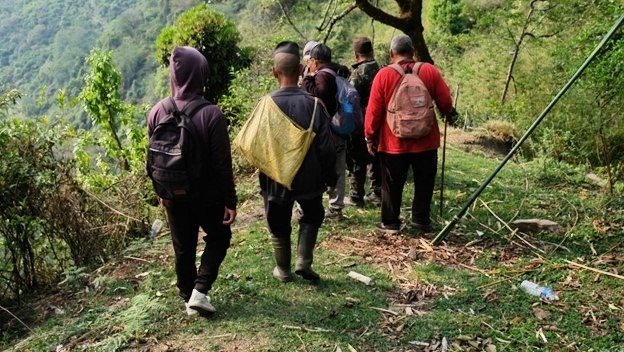
We gathered over 25 participants for the second hunt. On the chosen date and time—April 28, 2025—we set off, 20 villagers in the lead. Our company included men with the ubiquitous hasiya (knife) in the holder, one with a 45-meter rolled ladder on his back, another with long bamboo poles for harvesting, one woman with a box of sel roti (sweet fried dough) on her back, another carrying a large metal tiffin of tarkari (vegetables), a few plastic containers for the honey, and some woven bamboo sieves. Everything else would be sourced at the site.
We hiked down a very steep and narrow path to the midway point, where some of us split off to the top of the cliff where the puja (worship) would be done. Only a small group could go, as the path was too narrow. We squeezed into a tiny area by the cliff’s edge, dug our heels into the hillside, and hung onto tree trunks. The hunters casually sat on the edge of the cliff, barefoot, with no protective gear. The puja, to prevent anything bad from happening, was prepared and chanting began. The tree where the bamboo ladder would be attached was marked and blessed. Down below, villagers started fires to smoke the bees from their homes. The smoke reached us, as did the sound and sight of hundreds of bees buzzing in the air. We headed down to join the others.
Finding the golden treasure
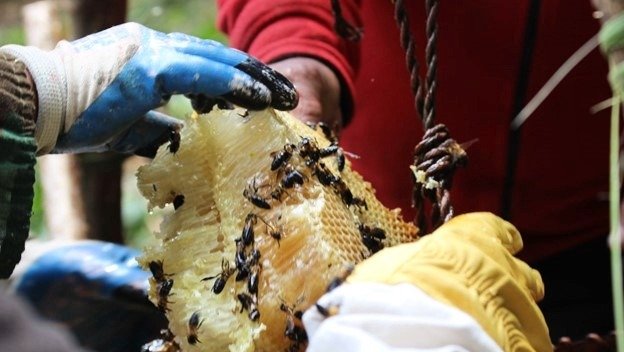
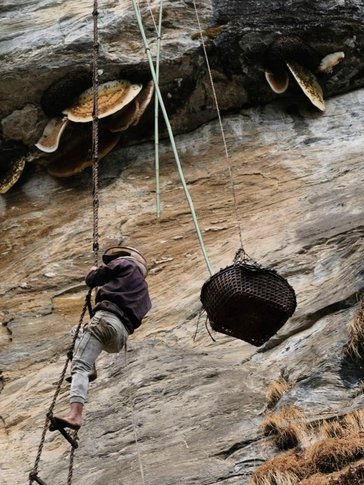
Below, we were greeted with glasses of rice beer and excitement. We watched as the ladder was draped over the cliff. The hunter wrapped his bare feet around the rungs and began to descend. He grabbed two long bamboo poles with paddles tied to the ends and zeroed in on a large brood comb. He removed several brood combs, cut the honey-filled portions, and then lowered them in baskets, hundreds of feet below. We watched with strained necks as he dangled from the ladder, legs entwined, arms and body reaching toward the cliff and combs.
A sweet reward
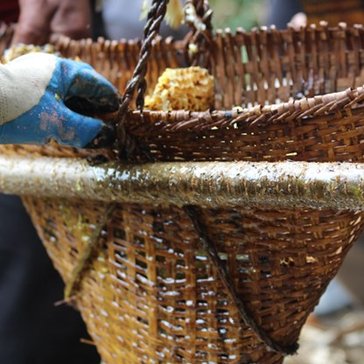
The honeycombs were then placed into a bamboo sieve. They pressed on the combs to extract the honey. Magnificent golden liquid oozed out and was funneled into large containers. Villagers gave us chunks of the comb to taste. It was very sweet but light, with an incredible flavor. The women called us over for sel roti; we took a piece and opened our hands to receive honey. Dip, eat, dip, eat, lick a finger, and repeat—to get every trace of honey. They tore up the box to create small plates for the tarkari. We were humbled by their ingenuity and devoured the food. It was a magical moment, all together with the villagers, sharing in the excitement, the fear, and the amazement of this centuries-old tradition.
Supporting a local tradition and economy
The honey earned the village over 60,000 rupees in profit. They viewed it as a huge success. The participants were all safe, no one was stung, and everyone was full of local food, new knowledge and experiences. We are working to ensure the event continues and hopefully grows.
Located within the Annapurna Conservation Area Project (ACAP), the hunt is restricted to villagers in the area, who also steward and monitor the health of the local jungle. Harvesting typically takes place twice a year although some years it only occurs once.
So much of the Peace Corps experience is staying open to possibilities, being flexible, shifting focus as I better understand the community and their needs. Promoting honey hunts was not on my list when I began service; but helping to promote a unique cultural tradition—a source of income and local pride—now tops that list.